



Research note · Scams & protection
Medical insurance scams: how to spot fake and misleading plans
A cheap “coverage” pitch can sound like relief when premiums feel hard to carry. Some offers are real but limited. Others are fake, mislabeled, or designed to take payment before you ever see what you bought.
This research page explains how medical insurance scams and misleading offers work, how to tell insurance from discount, limited-benefit, and health share products, and how to use a free Offer Detector before you pay. It is educational only. Always verify licenses and official rules on .gov sources.
Last reviewed: 2026-09-13
Verify on .gov: FTC, Spot Health Insurance Scams · IC3/FBI, Emerging Discount Medical Insurance Scams · HealthCare.gov · Medicare.gov · NAIC state insurance departments
Key takeaways
- Scammers and dishonest marketers often use unsolicited contact, urgency, and prices that look “too good” without a clear product type, patterns the FTC and FBI/IC3 describe in plain language.
- A medical discount plan is not health insurance. The FTC says discount plans are not a substitute for insurance; get details in writing and call your doctors before you pay.
- Mislabeled limited-benefit, short-term, association, or health-share products can sound like major medical. Ask: What product class is this, in writing?
- Before you enroll, verify the company and agent through your state insurance department, insist on a written policy or statement of benefits, and confirm your exact plan with your providers.
- If you already paid or suspect fraud, report to ReportFraud.ftc.gov, IC3.gov, your state DOI, and (for Medicare) Medicare fraud reporting.
Jump: Offer Detector · 12 scam patterns · Why scams sound believable · Product-class matrix · If you already paid · FAQ
Free educational screen
Offer Detector
Got a coverage pitch that feels cheap or urgent? Run the free Offer Detector before you pay. No account. No personal data stored.
12 medical insurance scam patterns
Each pattern below is educational. We describe patterns, not accusations against named companies, unless a regulator has published an action you can cite yourself. Sources lean on FTC, FBI/IC3, NAIC consumer guidance, and Medicare.gov.
1. Fake plan / fake ID card
- What it is: A seller collects premiums or enrollment fees for “coverage” that is not real insurance, sometimes with polished PDFs or plastic cards.
- What it looks like: Professional branding, vague “nationwide” language, reluctance to put benefits in a real policy, claims denied or ignored later.
- One question that exposes it: “What is the licensed insurer’s legal name in my state, and can I verify it on my state insurance department site today?”
- Source: FTC, Spot Health Insurance Scams (licensed by state commissioner); IC3 PSA.
2. Discount plan sold as insurance
- What it is: A medical discount program marketed as if it pays claims like insurance. Discount plans generally charge a fee for negotiated discounts with some providers; they are not a substitute for health insurance (FTC).
- What it looks like: “Coverage” talk, ID-style cards, “up to X% off” claims, pressure to enroll before you call your doctor.
- One question that exposes it: “In writing: is this insurance that pays claims, or a discount plan that does not?”
- Source: FTC, Spot Health Insurance Scams; FTC, Insurance or medical discount plan?.
3. Limited-benefit / indemnity marketed as “full coverage”
- What it is: A real but narrow product (fixed indemnity, hospital-only, accident-only, etc.) described with major-medical sounding words.
- What it looks like: Low monthly price, broad slogans (“full coverage,” “everything included”), thin details on caps, waiting periods, and what is unpaid.
- One question that exposes it: “Does this meet major medical / ACA comprehensive coverage standards in my state, or is it limited-benefit? Show me where the policy says that.”
- Source: FTC OE alert; state DOI consumer notices (e.g. Mass.gov legitimacy guidance).
4. Short-term sold as year-round major medical without limits said out loud
- What it is: Short-term, limited-duration coverage pitched as if it were ongoing comprehensive insurance, without clearly naming duration, renewability, and benefit limits.
- What it looks like: “Just like regular insurance” language; silence on end dates, underwriting, and excluded conditions.
- One question that exposes it: “What is the exact end date, can it be renewed, and what does the policy exclude in writing?”
- Source: FTC guidance to get a full statement of benefits before you sign up (FTC article).
5. Health share sold as guaranteed insurance (labeling)
- What it is: A health care sharing ministry or similar membership marketed as if it were a guaranteed insurance contract. Sharing programs are typically not insurance; rules, guidelines, and voluntary sharing differ from insured claims.
- What it looks like: Insurance vocabulary (“premium,” “coverage,” “guaranteed”) without clear “not insurance” labeling.
- One question that exposes it: “Is this insurance regulated by my state DOI, or a sharing membership that is not insurance? Put the product class in writing.”
- Source: Product-class clarity is a consumer-protection theme across FTC/state DOI materials; always read the membership guidelines. Labeling is compliance-sensitive, verify with state DOI / NAIC resources.
6. Government / Marketplace impersonation
- What it is: Calls, texts, ads, or lookalike sites pretending to be HealthCare.gov, Medicare, Medicaid, CHIP, or “the government.”
- What it looks like: Spoofed caller ID, logos, “your application needs updating,” payment or SSN requests. Official consumer sites use
.gov. - One question that exposes it: “What is the exact
.govURL I should open myself, and why are you asking for money or my SSN on this call?” - Source: FTC, Spot Health Insurance Scams (sign #1).
7. Medicare / “your card will be cancelled” urgency
- What it is: Scare tactics claiming Medicare coverage will end unless you pay for a new card, share bank details, or “update” information immediately.
- What it looks like: Unsolicited “Medicare calling” scripts; pressure for SSN, bank account, or gift-card payment.
- One question that exposes it: “Medicare.gov says I never need to pay for a new card and Medicare does not cold-call to cancel coverage, why should I stay on this line?”
- Source: FTC Medicare scams section; Medicare.gov fraud reporting.
8. Unauthorized enrollment / plan switch
- What it is: Someone uses personal information to submit an application or change coverage without a clear, informed authorization.
- What it looks like: Surprise plan change letters, unexpected premium draws, “we enrolled you for free groceries/benefits” after an online form.
- One question that exposes it: “Show me the signed authorization and the exact plan I was enrolled in, and how do I reverse it with the Marketplace/plan?”
- Source: FTC warnings on phishing ads and personal-data capture; protect SSN/Medicare numbers (FTC).
9. Phishing ads (“free groceries if you enroll”)
- What it is: Ads that lead with gifts, grocery money, or cash perks and bury (or misstate) what product you are actually joining.
- What it looks like: Social ads focused on freebies; thin coverage details; lead forms harvesting contact and identity data.
- One question that exposes it: “Ignore the gift, what product class am I buying, who is the licensed entity, and where is the written policy?”
- Source: FTC OE season alert.
10. Association / “group” plans that aren’t licensed in your state
- What it is: Coverage sold through an association, union-sounding group, or “national pool” that is not authorized as insurance in your state.
- What it looks like: “Join the association to unlock group rates”; hard-to-verify insurer; state DOI cannot find the company.
- One question that exposes it: “Is this company licensed to sell this product in my state, yes or no, and what is the NAIC/company ID I should search?”
- Source: FTC, check state insurance commissioner; NAIC state insurance departments; Mass.gov legitimacy notice.
11. Refund bait + unauthorized charges (FBI pattern)
- What it is: Pitch that you will get a refund of your old plan / upfront year payment / grocery aid, then refunds never arrive, cancellations stall, and bank accounts see unauthorized charges. The FBI/IC3 PSA on emerging discount medical insurance scams describes this pattern and notes that these schemes result in millions of dollars in losses annually (IC3 PSA, Apr 30, 2025).
- What it looks like: “Act now or lose the discount,” promised refunds without paperwork, multiple business names, card charges after cancel requests.
- One question that exposes it: “Put the refund timeline, method, and cancellation terms in writing before any payment, and why can’t I verify you on my state DOI site?”
- Source: IC3/FBI PSA (quote prevalence only with this link).
12. Too-good network claims never verified with providers
- What it is: Promises that “all your doctors and hospitals are covered” without checking the exact plan name with those providers.
- What it looks like: Verbal network assurances; directories that don’t match; ER/surgery bills that come back fully patient-responsible (FBI/IC3 case examples).
- One question that exposes it: “Will you wait while I call my hospital billing office with the exact plan name before I pay you anything?”
- Source: IC3 PSA tips; FTC discount-plan alert.
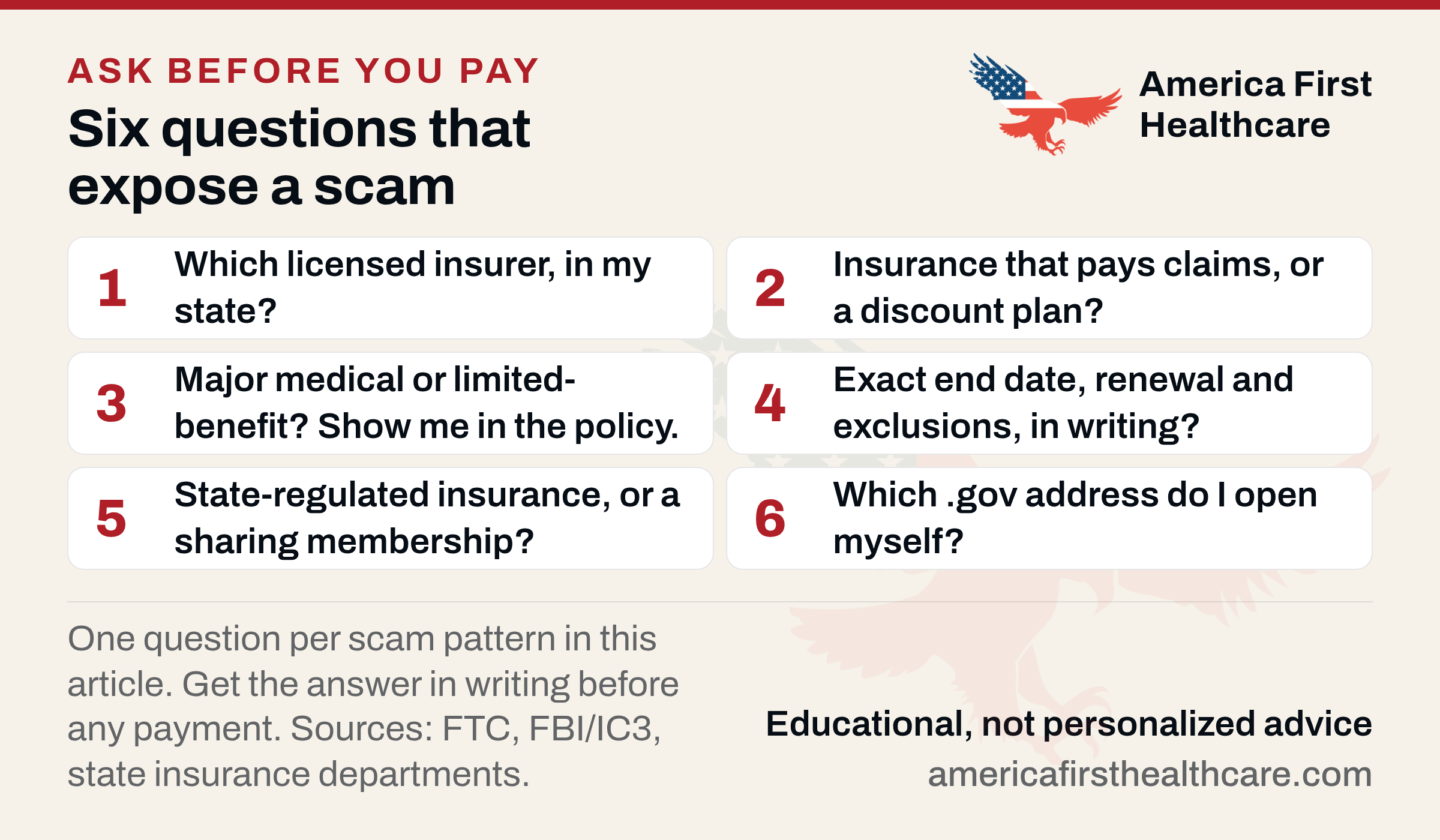
Why costs feel bloated (and why scams sound believable)
This section is structural and educational. It explains why families are vulnerable to a smooth pitch, not which private companies are “better.”
- Premiums vs take-home pay. When the monthly number competes with rent, food, and fuel, a dramatically lower quote feels like oxygen. Scammers design for that feeling (FBI/IC3: scams often target people looking for more affordable options).
- Opacity of deductibles, OOP caps, and networks. Households often compare premium alone. A “cheap card” can hide high patient responsibility, narrow networks, or non-insurance products.
- Product-class confusion. Insurance, discount plans, limited-benefit indemnity, short-term coverage, and health shares are different animals. Marketing language blurs the labels on purpose or by carelessness.
- Open Enrollment noise. FTC warns that OE season brings more ads and offers, including dishonest comprehensive-sounding pitches that are really discount or limited products. See also AFHC’s OE & Medicare AEP calendar.
- Underinsurance is already common as a household worry. Having a card is not the same as being protected when a serious bill hits. Read what underinsured means.
- Clarity is a defense. Naming ruin-level risks, limits, and product class out loud, before payment, is how families regain choice. That is the same discipline behind a structured healthcare review checklist and plain-English core + gap framing.
Opaque pricing and mislabeled products inflate risk. That is different from a claim that any one carrier “inflates costs by X%.” We do not invent savings percentages here.
Product-class matrix: insurance vs discount vs limited-benefit vs health share
Use this as a labeling aid. State rules differ. Confirm with your state DOI and written documents.
| Question | Major medical insurance (ACA-compliant examples) | Medical discount plan | Limited-benefit / fixed indemnity | Health care sharing membership |
|---|---|---|---|---|
| Is it insurance? | Yes (if licensed as health insurance in your state) | No, not a substitute for insurance (FTC) | Usually yes as a narrow insurance product, not comprehensive major medical | Typically not insurance (membership / guidelines) |
| Does it pay medical claims like a health plan? | Designed to pay covered claims per policy after cost sharing | Generally no, offers negotiated discounts with some providers | Pays fixed amounts or limited categories; large bills can remain yours | Sharing is usually voluntary per guidelines, not a guaranteed insurance claim |
| Must the company be licensed to sell insurance in your state? | Yes | Often registration/licensing rules differ by state, ask DOI; still not insurance | Yes, if sold as insurance | Usually not “insurance licensing”; ask DOI how your state treats sharing ministries |
| Can it be sold as “full coverage”? | Only if benefits match; demand the statement of benefits | Red flag if marketed as insurance | Red flag if marketed as major medical | Red flag if marketed as guaranteed insurance |
| What to verify before paying | License + full policy + network + OOP | Writing that says “not insurance” + call your doctors | Caps, exclusions, waiting periods in writing | Guidelines, limitations, “not insurance” disclosures in writing |
| Primary .gov / regulator start | State DOI + HealthCare.gov for Marketplace | FTC discount guidance + state DOI | State DOI | State DOI consumer pages; read disclosures carefully |
Compliance note: Health-share labeling must stay accurate. Do not imply AFHC endorsement or equivalence to insurance. Families should read membership guidelines and ask a licensed professional about their state’s rules.
What to do if you already paid or enrolled
- Stop new payments where you safely can. Call your bank/card issuer about unauthorized or disputed charges. Keep screenshots, call logs, emails, and policy PDFs.
- Write for cancellation and refund terms (email/portal). Note dates. FBI/IC3 examples include stalled cancellations and continued charges, paper trails matter.
- Check what you actually have. Log into HealthCare.gov / your state Marketplace, Medicare.gov, or your employer portal. Confirm active enrollments you recognize.
- Report:
- FTC: ReportFraud.ftc.gov
- FBI Internet Crime Complaint Center: IC3.gov
- State insurance department / commissioner: NAIC directory
- Medicare fraud or suspicious Medicare contact: Medicare.gov fraud reporting or 1-800-MEDICARE
- Monitor credit and explanations of benefits. Watch for identity misuse and surprise plan switches.
- Map legitimate next options, Marketplace, employer, Medicare, Medicaid/CHIP, or other lawful products, without rushing into another unclear pitch. A free healthcare review can help organize questions; it is not a promise to recover money already lost.
Having a card is not the same as being protected. Read what underinsured means.
Bring screenshots and any written "policy" to the healthcare review checklist.
FTC warns OE season brings more ads. See the OE and Medicare AEP calendar.
Naming ruin-level risk out loud is the same discipline as catastrophic core + gap.
Related research
- Browse the research library.
- Having a card is not protection: what underinsured means.
- Bring paperwork to the healthcare review checklist.
- Slow down during OE with the OE and Medicare AEP calendar.
- Know the real 2027 deadlines before anyone rushes you: when is Open Enrollment for 2027.
- Learn the household stack in catastrophic core + gap.
FAQ
Is a medical discount plan insurance?
No. The FTC states that medical discount plans are not a substitute for health insurance. Some offer real discounts with participating providers; others take fees and deliver little. Get details in writing and call your doctors before you pay. Source: FTC.
Can someone enroll me without permission?
Yes, unauthorized enrollment or plan switching can happen if someone obtains enough personal information. Protect SSN, Medicare numbers, and login credentials. Review your Marketplace/Medicare/employer records and report suspicious activity to the FTC and your state DOI.
How do I check if an agent is licensed?
Start with your state insurance department (NAIC directory). Ask for the agent’s full name and license number, then verify before you share payment details. If they refuse verification, walk away (state DOI consumer guidance aligns with this).
What’s the difference between limited-benefit and major medical?
Major medical (including many ACA Marketplace plans) is designed as comprehensive health coverage with defined cost sharing. Limited-benefit or fixed-indemnity products typically pay narrower benefits or fixed amounts and can leave large bills unpaid. If a seller says “full coverage,” match that claim to the written policy.
Should I pay someone to help with HealthCare.gov?
The FTC says do not pay for Marketplace enrollment help from people who demand cash, crypto, or card numbers to get or keep coverage. Legitimate Marketplace help (Navigators/Assisters) is not allowed to charge you. Enroll or get help via HealthCare.gov or 1-800-318-2596. Source: FTC OE alert and FTC Spot Scams.
What if the price is far below other quotes?
Treat a dramatically lower price as a reason to slow down, not a reason to skip documents. Confirm product class in writing, verify licenses, and call your providers about the exact plan. Low premium can mean a different product, or a scam, not necessarily a better deal.
Method / disclaimer
This page summarizes consumer-protection patterns from FTC, FBI/IC3, Medicare.gov, HealthCare.gov, NAIC state-department directories, and related state consumer notices, reviewed 2026-09-13. Government pages update. Verify before you act.
Educational only, not medical, legal, tax, or personalized insurance advice. AFHC does not recover scam losses and does not guarantee plan outcomes. License and product rules vary by state.
First Health ≠ AFHC (disambiguation)
“First Health,” “America’s Choice,” and similarly named third-party brands or networks are not America First Healthcare (AFHC). If an ad or card uses a lookalike name, verify the legal entity and license on your state DOI site before you pay. AFHC is America First Healthcare.
Next step
If you want a plain-English walkthrough of a confusing offer, or of coverage you already have, start a free healthcare review and bring the healthcare review checklist. Bring screenshots and any written “policy” you were sent. Official enrollment still happens through HealthCare.gov, Medicare.gov, your employer, or a licensed channel, not through pressure on a cold call.
Prefer a guided walkthrough? Start a free healthcare review.
More plain-English guides live in the research library.
For shorter articles and news, browse Resources.
See how AFHC works with families on Our services.
Medicare timing and product basics: Medicare.