



Resources · Business Edge
Why Health Insurance Costs Keep Rising for Families and Small Businesses
The expiration of enhanced premium tax credits is one of the most obvious reasons why health insurance premiums keep rising. According to KFF, this year’s Marketplace premium payments increased by an average of 58%.
This is lower than the 114% increase projected by KFF last year, but only because many who fell off the subsidy cliff transitioned to lower-premium, higher-deductible plans (e.g., from silver to bronze). The 37% increase in average Affordable Care Act (ACA) Marketplace deductibles confirms this.
Let’s not forget, though, that the enhanced tax credits that kept premiums down have always been a temporary relief measure. Now that they’re gone, Americans can see the true cost of ACA Marketplace health insurance and are starting to ask why health insurance is so expensive.
In this article, we discuss why family health insurance costs so much and why small business health insurance is expensive. As a trusted champion of personal responsibility, limited government dependence, and freedom of choice, America First Healthcare explores what is driving health insurance premiums up.
Key Takeaways
- Enhanced premium tax credits have expired, raising ACA marketplace premiums across the board.
- ACA mandates a 3:1 age band that inflates premiums for younger, healthier consumers and transfers the burden of insurance to them.
- The ACA mandates the inclusion of essential and additional benefits, even for people who don’t need them.
- The ACA Marketplace requires insurance even for people with pre-existing conditions, thereby skewing the risk pool and raising costs for everyone.
- Marketplace insurance severs the connection between pricing and customer attraction and retention, something that can keep prices down in typical markets.
- Hospital mergers and physician consolidation lessen the competition and concentrate pricing power.
- The mandates built into ACA Marketplace plans complicate insurance administration, leading to administrative bloat that costs millions of dollars, which in turn gets absorbed into every premium and the price of every service.
Health Insurance Cost Increase Explained: What Is Driving Health Insurance Premiums Up?
Why does a relatively healthy 21-year-old couple with a household income of $85,000 need to pay almost $977 per month ($11,726 per year) for a silver plan? That’s almost $500 per person in monthly insurance premiums.
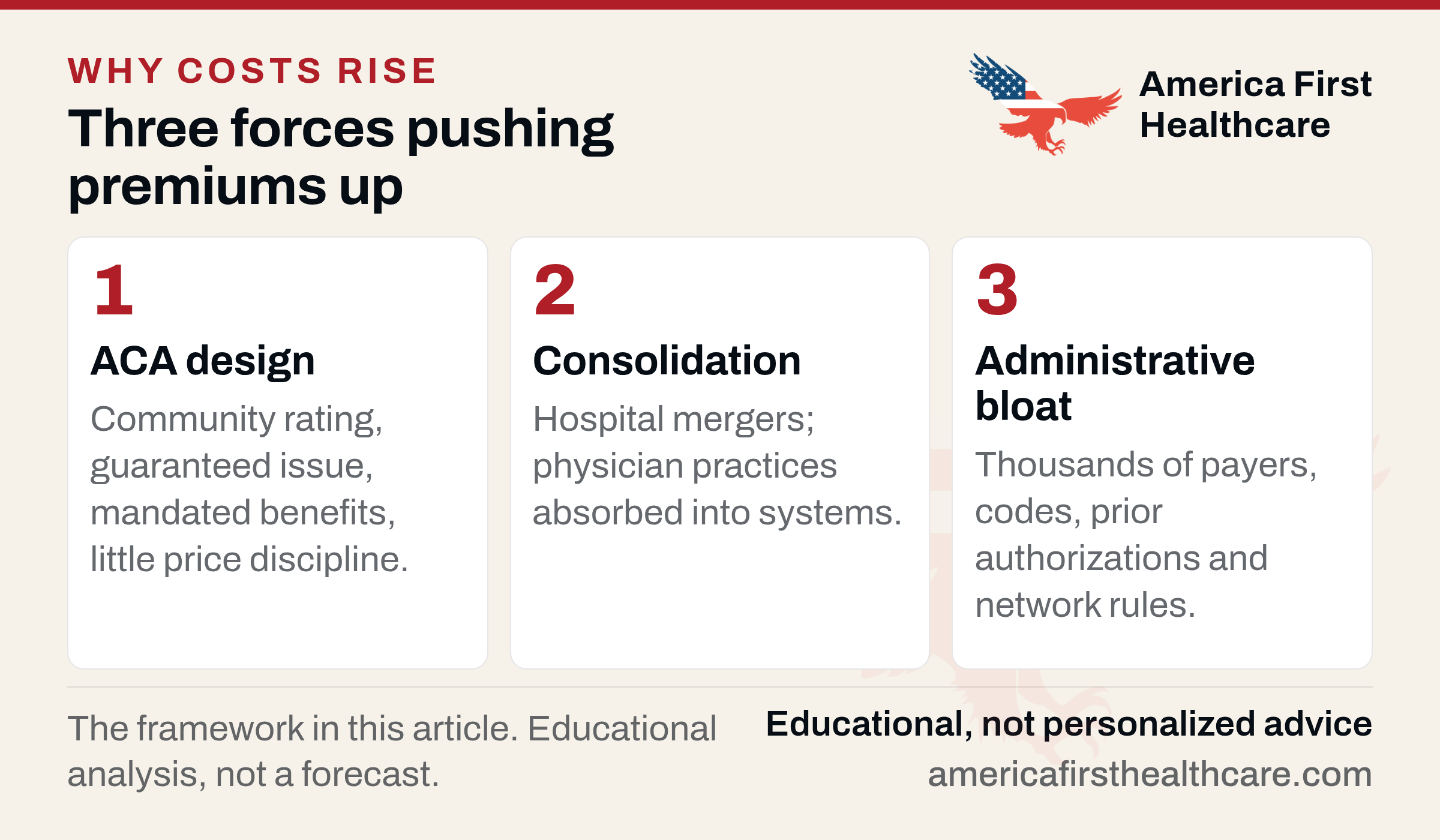
The following drivers of health insurance premiums explain why health insurance is so expensive.
1. The ACA Design
When the Affordable Care Act was passed in 2010, it made four structural decisions that mathematically raised premiums for healthy people.
Community Rating
Community rating restrictions prevent insurers from pricing plans based on an individual’s health status. They also cap the spread between the premiums of a 21-year-old and a 64-year-old at a 3:1 ratio, even though actual medical costs are closer to 5:1.
This keeps the cost lower for the older person but higher for the younger person. Ultimately, the ACA makes healthy people subsidize the sick. Once the healthy contributors realize this, they abandon their Marketplace health insurance, leaving a sicker risk pool that drives up premiums for everyone who stays.
The American Action Forum found that simply relaxing the age-band restriction could cut individual-market premiums by 4% to 10%.
Guaranteed Issue
Under the ACA, anyone can buy insurance after they get sick. Without a strict continuous-coverage requirement, there’s little incentive for a person to stay insured when they’re healthy and every reason for them to buy insurance when they fall ill.
This skews the risk pool further toward members with higher medical care costs, and premiums climb as a result.
Essential and Additional Health Benefits
Every ACA Marketplace plan must cover ten benefit categories, including maternity, pediatric dental, mental health, and substance abuse treatment. The ACA also mandates birth control and breastfeeding coverage.
These compulsory, essential and additional benefits raise coverage costs, but the insurance buyer who has no use for them can’t drop them from their Marketplace plan.
Lack of Price Discipline
In a real market, insurance buyers have to be more deliberate about their spending and discerning about their choices. They ask about prices, compare insurers, and assess providers. Insurance companies and healthcare providers, for their part, price their products and services competitively to attract and retain customers.
This price discipline is missing in the ACA design.
Subsidized customers do not absorb the full cost of insurance premiums, weakening the influence of price on their choice of health insurance company. Insured individuals may also avoid dwelling too much on service costs because the insurance company pays whatever exceeds their deductibles.
When a patient does not need to pay the full price at the point of service, they do not feel the need to ask what it is.
Meanwhile, a provider that knows the bill will be paid by a third party has no reason to lower prices. Likewise, an insurer that knows the government will subsidize costs may easily raise prices.
When insurers and health providers do not need to compete on price, they have no incentive to keep prices down.
The market cannot work when buyers don’t ask about prices and sellers don’t need to compete on price.
The ACA Design Means Cost Transfer
The ACA was designed to provide coverage to people with pre-existing conditions, and that is a worthy goal. However, the mechanism it chose to do so transferred costs directly onto healthy, self-paying families and small business owners.
Monopoly Pricing
Between 2000 and 2020, there were 1,164 hospital mergers in the United States. The Federal Trade Commission challenged only 13 of them, corresponding to an enforcement rate of about 1%. The share of hospitals in a system rose from 68% in 2016 to 76% in 2023.
Hospital consolidation is only one part of the picture. Physician practices are also increasingly being absorbed into hospital systems, further concentrating pricing power.
The consequences of the increasing consolidation of healthcare providers are straightforward. When hospitals merge to eliminate local competition and physicians get absorbed into hospital systems, prices go up.
The U.S. Department of Health and Human Services reported that the acquisition of one hospital by another leads to price increases ranging from 6% to 65%. Meanwhile, the U.S. Government Accountability Office found that physician consolidation into hospital systems increased Medicare spending without meaningfully improving the quality of care.
Administrative Bloat
The United States spends roughly $1 trillion a year on healthcare administration, and approximately a quarter of this can be saved by simplifying overly complex processes. Likewise, the average physician spends $68,000 per year just handling billing paperwork.
This overhead is baked into every claim, every premium, and every bill. It is the mechanical consequence of a system with thousands of payers, each with different codes, prior authorization requirements, and network rules. Every layer of mandate adds bureaucracy and complexity to every transaction, and premiums soar in response.
What Can You Do About It?
You have options other than the ACA Marketplace. Two of these are health sharing and private health insurance, and unlike Marketplace plans, they don’t dictate which doctor you’re allowed to see.
These alternatives can protect your family from catastrophic medical costs while saving you tens of thousands of dollars in exposure every year.
Consider the math. A family on an unsubsidized ACA silver plan could be paying $1,500–$2,000 in monthly premiums plus a $5,304 deductible before coverage kicks in for a total annual exposure of $23,000–$29,000.
In contrast, a health-sharing plan, maybe paired with a direct primary care membership and a health savings account, can bring costs down to below $10,000. That difference is a mortgage payment, a college fund contribution, or additional funds for retirement.
1. Health Sharing: Built on Community
Health sharing plans are community-based programs in which members contribute a monthly share (i.e., their health share) to a pool of funds used to cover fellow members’ medical bills.
Health sharing plans are not insurance. What they do is keep members accountable for their health and personally responsible for routine care, while protecting them against large, unexpected medical expenses.
They give members some control over the people whose contributions their contributions help. Since most programs are faith-based, participation lets members use their money to support other Americans who share their values.
Health sharing plans are also significantly more affordable. A healthy family of four can find a plan for $300–$500 per month. That’s only about a quarter of what the same family will spend on an unsubsidized ACA silver family plan.
What health sharing typically offers:
- Cash-pay arrangements, so freedom to see any doctor or specialist; no restricted networks
- Catastrophic protection
- Year-round enrollment; no open-enrollment windows
- Monthly costs that are lower by 40-60% (or even more) than full-price ACA plans for healthy families
- Alignment with values around personal responsibility and community
A few things to know:
- Health sharing plans are not insurance and are not subject to state insurance regulations.
- There is no legal guarantee that every bill will be paid. Members rely on the organization’s guidelines and community commitment.
- Pre-existing conditions often have waiting periods.
- Most programs have lifestyle and faith requirements.
Stick with programs that have long operating histories, transparent guidelines, and audited financials.
FAITH-BASED HEALTH SHARING
Stop overpaying for a broken system and start protecting your American Dream with healthcare that honors your freedom and values. Join a community of like-minded Americans.
2. Private Health Insurance: Tailored Coverage on Your Terms
Private health insurance plans exist outside the ACA Marketplace, and they restore something the ACA took away: the freedom to tailor your coverage to your life.
The most effective approach for many self-employed individuals, families, and small business owners is to get a private plan that fits their needs and lifestyle. For example, they can:
- Drop coverage for preexisting conditions.
- Choose to pay out of pocket for wellness checks.
- Get minimal coverage for routine care but considerable coverage for catastrophic medical events.
- Drop maternity, breastfeeding, rehabilitative, and other benefits that are automatically bundled within ACA Marketplace plans.
By intentionally tailoring their private health insurance plans to their needs, American families and business owners can get a plan that costs at least 20% less than the average ACA Marketplace plan.
What private plans typically offer:
- Freedom to see any doctor or specialist nationwide through a non-restrictive Preferred Provider Organization (PPO) arrangement
- Catastrophic protection, often into the millions per incident
- Year-round enrollment; no open-enrollment windows
- More affordable premiums compared to the full price of unsubsidized ACA plans
- Freedom from paying for mandated essential and additional benefits that you don’t need
AMERICA FIRST PRIVATE PLANS
Don’t pay for a one-size-fits-all health insurance system. Take back control and freedom over your healthcare decisions.
Frequently Asked Questions
Why do health insurance premiums keep going up every year?
Health insurance premiums keep rising because the system is designed to avoid price competition. ACA mandates force healthy people to subsidize sicker risk pools. Hospital mergers eliminate local competition and push prices up by as much as 65%. Administrative overhead (roughly $1 trillion annually) is also baked into every premium paid.
The mandatory ACA provisions of community rating, guaranteed issue, and essential health benefits significantly increase base costs for insurers and pass those costs onto unsubsidized families. Without real price competition on either side of the transaction, the system has no natural mechanism to bring costs down.
Why are family health plans getting more expensive?
Family health plans are getting more expensive because every layer of the system passes costs upward. ACA community rating inflates premiums for younger, healthier members, while hospital consolidation gives providers the pricing power to raise rates unchecked. The result is higher and continuously rising premiums.
Administrative overhead exacerbates the problem, with expenses wasted on complex processes consuming roughly 25 cents of every administrative dollar. These costs are reflected directly in every insurance buyer’s premium.
How do rising healthcare costs affect small business owners?
Rising healthcare costs hit small businesses harder than most. Unlike large corporations, small firms lack the bargaining power to negotiate lower rates, so business owners directly bear the brunt of rising health insurance premiums. Many face a stark choice: cut benefits, shift more costs onto employees, or drop coverage entirely, all of which hurt their ability to compete for talent.
What is the difference between premium increases and out-of-pocket increases?
Premiums are fixed monthly payments made regardless of whether you use your coverage. Out-of-pocket costs, such as deductibles, copays, and coinsurance, are what you pay when you need care. Both have been rising simultaneously, squeezing families from both ends: higher monthly costs and higher bills when they actually get sick.
Can plan design changes hide the true cost of coverage?
Yes, plan design changes often hide the true cost of coverage. By raising deductibles and tiering networks, insurers can keep premium increases minimal or insignificant, while increasing out-of-pocket costs. Families may end up paying less upfront, but they face increasingly higher medical bills when they need care.
When should families review coverage instead of auto-renewing?
Families should review coverage any time premiums spike, subsidies change, or a major life event shifts their needs. ACA Marketplace premiums rose by an average of 58% in 2026. Auto-renewing means accepting whatever the insurer raises your rate to, or accepting a higher deductible instead.
The right time to review coverage is before open enrollment in the Marketplace or before renewing a health sharing or private health insurance plan.
Healthcare Is a Personal Responsibility
One-size-fits-all government insurance signals that people can’t be trusted to make good decisions for themselves and their families. We disagree with that premise.
A healthy 28-year-old and a 55-year-old managing a chronic condition don’t need the same coverage. A family of four in rural Texas and a single professional in Manhattan don’t have the same needs, risks, and financial situations.
Forcing every American into plans built around the same mandated benefits at the same community-rated price doesn’t make health care equal. It makes it expensive for the people who don’t need the benefits they’re being forced to buy, and it prices out the very middle-class families it claims to help.
If you’re a self-employed professional, a small business owner, or a family stuck above the subsidy cliff, an expensive ACA Marketplace plan is not your only option.
At America First Healthcare, we specialize in helping individuals, families, and small businesses find coverage that fits their lifestyle, healthcare needs, and values through options including health sharing plans, private plans, and Medicare insurance.
We’re here to tell you you don’t have to settle for a one-size-fits-all policy. You’re responsible for your healthcare, and you’re free to choose the coverage you need, so we urge you to understand your options, compare them, and make a decision that’s right for yourself, your business, or your family.
Ready to explore your options? Schedule your Free Healthcare Review.
Having coverage that still leaves you exposed is what underinsured means.