



Resources · Health Freedom
Health Share vs. Traditional Insurance: Which Option Fits Your Family?
With the expiration of enhanced subsidies under the Affordable Care Act (ACA), a benchmark of Marketplace plans indicates a 21.7% increase in silver plan premiums.
This puts the health share vs traditional insurance debate back in perspective, especially since the real problem is not just rising costs, but how healthcare is structured.
Families are pushed into one size fits all plans that prioritize prepaid benefits over real financial protection. They are told health insurance should cover everything, when it was never designed that way. It was supposed to protect against financial catastrophe, not routine care.
Today, many Americans are over insured for small expenses, yet still financially exposed when something serious happens.
America First Healthcare, a trusted name in the movement for affordability, transparency, and freedom of choice in healthcare, offers an alternative and invites you to consider health sharing.
In this article, we weigh health share vs traditional insurance, exploring how health sharing works compared with insurance. Read on to learn the difference between health sharing and insurance.
Key Takeaways
- Health sharing is not insurance but a tool within a broader healthcare protection strategy.
- Traditional health insurance policies from Affordable Care Act insurers provide comprehensive coverage, but they cost more and use a one-size-fits-all approach.
- Health sharing plans have appreciably lower monthly costs than traditional health insurance.
- Health sharing allows members to get the services they need and not pay for the services they do not want or support.
Health Share vs. Traditional Insurance
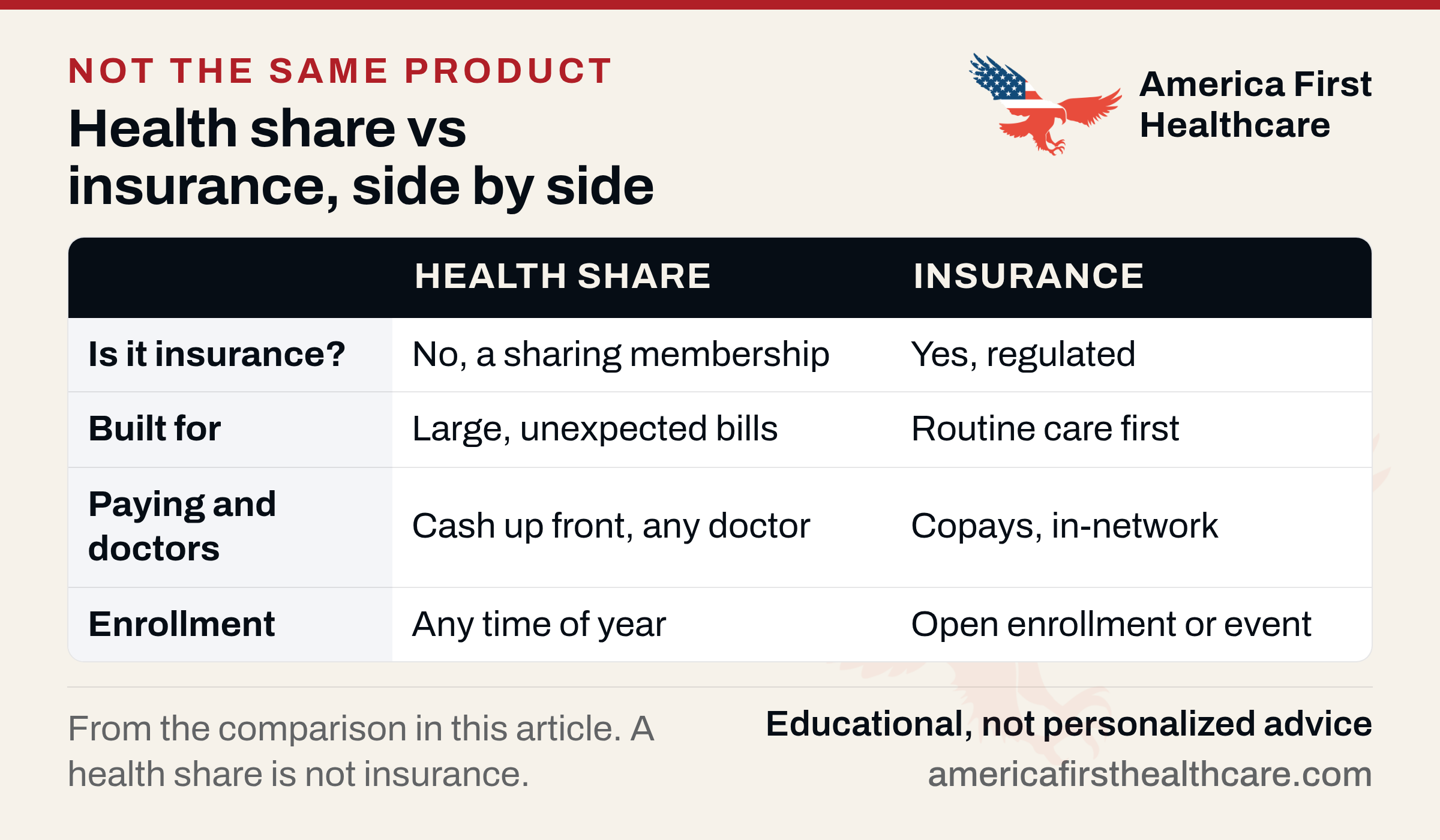
Health share is not insurance. It is an alternative to health insurance. While both provide protection from the severe financial burden of medical treatment, they have distinct approaches.
What Is a Health Share?
A health share is a medical cost sharing membership designed to help families manage large unexpected medical expenses, not routine care. The members pay a monthly share that goes into a pooled fund, and this fund is used to cover the members’ qualified or eligible medical expenses.
The Difference Between Health Sharing and Insurance
What is the difference between health sharing and traditional insurance?
Traditional ACA insurance policies have mandatory coverage for 10 essential benefits and two additional benefits. They are:
- Emergency services
- Outpatient care
- Inpatient care
- Pregnancy, maternity, and newborn care
- Mental health and substance use disorder treatment
- Prescription drugs
- Therapy and rehabilitation (services and devices)
- Laboratory services
- Wellness services and preventive care
- Pediatric services, including oral and vision care
- Birth control
- Breastfeeding
Traditional health insurance is built around covering routine and expected services first, while catastrophic financial protection becomes secondary.
The blanket coverage also applies to all insured individuals, regardless of need. As a case in point, a man does not need maternity, birth control, and breastfeeding benefits, but his plan has these bundled in, anyway.
On the contrary, health sharing plans are much leaner. Member sharing is activated only for clearly defined and specific incidents and medical conditions.
At its core, health sharing is designed to help members cope with unexpected and major medical expenses. That’s it. It’s protection against the potentially debilitating, massively burdensome cost of hospitalization, surgery, and emergency care.
Therefore, in health sharing plans:
- Pre-existing conditions are not covered by default. The health sharing programs that cover them usually set maximum sharing limits or waiting periods for pre-existing conditions.
- While telemedicine or virtual consultations are available, in-person primary care physician and specialist consultations are not, unless they are directly related to an eligible incident.
- Likewise, if directly related to a covered incident, prescription drugs may be covered, but only up to a specific timeframe (e.g., up to 90 days).
How Health Sharing Works Compared With Insurance
Health sharing pools the members’ monthly share contributions, and the program administrator facilitates how those funds are shared among members in need, subject to the plan’s guidelines.
In some plans, the members can directly contribute to other members’ expenses. Members submit their contribution receipts to the health sharing plan administrator for its review and tracking.
Health sharing plan members are cash-pay or self-pay patients. They pay upfront for medical expenses. Next, they file a claim for reimbursement if:
- The incident/illness qualifies for coverage.
- The cost of the treatment exceeds their tier’s minimum qualification threshold per incident/illness.
- The cost of the treatment puts them beyond their personal responsibility threshold.
If all of that is true, they will be partially or fully reimbursed for anything in excess of their minimum qualification and personal responsibility thresholds, subject to the terms of their plans.
How About Traditional Insurance?
In traditional insurance, the insured pays out-of-pocket for copays, any remaining deductibles, and non-covered procedures. The rest of the included benefits are obtained on a cashless basis, and the insurance company pays the providers for these.
However, every test, screening, procedure, or specialist consultation done must be in accordance with the policy’s strict endorsement procedures and should be made by in-network physicians. Insured patients must obtain services from network providers.
The Features of a Health Share
A health share, like traditional insurance, can have multiple tiers. Different tiers or levels have different limits or thresholds for the:
- Per-person monthly share (similar to monthly premium)
- Minimum amount per illness or incident (similar to copay)
- Personal responsibility, annual (similar to deductible)
- Personal responsibility for a specific benefit (similar to a deductible that applies to a specific benefit, e.g., maternity)
- Lifetime per-illness limit or annual maximum sharing limit (similar to the maximum annual benefit limit or the per-illness lifetime limit)
Pros and Cons of Health Share Plans
Health share plans from a health insurance company are for those who want protection from substantial medical costs arising from unexpected incidents and insist on medical freedom and financial responsibility.
Is health sharing worth it for families? Health sharing is not for everyone. It is designed for families who prioritize financial protection, personal responsibility, and control over how they access care.
The Benefits of Health Sharing Plans
These are the benefits that make health sharing plans worthwhile for families:
1. Lower Costs
Health sharing plans’ monthly share costs are substantially lower than the monthly premiums of traditional insurance. This is due to health sharing’s focus on sudden and unexpected medical expenses, instead of covering mandatory “essential” and “additional” benefits that the members may not need or want.
Services are treated as self-pay, which can result in lower medical care costs. An article on the Johns Hopkins Bloomberg School of Public Health highlights the disparity in medical service pricing. Cash pay pricing is often significantly lower because it removes the premium paid for insurance-driven price inflation and administrative overhead.
Self-pay patients may be eligible for prompt-pay discounts (discounts provided for full, upfront payments). In some cases, they may be able to negotiate even lower rates, maybe even at par with Medicare insurance rates.
What this means for families: It means affordable health protection that safeguards families from the financial burden of unexpected and substantial medical expenses.
2. Freedom of Choice
Health sharing plan members can choose their own doctors and receive treatment wherever they are or wherever they prefer. Some plans even allow claims for international medical expenses.
What this means for families: Families can continue seeing their preferred family physicians and specialists and can get treatment even when they’re on vacation.
3. Value and Needs Alignment
Like its private health insurance plans, America First Healthcare’s health sharing plans have minimal government regulation and are not required to include government-mandated benefits. With health sharing, members do not pay for the services they don’t need, and they do not fund causes that are contrary to their faith.
What this means for families: Families who are consciously trying to live a healthy lifestyle don’t have to be burdened by other people’s lifestyle decisions, but they can support those who share their values. They have peace of mind because their family’s healthcare dollars are not being used to promote services that conflict with their values.
4. Cost Transparency
Health sharing plans offer transparent costs for services, and only a minimal portion goes to administrative costs. Excessive healthcare costs are avoided because companies like America First Healthcare offer health sharing plans that put people above profits.
What this means for families: This means clarity on health plan costs for families.
5. Responsible Healthcare Spending
The leanness of health sharing plans, particularly the lack of mandatory benefits, induces members to be more selective, intentional, and responsible about their healthcare decisions and healthcare spending.
What this means for families: Families on health sharing plans enjoy a lower health-protection cost burden while being assured that they have support in the event of unexpected, major medical expenses.
6. Flexible Enrollment
Unlike traditional marketplace health insurance plans, health sharing plans do not have restrictive enrollment windows.
What this means for families: Families can enroll any time, which is perfect for navigating unplanned changes, such as a change of jobs or a growing family.
The Limitations of Health Sharing Plans
What are the main limitations families should understand first? Health sharing plans are unlike traditional insurance in scope.
- Pre-existing conditions are not covered, restricted, or have waiting periods. This means families with pre-existing conditions may want a different plan.
- Upfront, cash payment for services is required. Members must have a medical cash fund to serve as a buffer to pay for medical expenses out of pocket.
- They have limited or no preventive care coverage. Most health sharing plans have telehealth or virtual consultation, but general wellness and preventive care costs are not shared.
- They are not comprehensive. Unlike traditional insurance, health sharing plans require you to pay as you go for many benefits, including those that come bundled in with ACA plans, such as maternity benefits, mental health care, and laboratory services.
If a pregnancy is possible, check how the arrangement handles maternity in writing; our guide to health insurance and pregnancy compares the options.
Health Sharing: Part of a Broad Protection Strategy
Health sharing’s core purpose is to shield you from high-cost medical events, such as accidents or critical illnesses. You remain responsible for low-cost, routine care expenses.
Handling wellness visits and minor concerns lets you bypass insurance-inflated charges. This brings monthly share costs way down, making them significantly less expensive than monthly insurance premiums.
Since you’re paying cash for these non-urgent, regular, and preventive services, you get to enjoy them at a more affordable cash-pay rate.
The health sharing model emphasizes active risk management. It separates catastrophic risk from routine care. Consequently, you maintain personal responsibility and accountability over your family’s health, pay less for routine care, and remain protected against catastrophic medical expenses.
For how faith-based sharing works for a whole household, read how Christian health coverage alternatives work for families.
Frequently Asked Questions
Can families choose any doctor with a health share?
Yes, health share members can choose any doctor, specialist, or provider they prefer. Unlike traditional insurance, health sharing plans are not restricted to in-network providers, so families are not limited to a narrow list of approved doctors. This means members can work with practitioners or licensed providers they trust, which means genuine freedom over their healthcare decisions.
How do monthly sharing amounts compare with insurance premiums?
Health share monthly amounts are typically lower than marketplace health insurance premiums because of its laser-focused scope. Monthly share contributions directly cover the eligible medical expenses of fellow members instead of paying for the massive administration costs and profits of large insurance companies.
For families, correctly structured health sharing plans can significantly reduce monthly costs while maintaining protection for major medical events.
Who is usually a better fit for health sharing than insurance?
Health sharing tends to be a strong fit for individuals and families who want to use their healthcare spending to vote for their faith and values. It’s also for those who want to minimize government control over their healthcare spending and reduce the monthly cost of health protection.
Health sharing is especially well-suited for those who are generally healthy, prefer freedom in choosing their own doctors, and want to opt out of marketplace plans that fund services that are against their faith.
Can you enroll in a health share year-round?
Yes, you can enroll in a health share year-round. This is what makes health sharing plans a flexible health protection option for families. In contrast, ACA marketplace health insurance plans restrict sign-ups to open enrollment periods or qualifying life events.
Is Health Sharing Worth It for Families?
Health sharing is a strong fit for families who understand that healthcare is about protecting against financial disruption, not covering everything.
It’s for generally healthy families who want lower monthly costs, transparent and lower medical care costs, freedom to choose their own doctors, flexibility to enroll at any time, and assurance that their healthcare dollars align with their beliefs.
Ultimately, families must weigh the appeal of lower costs, consumer freedom, and the chance to use their health protection money to vote for their faith and values, against the need to take personal responsibility for non-major medical expenditures and to have a buffer fund for upfront cash payments.
Get clarity before you commit to coverage. Schedule your Free Healthcare Review and see where you may be overpaying or under protected.
Related reading: conservative health insurance: coverage that fits your values.