



Research note · Medicare-adjacent
How do you choose a Medicare advisor, and what does the advice cost?
To choose a Medicare advisor, pick someone who is licensed in your state, appointed with more than one carrier, willing to compare Medicare Supplement (Medigap) and Medicare Advantage side by side, and clear about how they are paid. Most advisors cost you nothing: Medicare Advantage and Part D plans pay them a commission that CMS caps each year, and Medigap insurers pay their own. If you want advice from someone who sells nothing, your State Health Insurance Assistance Program (SHIP) offers free one-on-one counseling, and 1-800-MEDICARE answers questions around the clock. The decision most people actually need help with is Medicare Supplement vs Medicare Advantage, and a good advisor should be able to argue both sides for your situation.
This guide is educational. It is not personalized insurance, legal or tax advice, and America First Healthcare is one of the licensed agencies it describes.
What is a Medicare advisor?
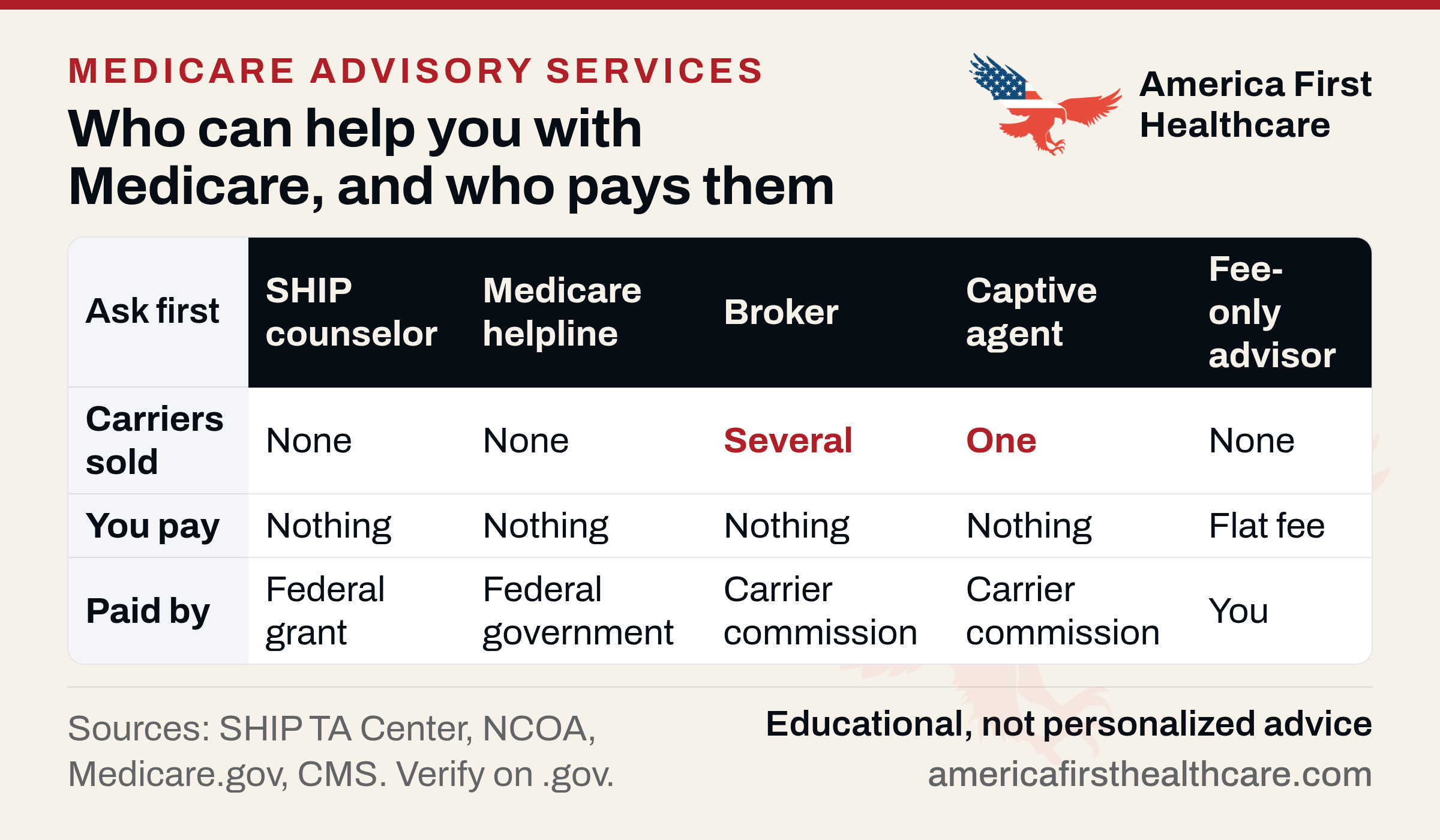
"Medicare advisor" is a marketing term, not a license category. Five different people answer to it, and they are paid differently:
- Independent agent or broker. Licensed by your state to sell health insurance, appointed with several carriers, and able to compare their plans. Paid by commission from the carrier you enroll with. This is what America First Healthcare's advisors are.
- Captive agent. Licensed, but appointed with one carrier. Can only show you that carrier's plans. Also paid by commission.
- SHIP counselor. A trained counselor, often a volunteer, with your State Health Insurance Assistance Program. SHIP describes its help as one-on-one counseling "from a trusted, unbiased source" and is funded by the federal Administration for Community Living (SHIP National Technical Assistance Center). The National Council on Aging notes that SHIPs "do not sell insurance products of any kind" and operate in all 50 states, the District of Columbia, Puerto Rico, Guam and the U.S. Virgin Islands (NCOA, who is the best person to talk to about Medicare).
- Fee-only Medicare advisor. Charges you a flat fee and takes no commission. Fewer of these exist, and a fee-only advisor cannot enroll you in most plans; you enroll yourself after the advice.
- 1-800-MEDICARE. Federal customer service at 1-800-633-4227 (TTY 1-877-486-2048), available around the clock except some federal holidays, plus live chat at Medicare.gov (NCOA). They answer questions and help you use the plan finder; they do not recommend a plan.
Who needs a Medicare advisor, and who does not
You do not need anyone to enroll in Parts A and B. That happens through Social Security. Where an advisor earns their place is the private-plan layer: Medicare Advantage (Part C), Medicare Supplement (Medigap) and Part D drug plans, which are sold by insurers, change every year, and carry deadlines with permanent penalties.
An advisor is worth the conversation if you:
- turn 65 in the next twelve months and have not chosen between Original Medicare plus Medigap and Medicare Advantage;
- take prescriptions that need checking against each plan's formulary, not a generic list;
- are still working past 65 and need to know whether delaying Part B is safe;
- have a Medicare Advantage plan whose network or benefits changed, and want to know whether to move;
- split time between states or travel, which decides the network question on its own.
You may not need one if your current plan still covers your doctors and drugs and the premium fits. An honest advisor's answer in that case is "keep it."
What Medicare advice costs
| Who | What you pay | Who pays them |
|---|---|---|
| SHIP counselor | Nothing | Federal grant to your state (Administration for Community Living) |
| 1-800-MEDICARE | Nothing | Federal government |
| Independent or captive agent | Nothing | The carrier, by commission, when you enroll |
| Fee-only advisor | A flat fee you agree in advance | You |
How commissions work. For Medicare Advantage and Part D, CMS publishes a national maximum an insurer may pay an independent agent for an initial enrollment each contract year, and renewal compensation is limited to half of that initial amount. Carriers may pay all, some or none of the maximum. CMS publishes the current year's national maximums in its annual agent and broker compensation memo, and any advisor should be willing to tell you the figure that applies to the plan they are recommending. Medigap commissions are set by each insurer and state, not by CMS, and are usually a percentage of premium.
Two consequences follow. First, the advice is free to you but not free, so ask whether a recommendation would pay the advisor differently. Second, a commissioned advisor is compensated for enrolling you, not for telling you to keep what you have, which is why the "keep it" answer is the best test of who you are dealing with.
How to choose: eight questions to ask before you enroll
- Are you licensed in my state, and what is your National Producer Number? Every licensed agent has one. Verify it with your state department of insurance before you share your Medicare number.
- Which carriers are you appointed with? An independent broker is not automatically appointed with every carrier in your county. Ask for the list and compare it with the plans shown on Medicare.gov's plan finder.
- How are you paid, and does it differ by plan type? The answer should be plain: commission from the carrier, with Medicare Advantage, Part D and Medigap paying differently.
- Will you compare Medicare Supplement and Medicare Advantage for me, not just one? An advisor who only ever recommends one structure is selling that structure.
- Will you check my doctors and my prescriptions against each plan before recommending it? Doctors and drugs decide the answer more than premiums do.
- What happens after I enroll? A yearly review during the Annual Enrollment Period (October 15 to December 7) and help with billing problems are what separate a service from a transaction.
- If my current plan already fits, will you say so? Ask it directly and watch the answer.
- Will you put the recommendation and the reasons in writing? Including the plan's out-of-pocket maximum, network type and the drug tiers for your medications.
Community advice reaches the same list. The most-cited Reddit thread on finding an unbiased Medicare advisor tells readers to use an independent broker, check state licensing, ask how the advisor is paid, and use SHIP as a free cross-check (r/medicare).
Medicare Supplement vs Medicare Advantage: the decision an advisor should walk you through
Medicare.gov's own comparison is the frame to hold any advisor to (Medicare.gov, compare Original Medicare and Medicare Advantage):
| Original Medicare + Medicare Supplement (Medigap) | Medicare Advantage (Part C) | |
|---|---|---|
| Doctor and hospital choice | Any doctor or hospital that takes Medicare, anywhere in the U.S. | Usually the plan's network and service area for non-emergency care |
| Referrals | Usually not needed for a specialist | May be needed |
| Cost sharing | You pay Part B's 20% coinsurance unless a Medigap policy covers it | Copays vary by service; some plans have a $0 plan premium |
| Yearly out-of-pocket limit | None under Original Medicare alone; Medigap fills the gap | Yes, the plan sets a yearly limit for covered services |
| Prior authorization | Usually not required | May be required |
| Drug coverage | Separate Part D plan and premium | Usually included |
| Extra benefits | Not included | Often dental, vision, hearing or gym, worth checking what they actually pay |
Medigap generally requires Original Medicare Parts A and B, and you cannot buy Medigap to cover Medicare Advantage costs (Medicare.gov, Medigap). Medigap also has a one-time open enrollment window tied to your Part B start; outside it, insurers in most states can apply medical underwriting. No advisor can waive that; the calendar decides it.
What changes for Medicare in 2026
- Part B. The standard premium is $202.90 a month and the annual deductible is $283 for 2026 (CMS, 2026 Medicare Parts A and B premiums and deductibles, released November 14, 2025).
- Part D. The standard deductible is $615 and out-of-pocket spending on covered drugs is capped at $2,100 for the year (CMS, CY 2026 Part D redesign program instructions). Below the cap, plan formularies and tiers still decide what you pay per prescription, which is why a medication check matters more than the premium.
- Annual Enrollment Period. October 15 to December 7, 2026, for changes effective January 1, 2027. You can compare 2027 plans from October 1 (Medicare.gov open enrollment; dates on our enrollment calendar).
- Medicare Advantage Open Enrollment. January 1 to March 31 each year, for people already in a Medicare Advantage plan who want to switch plans or return to Original Medicare.
- Late penalties. Medicare.gov states the Part B premium rises 10% for each full year you could have had Part B but did not, for as long as you keep it; Part D carries its own penalty of 1% of the national base premium per month without creditable coverage. Both are permanent, and they are the deadlines an advisor should be tracking for you.
Red flags
- An unsolicited call, text or door knock about Medicare. Medicare does not cold-call, and neither should a legitimate agent you have not contacted.
- A request for your Medicare number before you have agreed to enroll in anything.
- Gifts, meals or "free" offers tied to enrolling. CMS marketing rules restrict these.
- One carrier, every time, for every client.
- Refusal to put the plan name, out-of-pocket maximum and drug tiers in writing.
- Urgency that does not match the calendar. The Annual Enrollment Period is seven weeks long, every year.
More patterns, with sources, are in medical insurance scams.
Free and official help
- SHIP. Find your state program at shiphelp.org or call 877-839-2675.
- 1-800-MEDICARE (1-800-633-4227, TTY 1-877-486-2048) and the plan finder at Medicare.gov.
- Your state department of insurance verifies an agent's license and takes complaints.
- Medicare Rights Center operates a national consumer helpline and counseling program.
How America First Healthcare's Medicare review works
Our advisors are licensed independent agents, compensated by the carriers we are appointed with, and we tell you which carriers those are at the start of the call. The review is free, compares Original Medicare plus Medigap against Medicare Advantage for your doctors and prescriptions, and ends with a recommendation you can decline, including the recommendation to keep the plan you already have. Official enrollment happens through Medicare.gov, Social Security or the plan, not through this website. Details are on the Medicare page.
FAQ
Do I need a Medicare advisor?
Not to enroll in Parts A and B; Social Security handles that. An advisor helps with the private-plan decisions: Medicare Advantage vs Medicare Supplement, the Part D plan that covers your prescriptions, enrollment deadlines, and the yearly review. If your current plan still fits, the right answer from an advisor is to keep it.
How much does a Medicare advisor cost?
Usually nothing to you. Independent and captive agents are paid a commission by the carrier when you enroll, within maximums CMS sets each year for Medicare Advantage and Part D. SHIP counselors and 1-800-MEDICARE are free and sell nothing. Fee-only advisors charge a flat fee you agree in advance.
What is the difference between a Medicare agent and a Medicare broker?
Both are state-licensed. A captive agent represents one carrier and can only show that carrier's plans. An independent agent or broker is appointed with several carriers and can compare them. Ask which carriers any advisor is appointed with; independent does not mean all of them.
Where can I get free, unbiased Medicare advice?
Your State Health Insurance Assistance Program (SHIP), which offers one-on-one counseling and does not sell insurance, at shiphelp.org or 877-839-2675; and 1-800-MEDICARE (1-800-633-4227), the federal helpline, with live chat at Medicare.gov.
Medicare Supplement or Medicare Advantage: which should an advisor recommend?
Neither for everyone. Medicare Supplement (Medigap) works with Original Medicare, lets you see any doctor who accepts Medicare nationwide and leaves little to pay per visit, at a higher monthly premium plus a separate Part D plan. Medicare Advantage usually has a low or $0 plan premium and bundles drug coverage and extras, but uses a network, may require referrals and prior authorization, and charges copays up to a yearly limit. An advisor who will not lay out both for your doctors and prescriptions is not advising.
What changes for Medicare in 2026?
The standard Part B premium is $202.90 a month with a $283 deductible; the Part D deductible is $615 and out-of-pocket drug costs are capped at $2,100 for the year (CMS). The Annual Enrollment Period for 2027 coverage runs October 15 to December 7, 2026.
Key takeaways
- A Medicare advisor is a licensed agent or broker who compares Medicare Advantage, Medicare Supplement and Part D plans against your doctors, prescriptions and budget; "advisor" is not itself a license.
- Commissioned advisors cost you nothing because carriers pay them within CMS maximums; SHIP counselors and 1-800-MEDICARE are free and sell nothing; fee-only advisors charge you directly.
- Choose an advisor who is licensed in your state, appointed with more than one carrier, will compare Medigap and Medicare Advantage side by side, checks your doctors and drugs first, and will tell you to keep your plan if it fits.
- For 2026 the Part B premium is $202.90 with a $283 deductible, Part D drug costs are capped at $2,100, and the Annual Enrollment Period runs October 15 to December 7.
- Unsolicited calls, requests for your Medicare number, gifts tied to enrollment and one-carrier answers are the red flags.
- America First Healthcare's Medicare review is free, compares both structures, and ends with a recommendation you can decline.
Method / disclaimer
Facts on this page come from Medicare.gov, CMS premium and Part D announcements for 2026, the SHIP National Technical Assistance Center, the National Council on Aging and HealthCare.gov, as reviewed on 2026-09-17. Government pages update; verify before you act. Educational only, not medical, legal, tax or personalized insurance advice. America First Healthcare is an independent licensed insurance agency compensated by carriers.
Next step
If you want the Medicare Supplement vs Medicare Advantage comparison run against your own doctors and prescriptions, start a free healthcare review. It is a conversation, and "keep what you have" is one of the possible answers.
More plain-English guides live in the research library. Dates for every enrollment window are on the open enrollment and Medicare AEP calendar.