



Research note · Definitions
PRIVATE HEALTHCARE PLANS USA
Private health insurance is health coverage you get from a private insurance company rather than from a government program like Medicare or Medicaid. It is how most Americans are covered: in 2024, 66.1% of people had private coverage for some or all of the year, most of them (53.8%) through an employer and 10.7% by buying it directly (U.S. Census Bureau, Health Insurance Coverage in the United States: 2024). "Private" covers very different products, though. An ACA plan bought on HealthCare.gov is private insurance. So is a short-term plan that can refuse you for a pre-existing condition. The single most useful thing to know before you buy is which kind of private plan you are looking at, because that decides what it must cover.
Last reviewed: September 24, 2026; 2027 figures checked October 11, 2026. Figures link to their source; confirm anything you plan around there.
Private health insurance at a glance
| Fact | Figure | Source |
|---|---|---|
| People with private coverage, 2024 | 66.1% | Census Bureau |
| Through an employer | 53.8% | Same |
| Bought directly (direct purchase) | 10.7% | Same |
| Adults 19 to 64 with private coverage | 74.0% | Same |
| Most a 2027 Marketplace plan can make you pay for covered in-network care | $12,000 individual / $24,000 family | HealthCare.gov |
| Same limit for 2026 | $10,600 / $21,200 | Same |
| 2027 Open Enrollment | November 1, 2026 to January 15, 2027 | HealthCare.gov |
| Premium tax credit income range for 2027 coverage, one person (100% to 400% of the poverty level) | $15,960 to $63,840 | HealthCare.gov; IRS Rev. Proc. 2026-26 |
What counts as private health insurance?
Coverage is private when a private company, not the government, is the insurer. The Census Bureau reports private coverage (employment-based and direct-purchase) separately from public coverage such as Medicare and Medicaid; in 2024 private coverage was 66.1% and public 35.5%, and some people have both (Census Bureau).
That means a Marketplace plan is private insurance. The government runs the store and may subsidise the premium, but a private insurer issues the policy. The question that matters is not "private or Obamacare?" but "is this plan ACA-compliant major medical, or something else?"
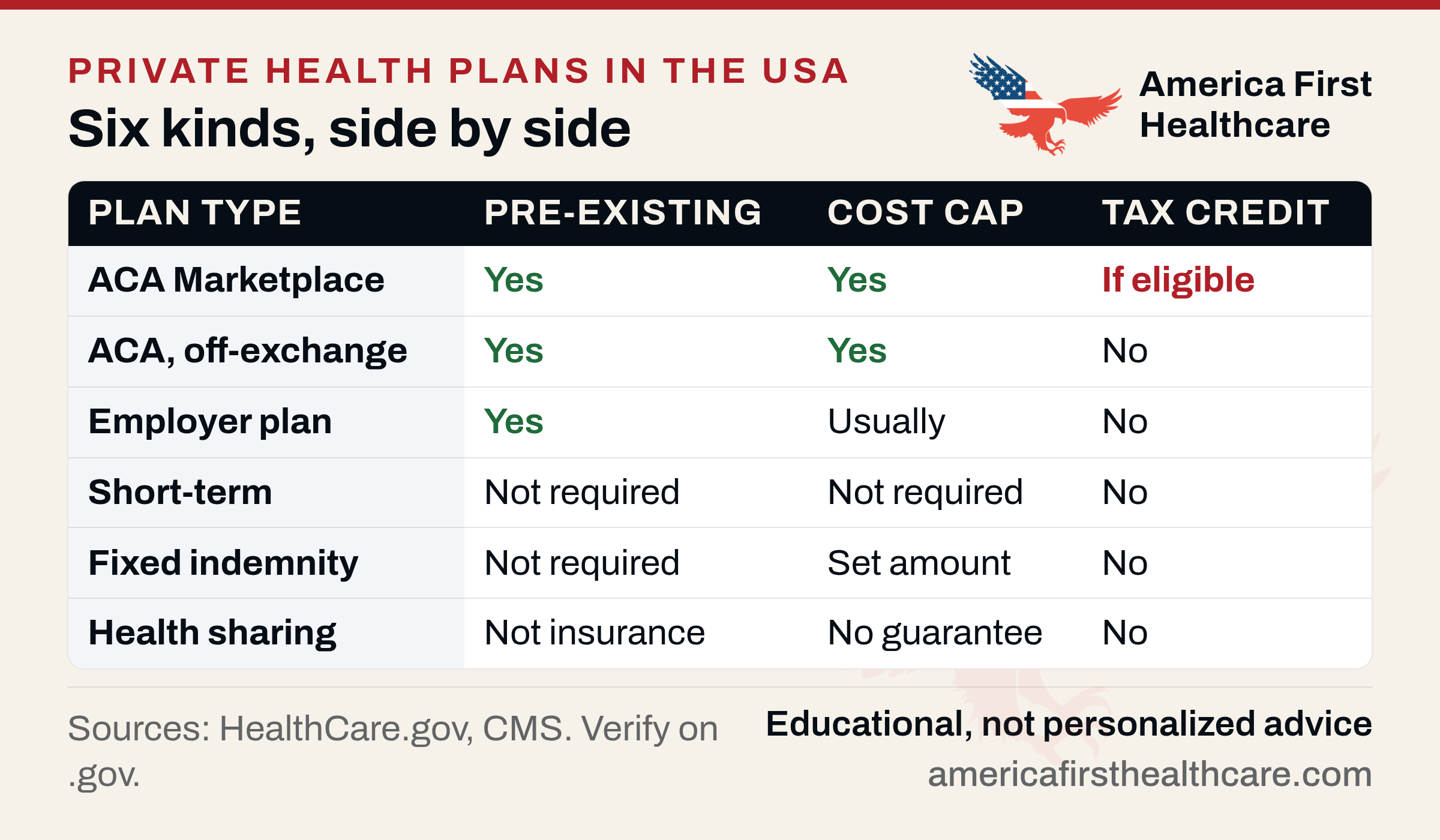
The six kinds of private health plans in the USA
1. ACA Marketplace plans
Bought through HealthCare.gov or your state's exchange. Every Marketplace plan covers the ten essential health benefits: outpatient care, emergency services, hospitalization, pregnancy and newborn care, mental health and substance use treatment, prescription drugs, rehabilitative services, lab services, preventive care, and pediatric care including children's dental and vision (HealthCare.gov). It cannot reject you or charge you more for a condition you already had (HealthCare.gov), and it caps what you pay each year for covered in-network care. It is the only place the premium tax credit applies (HealthCare.gov).
2. ACA-compliant plans sold outside the Marketplace
Some insurers sell ACA-compliant individual plans directly or through agents. They follow the same benefit and pre-existing-condition rules; what you give up is the premium tax credit, which is available only through the Marketplace (HealthCare.gov). If you would not qualify for a credit anyway, the difference is mostly the sales channel. Availability varies by state and insurer.
3. Employer and job-based plans
The most common private coverage in the country, at 53.8% of people in 2024 (Census Bureau). If you are leaving a job, see losing employer coverage for COBRA and the 60-day clock; if you run a small team, see small business owners.
4. Short-term, limited-duration insurance
Real insurance, but not ACA coverage. Federal rules describe it as "primarily designed to fill temporary gaps in coverage," and because it is excluded from the definition of individual health insurance coverage it is "not subject to the prohibitions on discrimination based on health status, pre-existing condition exclusions, and lifetime and annual dollar limits on essential health benefits" (CMS, March 28, 2024). The 2024 federal rule limits the first term to three months and the total to four; how that is enforced now, and what your state allows, varies. Some states ban it (California and New York among the states we have verified) and many limit it; the state lookup below shows what we have checked for each state.
5. Fixed indemnity and hospital indemnity
Pays you a set amount per day or per event, such as "$100 per day" in the group market or "$50 per medical examination" in the individual market, "regardless of the amount of expenses a consumer incurs." CMS calls it "a form of income replacement" that "is not a substitute for comprehensive coverage" (CMS). Useful on top of major medical; risky as your only plan. Worked example: hospital indemnity insurance vs major medical.
6. Health care sharing programs
Members share medical costs under a program's guidelines. These are not insurance, so there is no insurance contract and no guarantee a bill will be shared. See health share vs traditional insurance before you consider one.
Which private plan fits you?
Answer five questions. The result tells you which kinds of plan to look at first and what to watch for. It is educational, not a quote or a recommendation, and it stores nothing.
Plan finder
Which kind of private plan should you look at first?
0 of 5 answered. Educational only; nothing is saved or sent.
Answer all five to see where to start.
What private health insurance covers
On ACA major medical (Marketplace, off-Marketplace ACA, most employer plans), the floor is the ten essential health benefits listed above (HealthCare.gov). Adult dental and vision are not essential health benefits and usually cost extra; see does health insurance cover dental and vision? Listed preventive care, such as colorectal cancer screening from 45 and screening mammograms from 40, is covered without a copay in network, even before the deductible; see does health insurance cover preventive care? Pregnancy and childbirth are covered from the day the plan starts (HealthCare.gov); see health insurance and pregnancy.
On everything else (short-term, indemnity, health sharing), there is no required list. Read the exclusions before the benefits, and get them in writing.
What private health insurance costs
There is no honest single number. What you pay depends on:
- The plan type. Marketplace plans may not price on health; besides age, only location, tobacco use, household size and metal tier count (details). Underwritten products ask about diagnoses, prescriptions and tobacco, and can charge more, exclude a condition or decline (details).
- Your income, on the Marketplace. Savings are based on your income estimate for the coverage year, and you get exact prices only on an application (HealthCare.gov). HealthCare.gov's glossary describes premium tax credit eligibility for incomes between 100% and 400% of the federal poverty level (HealthCare.gov). For 2027 coverage that is $15,960 to $63,840 for one person and $33,000 to $132,000 for a family of four, using the 2026 poverty guidelines (HealthCare.gov, federal poverty level).
- The whole year, not the premium. Add the deductible, coinsurance and copays up to the out-of-pocket maximum. A low premium with a high deductible can cost more in a bad year. See deductible, copay, coinsurance and out-of-pocket max, with examples.
Why prices keep rising is covered in why health insurance costs keep rising. For the full cost checklist, see how to choose a private health insurance plan.
Private health insurance vs Obamacare, Medicare and Medicaid
| ACA Marketplace ("Obamacare") | Other private plans | Medicare | Medicaid | |
|---|---|---|---|---|
| Who runs it | Private insurers, sold on HealthCare.gov or a state exchange | Private insurers or programs | Federal government (private plans for Advantage and Part D) | States with federal funding |
| Pre-existing conditions | Covered | Depends on the plan type | See Medicare.gov | Covered |
| Help with premiums | Premium tax credit if you qualify | None | Help programs for low income | Low or no cost if eligible |
| When you can join | Open Enrollment or a Special Enrollment Period | Varies; some year-round | Enrollment periods around 65 and each fall | Any time if eligible |
Sources: HealthCare.gov (Medicaid and pre-existing conditions), Medicare.gov (enrollment periods); details in private health insurance vs Obamacare and how to choose a Medicare advisor.
When you can buy
Marketplace plans: Open Enrollment for 2027 runs November 1, 2026 to January 15, 2027; enroll by December 15 for a January 1 start. Outside it you need a Special Enrollment Period, for example after losing other coverage, moving, marrying or having a baby (HealthCare.gov; coverage outside Open Enrollment). Details: when is Open Enrollment for 2027?
Other private plans: some can be bought at any time of year, which is part of their appeal and part of their risk. Ask what happens at renewal and whether the end of the plan gives you a Special Enrollment Period (for short-term plans it generally does not).
Private health insurance in your state
Rules differ by state: who runs the marketplace, whether short-term plans are allowed, and where to get free help. Pick your state.
State lookup
Private health insurance rules in your state
Pick a state to see its marketplace, short-term rules and free help.
How to choose private health insurance: 7 steps
- Name the plan type in writing. ACA major medical, short-term, fixed indemnity or health sharing. If the seller will not say, stop.
- Check for a tax credit. Estimate your income for the coverage year on HealthCare.gov before you shop off the Marketplace.
- List your doctors, hospital and prescriptions, then check each against the plan's directory and drug list (how).
- Price a bad year, not just the premium: premium × 12 plus the out-of-pocket maximum.
- Read the exclusions, especially pre-existing conditions, maternity, mental health and prescription drugs, on anything that is not ACA major medical.
- Check the timing: Open Enrollment, a Special Enrollment Period, and what happens at renewal.
- Verify who is selling it. Look the agent up on the NIPR license lookup or with your state insurance department, and read how to know a health insurance agency is legit.
Where to get help, including free help
- Free Medicare counseling: your state's SHIP, listed on every state page.
- Free Marketplace help: HealthCare.gov's Find Local Help directory lists assisters trained and certified by the Marketplace, who must give "fair, impartial, and accurate information" (HealthCare.gov).
- A licensed agent or broker can compare plans from the insurers they are appointed with. HealthCare.gov notes that agents and brokers are "generally paid by insurance companies whose plans they represent" (same page). Ask how they are paid.
America First Healthcare is an independent licensed agency. In a free 15-minute review, a licensed advisor tells you which kind each plan you are considering is, ACA major medical or not, and what that means for you. We are paid by the carriers we are appointed with, and you can decline any recommendation. Start a free healthcare review, or read the most common health insurance questions first. To see what clients say about us, including the critical reviews, read America First Healthcare reviews.
Frequently asked questions
What is private health insurance?
Private health insurance is coverage issued by a private insurance company rather than a government program. It includes employer plans, plans you buy yourself on or off the ACA Marketplace, and other products such as short-term and fixed indemnity plans. In 2024, 66.1% of people in the United States had private coverage, according to the Census Bureau.
Is a Marketplace (Obamacare) plan private insurance?
Yes. Marketplace plans are issued by private insurers; HealthCare.gov or a state exchange is the store, and the government may help pay the premium through the premium tax credit.
How much does private health insurance cost?
It depends on the plan type, your age, location and household, and, on the Marketplace, your income estimate for the year. HealthCare.gov gives exact prices and savings only when you fill out an application. Compare the whole year: premiums plus the deductible and coinsurance up to the out-of-pocket maximum, which for a 2027 Marketplace plan is no more than $12,000 for one person ($10,600 in 2026).
Does private health insurance cover pre-existing conditions?
ACA major medical does: Marketplace plans cannot reject you, charge you more or refuse to pay for essential health benefits because of a condition you had before coverage started. Short-term plans are not subject to that rule and can exclude pre-existing conditions.
Can I buy private health insurance any time of year?
Marketplace plans only during Open Enrollment (November 1, 2026 to January 15, 2027 for 2027 coverage) or with a Special Enrollment Period. Some other private products can be bought year-round, but they may not be ACA coverage, so check what they exclude.
What is the best private health insurance?
There is no single best plan; the right one depends on your doctors, prescriptions, health, income and budget. Start by confirming the plan is ACA major medical if you need guaranteed coverage for pre-existing conditions, then compare networks and the cost of a bad year.
Is private health insurance better than Obamacare?
Neither is better for everyone. Marketplace plans are the only ones that take the premium tax credit and must cover pre-existing conditions; some private plans outside the Marketplace cost less for healthy people but can exclude what the Marketplace must cover. Compare both side by side.
Sources
- U.S. Census Bureau, Health Insurance Coverage in the United States: 2024 (P60-288, September 9, 2025)
- HealthCare.gov: What Marketplace plans cover, Pre-existing conditions, Premium tax credit, Income levels and savings, Out-of-pocket maximum, Dates and deadlines, Federal poverty level, Get help applying
- CMS, Short-term, limited-duration insurance and independent, noncoordinated excepted benefits coverage fact sheet (March 28, 2024)
- IRS, Revenue Procedure 2026-26 (premium tax credit applicable percentage table for 2027)
Educational only, not legal, tax or personalized insurance advice.