



Resources · Coverage Basics
When is Open Enrollment for 2027? Dates, deadlines and what changed
The short answer
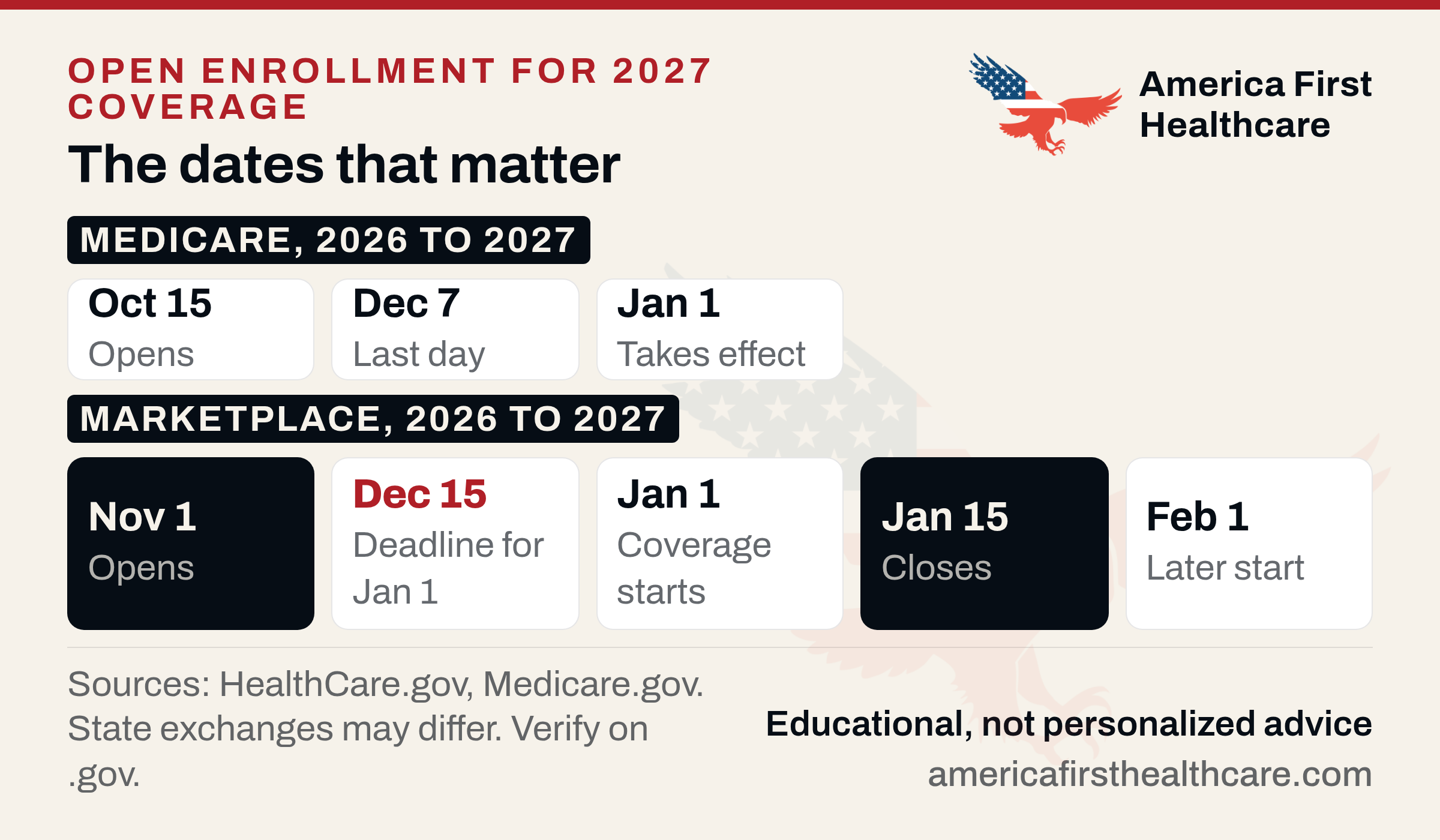
Open Enrollment for 2027 Marketplace coverage starts November 1, 2026 and ends January 15, 2027. Enroll or change plans by December 15 and pay your first premium, and coverage starts January 1. Enroll between December 16 and January 15, and it starts February 1. After January 15 you can enroll or change plans only if you qualify for a Special Enrollment Period (HealthCare.gov, dates and deadlines).
If you have Medicare, your window is different: Medicare Open Enrollment runs October 15 to December 7, and changes take effect January 1 (Medicare.gov).
Last checked: September 23, 2026, against HealthCare.gov and Medicare.gov. Government pages change; confirm there before you act.
2027 Open Enrollment dates
These are the dates HealthCare.gov publishes for the Marketplace (dates and deadlines):
| Date | What happens |
|---|---|
| November 1, 2026 | Open Enrollment starts. First day to enroll in, renew or change a Marketplace plan for 2027. |
| December 15, 2026 | Last day to enroll or change plans for coverage that starts January 1. |
| January 1, 2027 | Coverage starts for people who enrolled by December 15 and paid their first premium. |
| January 15, 2027 | Open Enrollment ends. Last day to enroll in or change a Marketplace plan for 2027. |
| February 1, 2027 | Coverage starts for people who enrolled December 16 to January 15 and paid their first premium. |
Does my state use the same dates?
Not always. Some states run their own Marketplace instead of HealthCare.gov, and their end dates can differ. Every state's 2027 window, deadline and source is in Open Enrollment 2027 dates by state. If your state has its own exchange, check its site too. HealthCare.gov's Find Local Help directory lists free, trained assisters by ZIP code, and the Marketplace Call Center is 1-800-318-2596 (HealthCare.gov).
What if I miss January 15?
You can still get Marketplace coverage between January 16 and October 31 if you qualify for a Special Enrollment Period, for example after losing other coverage, getting married, having a baby or moving. Medicaid and CHIP take applications all year, and if you qualify you can enroll immediately (HealthCare.gov, coverage outside Open Enrollment). Without one of those, you wait for the next Open Enrollment.
What changed for 2027
The out-of-pocket maximum went up
The out-of-pocket maximum is the most you pay in a plan year for covered, in-network care through deductibles, copays and coinsurance. After that, the plan pays 100% of covered benefits. HealthCare.gov lists the Marketplace limits (glossary):
| Plan year | Individual | Family |
|---|---|---|
| 2026 | $10,600 | $21,200 |
| 2027 | $12,000 | $24,000 |
That is a ceiling, not what every plan charges; many plans set a lower one. It also does not count your monthly premiums, services the plan does not cover, out-of-network care, or amounts a provider bills above the allowed amount (same source). For how the deductible, copays and the maximum stack up in a real year, see deductible, copay, coinsurance and out-of-pocket max, with examples.
Tax credits: what HealthCare.gov says now
A question we hear a lot in review calls is some version of "what happens in January if there are no tax credits?" Here is what the official pages say, and what they do not.
HealthCare.gov's glossary currently describes premium tax credit eligibility for household income between 100% and 400% of the federal poverty level, in all states. The credit is based on the household and income estimate on your application, and you can take all, some or none of it in advance to lower your monthly premium. If you take more than your final income qualifies you for, you pay the difference back at tax time (HealthCare.gov, premium tax credit).
Two details matter for 2027:
- Savings are based on your income estimate for the year you want coverage, not last year (HealthCare.gov, income levels and savings). If your 2027 income will change, estimate 2027.
- You get exact prices and savings only when you fill out a Marketplace application (same source). Any number you hear before that, including from us, is an estimate.
The glossary does not describe a credit for income above 400% of the poverty level. If your income is near that line, run your own numbers on the application rather than trusting a rule of thumb. The only way to get the premium tax credit is through the Marketplace (same glossary page).
Will my premium go up in 2027?
Probably, before any tax credit. Insurers proposed a median increase of 15% for 2027 across 276 insurers in all 50 states and DC; those are proposed rates, not final (KFF, updated August 3, 2026). Your own price still depends on your state, age, household, income and plan. Averages by state, before and after tax credits, are in how much health insurance costs per month. HealthCare.gov lets you preview plans and prices before you apply. Compare your renewal notice with at least two other plans before December 15. If your plan auto-renews, the price and the network can still change.
What to do before November 1
- Estimate your 2027 household income. Start from last year's adjusted gross income and adjust for expected changes; HealthCare.gov has an income calculator.
- List your doctors, hospital and prescriptions. Networks and drug lists change each year. Our guide to checking your doctor, hospital and prescriptions before you buy shows how.
- Decide what you need covered that a plan might leave out. If a pregnancy is possible, read health insurance and pregnancy. If dental or vision matters, read does health insurance cover dental and vision?
- Know what a plan is before you buy it. A fixed indemnity plan that "pays $200 a day" is not major medical and has no out-of-pocket maximum on the bill. See hospital indemnity vs major medical.
- Put December 15 in your calendar. It is the date that decides whether coverage starts January 1.
- Watch for scams. Open Enrollment brings more cold calls and ads. Read common health insurance scams before you give anyone your information.
Marketplace or something else?
Open Enrollment is about Marketplace plans, but it is also when many households compare them with private, off-Marketplace options. The trade-offs are real: Marketplace plans must cover pre-existing conditions (HealthCare.gov) and the essential health benefits (HealthCare.gov), and are the only way to get the premium tax credit; some private plans are medically underwritten and may cost less for healthy people while excluding what the Marketplace must cover. We lay out both sides in private health insurance vs Obamacare. If you are self-employed, see health insurance for the self-employed; if you are leaving a job, see losing employer coverage.
For every window in one place, including Medicare's January to March periods, see our open enrollment and Medicare AEP calendar.
How AFHC handles this
America First Healthcare is an independent licensed agency. In a free 15-minute review, a licensed advisor looks at what you have now and what you are weighing for 2027, and tells you which category each plan is in: Marketplace, underwritten major medical, short-term or fixed indemnity. We do not promise a lower premium, and official Marketplace enrollment happens through HealthCare.gov or your state's exchange. If you want help getting ready before December 15, start a free healthcare review. If you are wondering who we are, our reviews page shows what clients say.
Frequently asked questions
When is Open Enrollment for 2027?
Marketplace Open Enrollment for 2027 coverage runs from November 1, 2026 to January 15, 2027, according to HealthCare.gov. Enroll by December 15, 2026 for coverage that starts January 1, 2027. Enroll December 16 to January 15 and coverage starts February 1. State-run exchanges can set different end dates.
What is the last day to enroll for coverage starting January 1, 2027?
December 15, 2026. HealthCare.gov says coverage starts January 1 for people who enroll in or change plans by December 15 and pay their first premium.
What is the out-of-pocket maximum for 2027?
For a 2027 Marketplace plan, no more than $12,000 for an individual or $24,000 for a family, according to HealthCare.gov. For 2026 it is $10,600 and $21,200. Premiums, uncovered services and out-of-network care do not count toward it.
Who qualifies for a premium tax credit in 2027?
HealthCare.gov's glossary describes eligibility for household income between 100% and 400% of the federal poverty level, in all states. The credit is based on your estimated income for the coverage year, and you get exact savings only when you fill out a Marketplace application.
Can I enroll after January 15?
Only if you qualify for a Special Enrollment Period, for example after losing other coverage, getting married, having a baby or moving. Medicaid and CHIP accept applications all year. Otherwise the next chance is the next Open Enrollment.
Is Medicare Open Enrollment the same as Marketplace Open Enrollment?
No. Medicare Open Enrollment runs October 15 to December 7, and changes take effect January 1 of the next year; the plan must get your request by December 7. Marketplace Open Enrollment runs November 1 to January 15.
Does AFHC enroll me on HealthCare.gov?
Official Marketplace enrollment happens through HealthCare.gov or your state's exchange. A free healthcare review helps you compare options, check doctors and prescriptions, and get ready before the deadline. It is educational help, not a promise of a lower premium.
Sources
- HealthCare.gov, When can you get health insurance? (Open Enrollment dates for 2027 coverage)
- HealthCare.gov, Out-of-pocket maximum/limit (2026 and 2027 limits)
- HealthCare.gov, Premium tax credit and Income levels and savings
- HealthCare.gov, Get or change coverage outside of Open Enrollment
- Medicare.gov, Open Enrollment
Educational only, not legal, tax or personalized insurance advice.