



Resources · Coverage Basics
Does health insurance cover dental and vision?
The short answer
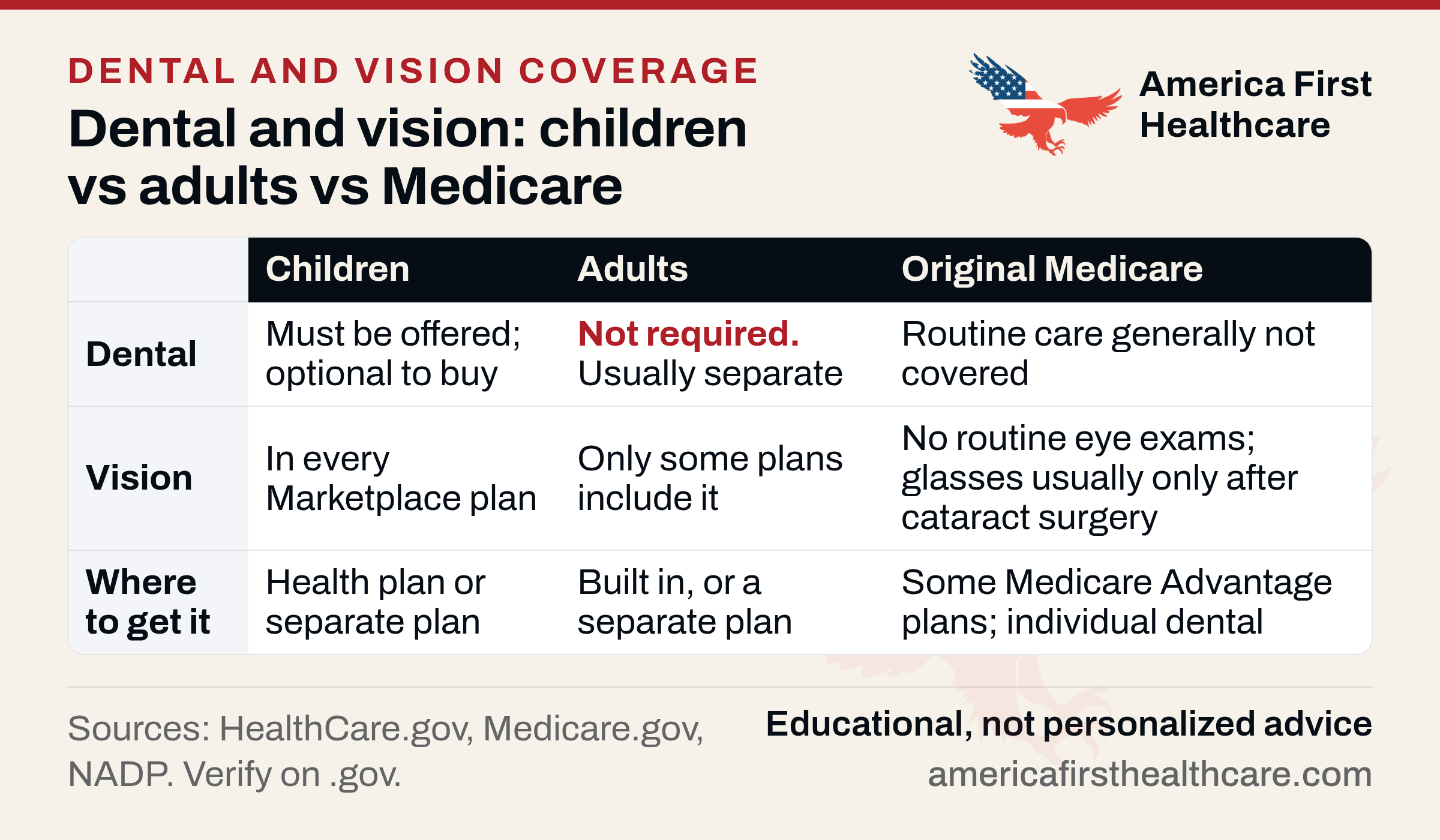
Usually not for adults. Dental and vision are not essential health benefits for adults, so a health plan does not have to include them, and dental can be bought as a separate plan (HealthCare.gov, dental coverage). Children are different: pediatric dental and vision care are essential health benefits, and every Marketplace plan includes vision coverage for children (HealthCare.gov, what Marketplace plans cover). A separate dental plan has its own premium, usually an annual maximum, and may have a waiting period before some services are covered. Original Medicare generally does not cover routine dental care, routine eye exams or glasses (Medicare.gov).
Does health insurance come with dental and vision, or is that separate?
Either. On the Marketplace you can pick a health plan with dental built in, or one without it plus a separate dental plan. If dental is built in, one premium pays for both. If it is separate, you pay a second premium (HealthCare.gov).
Two rules catch people out. You cannot buy a Marketplace dental plan without buying a Marketplace health plan at the same time. And dental built into a health plan cannot be removed without changing health plans, while a separate dental plan can be cancelled at any time (same source).
Vision works the same way. HealthCare.gov describes vision coverage as a benefit that at least partially covers vision care, like eye exams and glasses, and says only some Marketplace plans include it for adults (HealthCare.gov).
Private health plans bought outside the Marketplace follow their own benefit design, so read the benefit summary rather than assuming. Our guide to private PPO vs Obamacare plans covers how the two markets differ.
Children vs adults: why the rules differ
For anyone 18 or younger, dental coverage must be available, either inside the health plan or as a separate dental plan. You do not have to buy it, but it has to be offered. For adults there is no such requirement (HealthCare.gov). Pediatric vision is also on the list of essential health benefits, and every Marketplace plan includes vision coverage for children (HealthCare.gov).
So a family can find the children covered while the parents are not. Check each person separately.
How dental plans are usually structured
The NAIC, the organization of state insurance regulators, groups dental coverage into four types: dental PPOs, dental HMOs, dental indemnity plans, and discount or savings plans (NAIC consumer alert, 2018). Discount plans are not insurance in the same sense: they pay nothing toward the cost of care, and you pay the dentist a discounted fee yourself (NADP, understanding dental benefits).
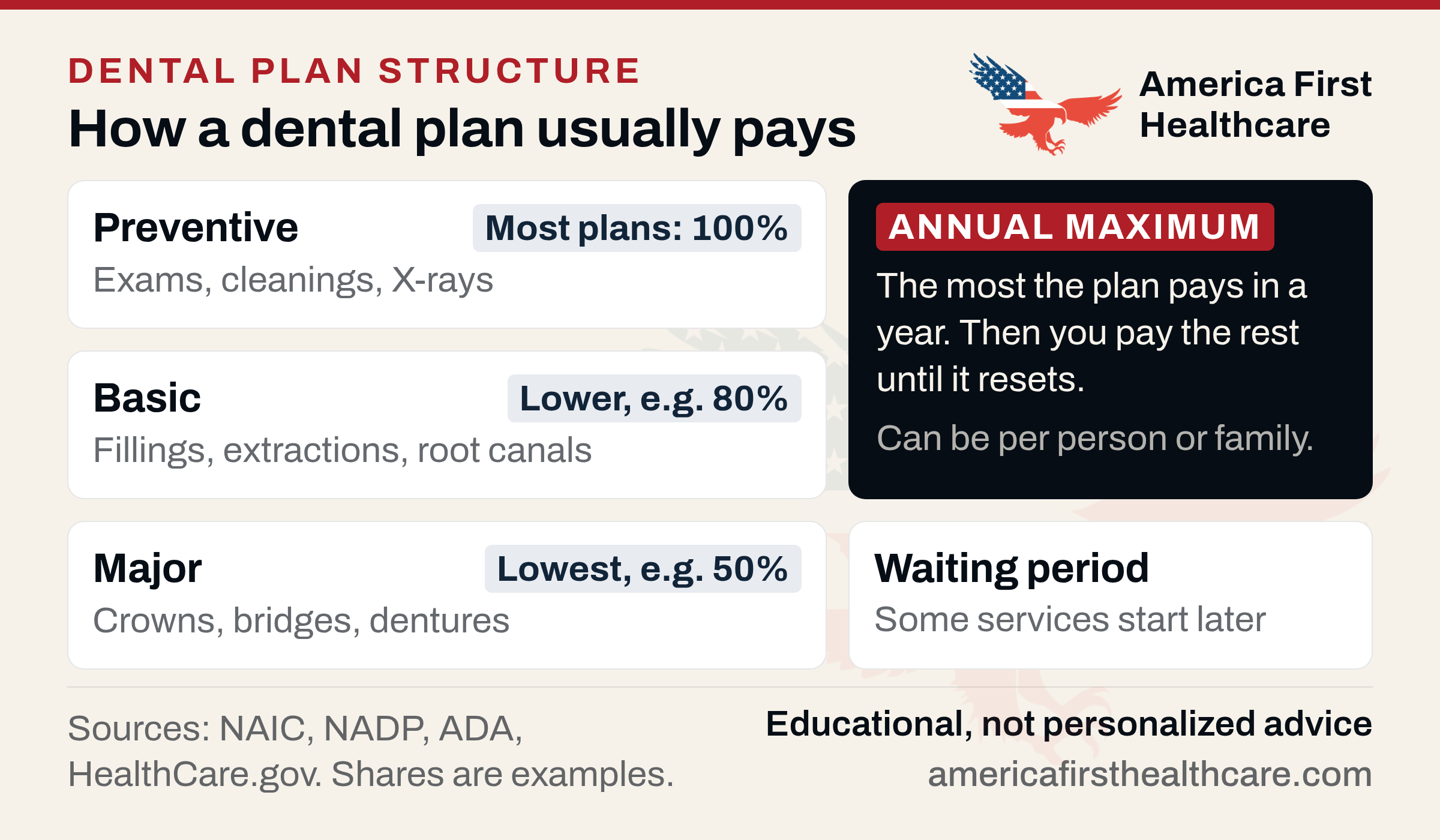
Most insured plans sort services into three payment tiers. The table uses the categories and examples the NAIC and the National Association of Dental Plans (NADP) describe; the percentages are their illustrations, not a promise about any plan.
| Tier | Typical services | How it is often paid | Watch for |
|---|---|---|---|
| Preventive | Exams, cleanings, X-rays, sealants | Most plans cover 100% | Sealants may be limited by age |
| Basic | Fillings, extractions, root canals, gum disease treatment | A lower share, for instance 80% in network | Root canals are sometimes classed as major |
| Major | Crowns, bridges, inlays, dentures; implants on some plans | The lowest share, such as 50% | Implants may carry frequency limits |
| Orthodontics | Braces, retainers | Usually a rider, not the base plan | You need dental coverage to add the rider |
Deductibles are usually between $50 and $100, and dental HMOs rarely have an annual maximum (NADP). A plan may also base its payment on its own "customary" fee, which can be lower than your dentist's fee (American Dental Association).
What an annual maximum means, and does the plan help my annual max?
The annual maximum is the most the plan will pay in a year, even if your dental bills are higher. It can apply per person or per family (ADA). Once it is used up, you pay the rest until it resets.
Maximums vary widely. According to NADP figures quoted by the ADA, about a third of in-network annual maximums fall between $1,000 and $1,500, and about half between $1,500 and $2,500 (ADA News, December 2025). NADP says about 65% of dental PPOs have a maximum of $1,500 or more, and some carriers let part of an unused maximum roll over (NADP).
A made-up example. Every number here is invented to show the arithmetic. Take a plan with a $1,500 annual maximum, a $50 deductible that does not apply to preventive care, and 100% / 80% / 50% coinsurance. In one year you have $300 of cleanings and X-rays, a $200 filling and two $1,200 crowns.
| Service | Plan pays | You pay | Plan total so far |
|---|---|---|---|
| Cleanings and X-rays, $300 | $300 | $0 | $300 |
| Filling, $200 ($50 deductible, then 80%) | $120 | $80 | $420 |
| First crown, $1,200 at 50% | $600 | $600 | $1,020 |
| Second crown, $1,200 at 50% | $480 (maximum reached) | $720 | $1,500 |
You pay $1,400 of the $2,900 total, and the second crown is where the maximum bites. Delaying work until the maximum resets does not remove coinsurance, the ADA notes (ADA News).
Waiting periods: why the first year matters
A separate dental plan can have a waiting period before it covers services for adults. You pay premiums during it, and HealthCare.gov advises getting the details from the insurer before you enroll (HealthCare.gov).
NADP says that with individual policies, often only preventive, restorative, root canal and oral surgery benefits apply in the first year, with gum treatment, dentures and bridges available after that (NADP). The NAIC describes the same pattern (NAIC).
So "what's the earliest the dental can start?" has two answers: the date the policy takes effect, and the date each category starts paying. Ask for both. Also ask whether the share the plan pays for basic or major work is lower in the first year than later, and get any schedule in writing.
If I needed an implant, would that be covered?
Maybe, but not necessarily right away. Some plans treat implants as a major procedure, sometimes with a frequency limit (NAIC; NADP). Some group plans also restrict coverage for a condition present before you enrolled, such as a missing tooth (ADA). Check the waiting period, the maximum and any missing-tooth rule first.
Vision coverage: is the eye exam covered? What about glasses?
For adults, vision coverage is optional, and it may only partly cover exams and glasses (HealthCare.gov). Treat the exam and the eyewear as separate questions: whether each is covered, how often, and whether contacts count. Children's vision is included in every Marketplace plan.
Medicare and dental and vision
In most cases, Original Medicare does not cover routine cleanings, fillings, extractions, dentures or implants. It may cover some dental care tied to a covered medical treatment or a hospital stay (Medicare.gov, dental services). It does not cover routine eye exams for glasses or contacts (Medicare.gov, routine eye exams), and Part B usually does not cover eyeglasses or contacts, except one pair after cataract surgery with an implanted lens (Medicare.gov, eyeglasses and contact lenses).
Some Medicare Advantage plans offer extra benefits like vision, hearing or dental (Medicare.gov). People over 65 can also buy individual dental coverage (NADP). Check them plan by plan during the Annual Enrollment Period; dates are on our open enrollment and Medicare AEP calendar, and our Medicare page explains the options.
Can I keep dental and vision through work and buy health on my own?
Whether you can take your employer's dental and vision without its medical plan depends on that employer's plan, so ask HR. The bigger issue is the health side: if you have or are offered job-based health coverage that meets the Marketplace's cost and minimum-coverage standards, you will not qualify for Marketplace savings, and HealthCare.gov says most job-based plans meet them (HealthCare.gov, if you have job-based insurance). Factor that in before declining the medical plan. Self-employed readers can see health insurance for self-employed people.
Questions to ask before you buy
- Is dental or vision built into this health plan, or a separate plan with its own premium?
- Who on the policy is covered: adults, children, or both?
- Is it insurance, or a discount plan that pays nothing toward care?
- What is the annual maximum, per person or per family, and does preventive care count against it?
- What is the deductible, and does it apply to preventive care?
- What is the waiting period for basic work, major work and orthodontics?
- Does the share the plan pays change after the first year?
- Are implants covered, and is there a missing-tooth rule?
- Is my dentist in network, and how does the plan pay out of network?
- For vision: are the exam, glasses and contacts each covered, and how often?
Our healthcare review checklist and guide to choosing a private health insurance plan cover the medical side.
How AFHC handles this
In a free 15-minute review, a licensed advisor looks at your health, dental and vision coverage together and walks through the questions above. Dental insurance is regulated by your state insurance department (NAIC). To see what clients say about working with us, including the critical reviews, read America First Healthcare reviews.
Frequently asked questions
Does health insurance include dental and vision?
For adults, usually not. Dental and vision are not essential health benefits for adults, so a health plan does not have to include them, although some do (HealthCare.gov). Adults can add dental through a separate dental plan (HealthCare.gov).
Is dental included in health insurance for children?
Pediatric dental is an essential health benefit, so for anyone 18 or younger it must be available, either in the health plan or as a separate dental plan. You do not have to buy it (HealthCare.gov).
Does dental insurance cover X-rays?
X-rays are usually part of preventive care, which most dental plans cover at 100%. Check your plan for how often X-rays are covered (NADP).
What is a dental insurance waiting period?
It is a stretch of time after enrollment before the plan covers certain services. You pay premiums during it, but the plan does not pay for the waited services until it ends. Separate dental plans can have waiting periods for adults (HealthCare.gov).
What is a dental insurance annual maximum?
It is the most a dental plan will pay in a year, even if your bills are higher, and it can apply per person or per family. After you reach it, you pay the rest until it resets (ADA).
Can I buy a Marketplace dental plan without a health plan?
No. HealthCare.gov says you cannot buy a Marketplace dental plan unless you are buying a health plan at the same time (HealthCare.gov). Individual dental policies are also sold outside the Marketplace (NADP).
Does Medicare cover dental and vision?
Original Medicare generally does not cover routine dental care (Medicare.gov), routine eye exams, or glasses, with narrow exceptions such as glasses after cataract surgery. Some Medicare Advantage plans offer dental, vision or hearing benefits (Medicare.gov).