



Research note · Checklists
How do you choose a private health insurance plan in 2026?
To choose a private health insurance plan, check four things in order: whether you are eligible, because private plans are medically underwritten and cannot use the premium tax credit; what the plan costs in a bad year, premium plus deductible plus anything excluded; what the policy caps or leaves out, from benefit maximums to maternity; and whether your doctors, hospital and pharmacy are in the network. A private plan fits a healthy household that does not qualify for a meaningful subsidy and wants a broad PPO network. It is the wrong fit for anyone with a condition an underwriter would exclude, anyone planning a pregnancy on a non-ACA product, or anyone relying on the premium tax credit.
This guide is educational and written by an independent licensed agency that sells the plans it describes. It quotes no premiums and every rule links to its source.
For every kind of private plan in the USA side by side, with a plan finder and a state lookup, start with private health insurance in the USA.
What counts as a private health insurance plan?
"Private" here means bought outside the government Marketplace, either directly from a carrier or through an independent licensed agency. The National Association of Insurance Commissioners puts the trade-off in one sentence: these plans "don't qualify for the financial help available through the Marketplace and may not include the same benefits" (NAIC, what are my health plan options for 2026). Four product types get sold under the label, and they are not interchangeable:
- Off-Marketplace ACA-compliant plans. Same essential health benefits and guaranteed-issue rules as Marketplace plans, sold directly by the carrier. No premium tax credit.
- Medically underwritten major medical. Health questions at application; the carrier can decline, charge more or attach an exclusion rider. May not cover all ten essential health benefits. Often the broadest PPO networks.
- Short-term medical. Temporary, underwritten, not ACA-compliant. Duration limits vary by state. A bridge, not a home.
- Fixed indemnity and other supplemental products. Pay a set amount for a named event. Not health insurance and never a core plan. See gap insurance.
Health sharing ministries are sometimes sold alongside these. They are not insurance and are not regulated as insurance, a distinction the NAIC makes explicitly (NAIC). Our health share vs traditional insurance guide covers them.
Who is eligible for a private health plan?
- Underwriting decides. For underwritten products, the application asks about diagnoses, prescriptions, height and weight, tobacco and recent treatment. Outcomes are standard rate, higher rate, exclusion rider or decline. Marketplace plans may not use health at all (HealthCare.gov, how plans set your premiums).
- Your state decides what is sold. Carriers, product types and short-term duration limits differ by state. A plan quoted in one state may not exist in the next. Rules by state are on coverage by state.
- Subsidy eligibility rules a private plan out for many. The premium tax credit applies only to Marketplace plans. If you qualify for it, a subsidised Bronze or Silver plan is usually cheaper in total than any private plan.
- Medicare-eligible people are a different market. HealthCare.gov states it is against the law for someone who knows you have Medicare to sell you a Marketplace plan (HealthCare.gov, Medicare and the Marketplace). The private choice at 65 is Medicare Advantage or Medicare Supplement, covered on the Medicare page.
- Timing is looser. Many private plans enroll year-round, where Marketplace plans require open enrollment or a special enrollment period.
What does a private health insurance plan cost?
This page quotes no premiums. Six factors move the number, and you should be able to see each one in a quote:
- Age. Premiums rise with age in every market. Marketplace rules cap the ratio at three to one between older and younger adults; underwritten plans price age their own way.
- Health history. The largest driver for underwritten plans, and the one Marketplace plans may not use.
- Deductible. Higher deductible, lower premium, more of an ordinary year on you.
- Network type. A nationwide PPO costs more than a local HMO or EPO because you are paying for the choice.
- Location, tobacco use and household size.
- What is excluded. A low premium with an uncapped exclusion is not cheap.
The number to compare is the total in a bad year: premium times twelve, plus the deductible, plus coinsurance up to the out-of-pocket maximum, plus anything the policy excludes. For context on the alternative, insurers raised ACA Marketplace premiums an estimated 26% on average for 2026, with the benchmark Silver premium up about 30% in HealthCare.gov states (KFF, 2026 Marketplace premiums). That is a reason to get both quotes for the same age and zip code, not a savings claim.
See how the deductible, coinsurance and out-of-pocket maximum add up in deductible, copay, coinsurance and out-of-pocket max, with examples.
Coverage limits to check before you sign
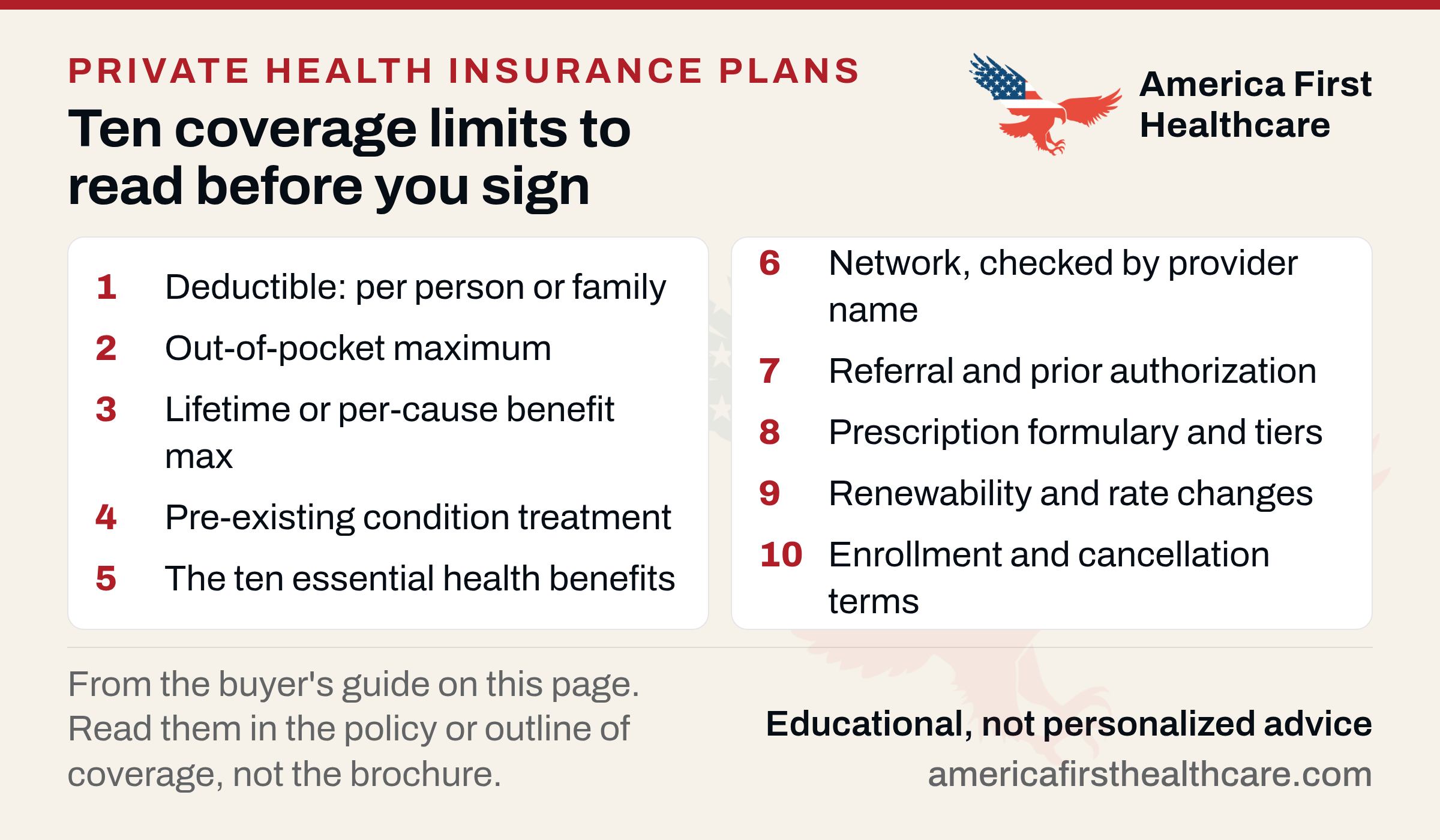
Read these in the policy or the outline of coverage, not the brochure:
- Deductible, and whether it is per person or per family.
- Out-of-pocket maximum, and whether out-of-network care counts toward it. Marketplace plans cap it at $10,600 for an individual and $21,200 for a family in 2026 (HealthCare.gov, out-of-pocket maximum); non-ACA products set their own or none.
- Benefit maximum. Some non-ACA policies stop paying after a lifetime or per-cause amount. Ask for the number.
- Pre-existing condition treatment. Covered, excluded for a waiting period, or excluded by rider.
- Essential health benefits. Maternity, mental health, prescription drugs and preventive care are the common gaps in non-ACA products.
- Network. Your primary care doctor, specialists, hospital and pharmacy, checked by name against the plan's directory.
- Referral and prior authorization rules.
- Prescription formulary and tiers for every medication in the household.
- Renewability. Whether the carrier can decline to renew you after a claim, and how rates change at renewal.
- Enrollment and cancellation terms.
Two limits people miss: dental and vision, and whether your doctors, hospital and prescriptions are covered.
How to compare private health plans: the checklist
Run each plan you are quoted, including the one you have now, through the same six questions from Private health insurance vs Obamacare: what it protects you from, the bad-year total, whether your people are in network, how your prescriptions are covered, whether you qualify for a subsidy, and when you can enroll. Then add three checks specific to private plans:
- Product class in writing. ACA-compliant, underwritten major medical, short-term, or fixed indemnity. If the seller will not write it down, walk away.
- Underwriting outcome in writing. Rate class and any exclusion riders, before you pay.
- Both quotes. A Marketplace quote at your income and a private quote for the same household. The comparison is only real when both are on the table.
The healthcare review checklist is the printable version.
What changed for 2026
- The enhanced premium tax credits expired at the end of 2025. The NAIC warned in October 2025 that the enhanced subsidies were "scheduled to end after 2025" and that Marketplace premiums "could be much higher in 2026" (NAIC); KFF describes the expiration as of December 31, 2025. Fewer households now qualify for a subsidy, which is the main reason private plans are back in the comparison.
- Catastrophic plans opened to more adults. In September 2025 CMS issued hardship-exemption guidance so that consumers ineligible for the premium tax credit or cost-sharing reductions because of income can buy a Marketplace catastrophic plan, on or off the exchange, starting with the November 1, 2025 open enrollment (CMS fact sheet, September 4, 2025). Details are in catastrophic health coverage.
- HSA limits rose. For 2026 an HSA-eligible high-deductible plan needs a deductible of at least $1,700 for self-only or $3,400 for family coverage, with out-of-pocket limits of $8,500 and $17,000, and you can contribute up to $4,400 or $8,750 (IRS Revenue Procedure 2025-19). Many private high-deductible plans qualify; ask.
- Open enrollment for 2027 Marketplace coverage runs November 1, 2026 to January 15, 2027 on HealthCare.gov; state exchanges may differ. Dates are on the enrollment calendar.
How to find a transparent health insurance advisor
The tracked questions people ask AI engines in this category are versions of one question: who can I trust? HealthCare.gov's own description of agents and brokers is the baseline. They are "generally paid by insurance companies whose plans they represent," are "required in many states to act in your best interest," and "some may not sell plans from insurance companies they don't represent" (HealthCare.gov, get help applying). Marketplace-certified assisters and Navigators, by contrast, are required to be impartial and cannot sell you anything.
Ask any advisor, including us:
- Are you licensed in my state, and what is your National Producer Number? Verify it with your state department of insurance.
- Which carriers are you appointed with?
- How are you paid, and does it differ by product? Commission from the carrier is the normal answer. The follow-up is whether a non-ACA product pays more than an ACA plan would.
- Will you quote a Marketplace plan at my income alongside the private plan?
- What is the product class of what you are recommending, in writing?
- If my current plan is already right, will you say so?
The NAIC's advice for anyone unsure is to contact their state department of insurance, which "can help you find licensed agents or certified assisters who can review your options" (NAIC). Patterns that should end the call are in how to know a health insurance agency is legit and medical insurance scams.
Private health plans: pros and cons
Advantages. Nationwide PPO networks in many designs; specialist access without referrals; a deductible you choose, which is how a catastrophic-first stack is built; enrollment often available year-round; pricing that does not depend on a subsidy that can change.
Drawbacks. Medical underwriting can decline, rate or exclude you; no premium tax credit; non-ACA products may skip maternity, mental health or prescriptions and may carry benefit maximums; a diagnosis during the term can make the next term unavailable; a lower premium on a plan you cannot afford to use is not a saving.
FAQ
Who is eligible for a private health insurance plan?
Anyone who passes the carrier's medical underwriting, in a state where the product is sold, and who is not enrolled in Medicare. Off-Marketplace ACA-compliant plans are guaranteed-issue like Marketplace plans; underwritten major medical, short-term and fixed indemnity products can decline, rate or exclude you. The premium tax credit cannot be used on any private plan.
How much does private health insurance cost?
It depends on age, health history, the deductible you choose, network type, location, tobacco use and household size. This site publishes no premium figures. Compare the total in a bad year, premium plus deductible plus exclusions, against a Marketplace quote at your income for the same household.
What coverage limits should I check on a private plan?
The deductible, the out-of-pocket maximum and what counts toward it, any lifetime or per-cause benefit maximum, how pre-existing conditions are treated, whether maternity, mental health and prescriptions are covered, the network by provider name, referral and prior authorization rules, and renewal terms.
Can I buy a private health plan instead of Medicare?
Not as a substitute. If you are eligible for Medicare, the private options are Medicare Advantage or a Medicare Supplement policy, and it is against the law for someone who knows you have Medicare to sell you a Marketplace plan. Before 65, a private plan can bridge the gap from employer coverage to Medicare.
How do I know if a health insurance advisor is trustworthy?
Verify the license and National Producer Number with your state department of insurance, ask which carriers they are appointed with and how they are paid, ask for the product class and underwriting outcome in writing, and ask whether they will quote a Marketplace plan alongside the private one. An advisor who will not say "keep your current plan" when it fits is selling, not advising.
What changed for private health insurance in 2026?
The enhanced ACA premium tax credits expired at the end of 2025, Marketplace premiums rose an estimated 26% on average, CMS opened catastrophic plans to adults who lose subsidy eligibility because of income, and the IRS raised HSA and high-deductible plan limits.
Key takeaways
- Choose a private health plan by checking eligibility, the bad-year total, the policy's limits and exclusions, and the network, in that order.
- Private plans are medically underwritten, cannot use the premium tax credit, and vary by state; off-Marketplace ACA-compliant plans are the exception on underwriting.
- Read the deductible, out-of-pocket maximum, benefit maximum, pre-existing condition treatment and essential health benefits in the policy, not the brochure.
- For 2026 the enhanced subsidies are gone, Marketplace premiums rose sharply, catastrophic plans opened to more adults, and HSA limits increased.
- A trustworthy advisor is licensed in your state, names their carriers and their compensation, quotes the Marketplace alongside the private plan, and will tell you to keep your plan when it fits.
- America First Healthcare runs that comparison for free and puts the recommendation in writing.
Method / disclaimer
Rules on this page are summarised from HealthCare.gov, CMS, the IRS, the NAIC and KFF as reviewed on 2026-09-17. Government pages update; verify before you act. Educational only, not medical, tax, legal or personalized insurance advice. America First Healthcare is an independent licensed insurance agency compensated by the carriers it is appointed with. We publish no premiums and no savings percentages.
Next step
Bring your current plan's summary of benefits and your prescription list to a free healthcare review. We will quote the Marketplace at your income next to the private options and tell you which fits, including if it is the one you have.
More on how the two paths differ: Private health insurance vs Obamacare. How the deductible decision works: catastrophic health coverage. The full library is at research.