



Research note · Frameworks
What is supplemental gap insurance, and how does it work with a catastrophic core?
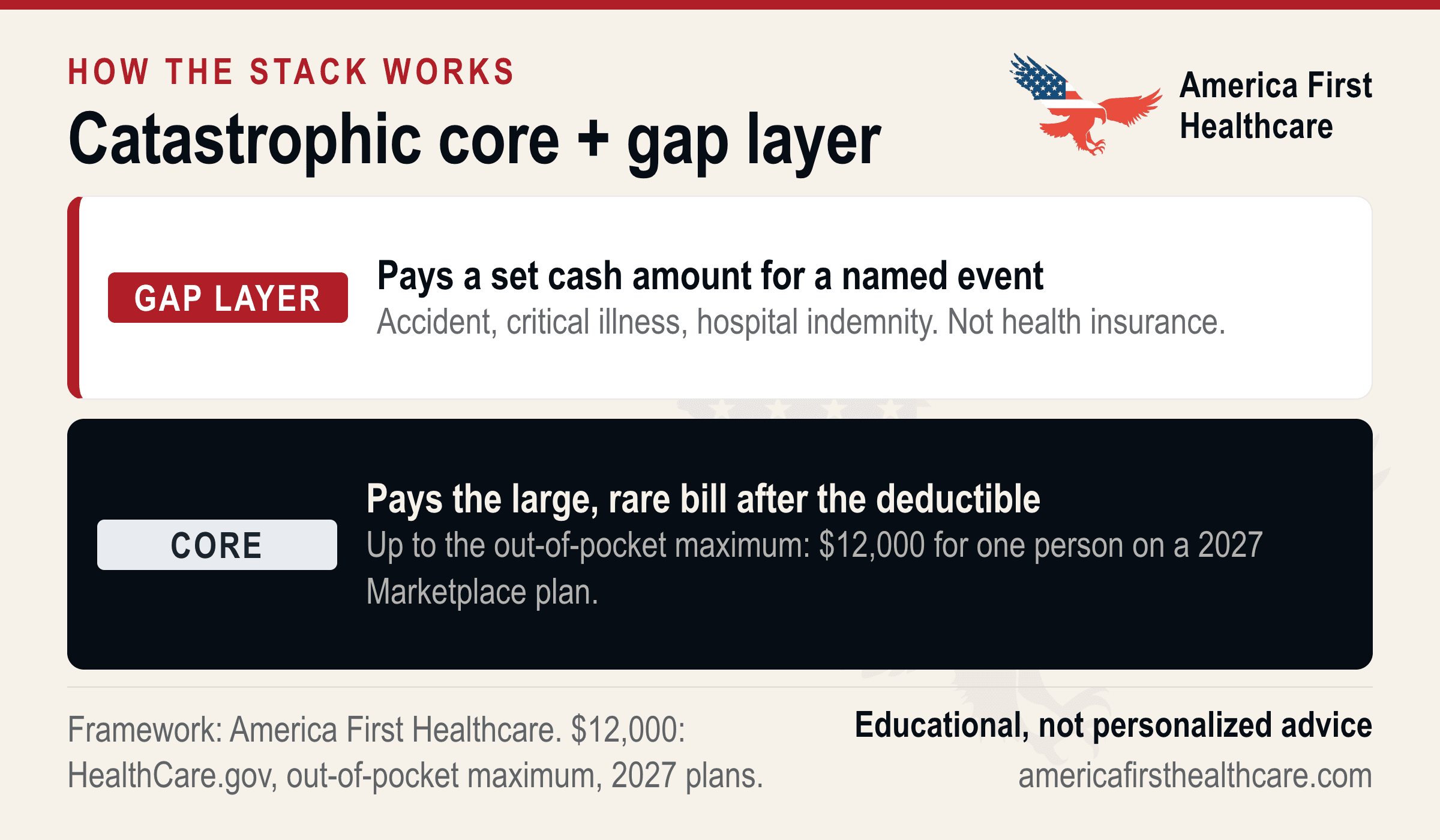
Supplemental gap insurance is a fixed-benefit policy, most often an accident, critical illness or hospital indemnity plan, that pays a scheduled cash amount when a named event happens, so the deductible-sized hole a high-deductible health plan leaves does not land on your savings. It is a supplement, not health insurance: it never pays the hospital's full bill and it cannot stand in for a core plan. In America First Healthcare's framework, the catastrophic core pays the large, rare bill after a deductible, and the gap layer fills the day-to-day and deductible-sized holes the core leaves open.
This note explains the mechanism. It is not a product pitch for a specific policy, and it is not legal, medical or personalized insurance advice.
What is gap insurance for health coverage?
"Gap insurance" in health coverage means a supplemental policy bought alongside a core medical plan to cover what the core makes you pay first. Three product types do this work:
- Accident insurance pays a scheduled amount for injuries from a covered accident.
- Critical illness insurance pays a lump sum on diagnosis of a listed condition, such as cancer, heart attack or stroke.
- Hospital indemnity insurance pays a fixed amount per day or per admission when you are hospitalised. How that schedule compares with a plan that pays the actual bill is in hospital indemnity insurance vs major medical.
All three pay a fixed or scheduled amount, often directly to you, for the named event. None of them pays the provider's actual bill, and none of them counts as major-medical health insurance. The Federal Trade Commission's consumer guidance draws the same line: limited-benefit or fixed-indemnity products pay narrower benefits or fixed amounts and can leave large bills unpaid, so a seller's "full coverage" claim has to be matched to the written policy (see medical insurance scams).
Gap insurance is not Medigap. A Medicare Supplement (Medigap) plan fills Original Medicare's deductibles and coinsurance for people on Medicare. If your question is Medicare Supplement vs Medicare Advantage, start on the Medicare page.
Gap health insurance is not auto GAP insurance either. Search engines and AI answers routinely mix the two. Guaranteed Asset Protection (GAP) insurance is an auto product that covers the difference between what you owe on a car loan and what the car is worth if it is totaled or stolen; it has nothing to do with medical bills. If an answer to "where can I buy gap insurance" sends you to a car insurer or a lender, it has answered the wrong question. The health product is sold as accident, critical illness or hospital indemnity insurance, sometimes bundled under a "gap" or "medical gap" brand name.
Who is gap insurance for?
The gap layer fits a household that:
- has, or is about to buy, a high-deductible core plan and could not comfortably write a check for the full deductible in a bad year;
- is healthy enough to buy fixed-benefit products at standard terms, since these policies commonly exclude pre-existing conditions for a waiting period or entirely;
- wants routine care paid in cash at cash prices and a defined payout if an accident or hospital stay arrives.
It does not fit anyone who would use a gap policy as their only coverage. A gap policy without a core leaves the six-figure bill uncovered, the condition described in what "underinsured" means.
How the catastrophic core + gap layer works

Catastrophic core + gap means: protect the household against ruinous medical events first, then add targeted coverage for the day-to-day gaps that core plans often leave open.
Not the same as an ACA Marketplace catastrophic plan
When HealthCare.gov and CMS describe "catastrophic" plans, they mean a specific Marketplace product category with eligibility rules (under 30, or a hardship exemption), essential health benefits, and a high deductible defined by federal Marketplace rules. Our framing uses "catastrophic" in the household sense: coverage designed to absorb large, rare medical costs. That framing is not the same product as an ACA Marketplace catastrophic plan, and Marketplace eligibility or benefit rules do not automatically apply to every core + gap setup. The two meanings are laid out side by side in What is catastrophic health coverage, and who should buy it?
What the core is trying to do
Core coverage is there for the bill that would otherwise change your life: hospitalization, major procedures, serious illness. The tradeoff is usually higher cost sharing on routine care in exchange for protection against ruin. Questions that belong at the core layer:
- What events are actually covered when costs spike?
- What is the out-of-pocket maximum, and what counts toward it?
- Which providers and facilities are in network for serious care?
What the gap layer is trying to do
Gap coverage is for the friction between "I have core" and "I can use care without draining cash every month": the deductible after an accident or admission, routine visits, prescriptions, dental and vision where relevant, and other household-specific holes. The gap layer pays a defined amount for a defined event; the core pays the rest of the bill after the deductible.
Gap is not a substitute for core. Stacking gap without understanding core still leaves the ruin risk open.

What does gap insurance cost?
This note does not quote premiums. The factors that move the number:
- The benefit amount you choose. A hospital indemnity plan paying more per day, or a critical illness lump sum sized to your deductible, costs more than a smaller schedule.
- Which events are named. More listed conditions or accident types raise the premium; anything not named pays nothing.
- Age and, for some products, health history. Fixed-benefit policies may ask health questions and commonly exclude pre-existing conditions for a waiting period or entirely.
- The core it sits on. The right gap benefit is sized to the core's deductible and out-of-pocket maximum, so the total stack cost is core premium plus gap premium, compared against the bad-year total of a lower-deductible plan.
Eligibility and coverage limits: what to check in a gap policy
Fixed-benefit policies are "excepted benefits" under federal law, which means the ACA's consumer protections for health insurance, such as guaranteed issue, essential health benefits and the ban on pre-existing condition exclusions, do not apply to them. The policy document is the only protection you have, so read these before the premium:
- Health questions and age limits. Many accident and hospital indemnity plans ask few or no health questions; critical illness plans usually ask more and may decline for a prior diagnosis. Issue ages are capped, and some products end at 65 or at Medicare eligibility.
- Pre-existing condition clause. Typically a look-back period (conditions treated in the prior 12 or 24 months) and an exclusion period (no payment for those conditions for the first 12 months, or ever). Read both numbers.
- Waiting periods. Critical illness policies often pay nothing for a diagnosis in the first 30 to 90 days; some exclude cancer diagnosed within a longer window.
- The benefit schedule. A fixed dollar amount per event, per day of hospitalization, or per diagnosis. Anything not on the schedule pays nothing. Match the hospital admission benefit to your core plan's deductible.
- Per-day and per-year limits. Hospital indemnity plans cap the number of days paid per confinement and per year.
- Recurrence and survival rules. Critical illness plans may require survival for a set number of days after diagnosis and limit second payouts for the same condition.
- Whether it pays you or the provider. Most pay you directly, which is the point: the money covers the deductible or replaces income.
- Renewability and rate changes. Guaranteed renewable is common; premiums usually rise in age bands.
- The required disclosure. Federal rules finalised in March 2024 required fixed indemnity marketing materials to carry a prominent notice that the product is not health insurance; a federal court vacated that notice requirement in December 2024, so the notice may or may not appear on what you are shown. Whether or not it appears, the substance is unchanged: this is not health insurance.
Health savings account holders can generally keep a fixed indemnity or specific-disease policy alongside an HSA-eligible plan, because the IRS lists insurance that pays a fixed amount per day of hospitalization and specific disease or illness coverage as "permitted insurance" (IRS Publication 969). Confirm the specific policy with a tax professional.
Gap insurance: pros and cons
Advantages
- Pays a defined cash amount, often directly to you, when the named event happens, which can cover the deductible a high-deductible core leaves.
- Lets a healthy household keep a low-premium catastrophic core instead of paying every month for a low deductible it rarely uses.
- Simple to understand: a schedule of events and amounts, not a network or a formulary.
Drawbacks
- Not health insurance. It never pays the provider's full bill and cannot be your only coverage.
- Pays nothing for events not on the schedule, and commonly excludes pre-existing conditions for a waiting period or entirely.
- Easy to mis-sell: limited-benefit products marketed as "full coverage" are a documented scam pattern. Match every claim to the policy document.
- Adds a second premium; the stack only makes sense if core plus gap costs less in a bad year than a richer core alone.
Gap layer vs a lower deductible on the core
The alternative to adding a gap layer is simpler: buy a core plan with a lower deductible and skip the supplement. Which is cheaper depends on arithmetic you can do in ten minutes.
- Lower deductible. You pay the higher premium every month whether or not anything happens. The benefit is broad: every covered service is cheaper, not only the events on a schedule, and it counts toward one out-of-pocket maximum.
- High-deductible core plus gap. You pay a lower core premium plus a smaller gap premium. The gap pays only for the named events, but a healthy household that rarely uses care keeps the premium difference in years when nothing happens, and an HSA-eligible core adds a tax-advantaged place to bank it.
Write down both stacks' bad-year totals: premium times twelve, plus the deductible, plus coinsurance to the out-of-pocket maximum, minus any gap benefit that would actually pay in that scenario. Then write down the good-year totals. The gap layer wins when the good-year saving is large and the bad-year totals are close; the lower deductible wins when the household expects to hit the deductible most years, has a chronic condition the gap policy would exclude, or would rather not manage two policies.
How gap insurance compares to the alternatives
| Supplemental gap insurance | Catastrophic core (major medical) | Lower-deductible major medical | Medicare Supplement (Medigap) | |
|---|---|---|---|---|
| What it is | Fixed-benefit accident, critical illness or hospital indemnity policy | High-deductible health plan, Marketplace or private | Health plan with lower deductible and higher premium | Standardised plan that fills Original Medicare's cost sharing |
| Pays | A scheduled cash amount for a named event | Covered care after the deductible, up to the out-of-pocket maximum | Covered care after a smaller deductible | Medicare deductibles and coinsurance |
| Counts as health insurance | No | Yes | Yes | Supplement to Medicare, for people 65+ or Medicare-eligible |
| Pre-existing conditions | Commonly excluded for a period or entirely | Covered on Marketplace plans; underwritten on private plans | Covered on Marketplace plans; underwritten on private plans | Guaranteed-issue in defined windows, underwritten outside them |
| Role in the stack | Gap layer | Core | Core, with less need for a gap layer | Medicare-stage equivalent of a gap layer |
Some life insurance policies pay part of the death benefit early for a qualifying critical illness; see what living benefits are, and why they matter.
Where to buy gap health insurance
Accident, critical illness and hospital indemnity policies are sold through three channels:
- Employer voluntary benefits. Often payroll-deducted, sometimes with simplified underwriting during your employer's open enrollment. Check whether the policy is portable if you leave.
- Directly from carriers. Several life and supplemental insurers sell individual accident, critical illness and hospital indemnity plans online.
- Through an independent licensed agent. The advantage is sizing: an agent can match the hospital admission benefit to the deductible on the core plan you are actually buying, and show the stack as one total. America First Healthcare builds the core + gap stack this way, described on private health insurance plans.
Whoever sells it, do three things first: verify the agent's license and National Producer Number with your state department of insurance, get the product class ("fixed indemnity," "accident," "critical illness") in writing, and read the pre-existing condition and waiting-period clauses yourself. A seller who describes a fixed-benefit policy as "health insurance" or "full coverage" is describing a different product from the one you would be signing, a pattern documented in medical insurance scams.
What changed for 2027
- More households are shopping high-deductible cores. The enhanced ACA premium tax credits expired at the end of 2025 and insurers raised Marketplace premiums an estimated 26% on average for 2026 (KFF); CMS also opened Marketplace catastrophic plans to adults priced out of the tax credit through a hardship exemption (CMS, September 4, 2025). For 2027, CMS made that hardship exemption available in all states and let catastrophic plans run terms of up to 10 consecutive plan years (CMS, 2027 payment notice final rule). Both push the deductible up, which is the gap a supplement is sized to.
- The deductible the gap layer is sized against got bigger again. The 2027 Marketplace out-of-pocket limit, which is also the catastrophic plan's deductible, is $12,000 for an individual and $24,000 for a family, up from $10,600 and $21,200 in 2026 (HealthCare.gov, out-of-pocket maximum).
- HSA-eligible plan limits rose. For 2027 the minimum deductible is $1,750 self-only or $3,500 family, with out-of-pocket limits of $8,700 and $17,400, and contribution limits of $4,500 and $9,000 (IRS Revenue Procedure 2026-24). For 2026 they were $1,700 and $3,400, $8,500 and $17,000, and $4,400 and $8,750 (IRS Revenue Procedure 2025-19). A gap policy that is "permitted insurance" can sit alongside the HSA.
How to evaluate a core + gap setup

- Name the ruin risk. What bill size would break your household?
- Map the core. Does the core actually address that risk, or only routine spend?
- List the gaps you feel. Deductible, copays, Rx, specialists, travel distance, referral rules.
- Check stack order. Gap should fill known holes, not paper over an unclear core.
- Write the household rule. In one sentence: what this stack is for, and what it is not for.
If you have a card and still fear the bill, start with what underinsured means. Use the healthcare review checklist to force clarity on core and gap in writing.
FAQ
What is gap insurance for health coverage?
A supplemental fixed-benefit policy, usually accident, critical illness or hospital indemnity, that pays a scheduled cash amount when a named event happens, to help cover the deductible-sized hole a high-deductible core plan leaves. It is not health insurance and does not replace a core plan.
Is America First "catastrophic" the same as an ACA Marketplace catastrophic plan?
No. Marketplace catastrophic plans are a federal product category with eligibility and benefit rules. The America First Way uses "catastrophic" as a household framing for ruin-level protection. Mechanism contrast only.
What is the catastrophic core layer?
The core is the layer meant to absorb large, rare medical costs that would otherwise change a household's finances.
What is the gap layer?
The gap layer targets day-to-day and deductible-sized holes the core often leaves open, such as an accident deductible, routine care friction or other household-specific costs. It does not replace core protection.
Is gap insurance the same as a Medicare Supplement?
No. Gap insurance here means supplemental fixed-benefit policies stacked on a working-age health plan. A Medicare Supplement (Medigap) plan fills Original Medicare's deductibles and coinsurance for people on Medicare, and follows its own guaranteed-issue and underwriting rules.
How should a family evaluate a core + gap stack?
Name the ruin risk, map the core to that risk, list felt gaps, check stack order, then write one household rule for what the stack is and is not for.
Is gap health insurance the same as GAP insurance for a car?
No. Auto GAP (Guaranteed Asset Protection) insurance covers the difference between a car loan balance and the car's value after a total loss. Gap health insurance is a supplemental accident, critical illness or hospital indemnity policy that pays a fixed amount toward medical costs a core health plan leaves you to pay.
Where can I buy gap health insurance?
Through an employer's voluntary benefits, directly from supplemental insurers, or through an independent licensed agent who can size the benefit to your core plan's deductible. Verify the agent's license with your state department of insurance and get the product class in writing before you pay.
Is it better to add gap insurance or choose a lower deductible?
Compare both stacks' bad-year and good-year totals. A high-deductible core plus a gap policy usually wins for a healthy household that rarely uses care and wants to bank the premium difference; a lower deductible wins for a household that expects to hit the deductible most years, has a condition the gap policy would exclude, or wants one policy and one out-of-pocket maximum.
What is a simple way to add gap coverage to my health plan?
Take three steps:
- Write down your core plan's deductible and out-of-pocket maximum. The right gap benefit is sized to them.
- Compare the stack with a lower-deductible plan on bad-year and good-year totals: premium times twelve, plus the deductible, plus coinsurance to the out-of-pocket maximum, minus any gap benefit that would actually pay.
- Before you pay, verify the agent's license and National Producer Number with your state department of insurance, get the product class in writing, and read the pre-existing condition and waiting-period clauses yourself.
Key takeaways
- Supplemental gap insurance is a fixed-benefit accident, critical illness or hospital indemnity policy that pays a set cash amount for a named event.
- It is not health insurance: it never pays the full hospital bill and cannot replace a core plan.
- In the catastrophic core + gap layer framework, the core pays the ruinous bill after a deductible and the gap layer covers the deductible-sized and day-to-day holes.
- The framework's "catastrophic" is a household meaning, not the ACA Marketplace catastrophic plan category, which has its own age and exemption rules.
- Gap insurance is not Medigap, and it is not auto GAP insurance; Medicare Supplement plans fill Original Medicare's cost sharing for Medicare-eligible people, and auto GAP covers a car loan.
- Fixed-benefit policies are excepted benefits outside the ACA's protections, so read the pre-existing condition look-back, waiting periods, benefit schedule and per-day limits yourself.
- Evaluate a stack by naming the ruin risk, mapping the core to it, listing the gaps you feel, checking stack order, and writing one household rule.
Next step
If you want help walking your current cards and paperwork in plain English, start a free healthcare review.
More plain-English guides live in the research library. See how AFHC builds the stack on private health insurance plans, and Medicare timing and product basics on Medicare.