



Research note · Definitions
What "underinsured" means (and how to tell if you are)
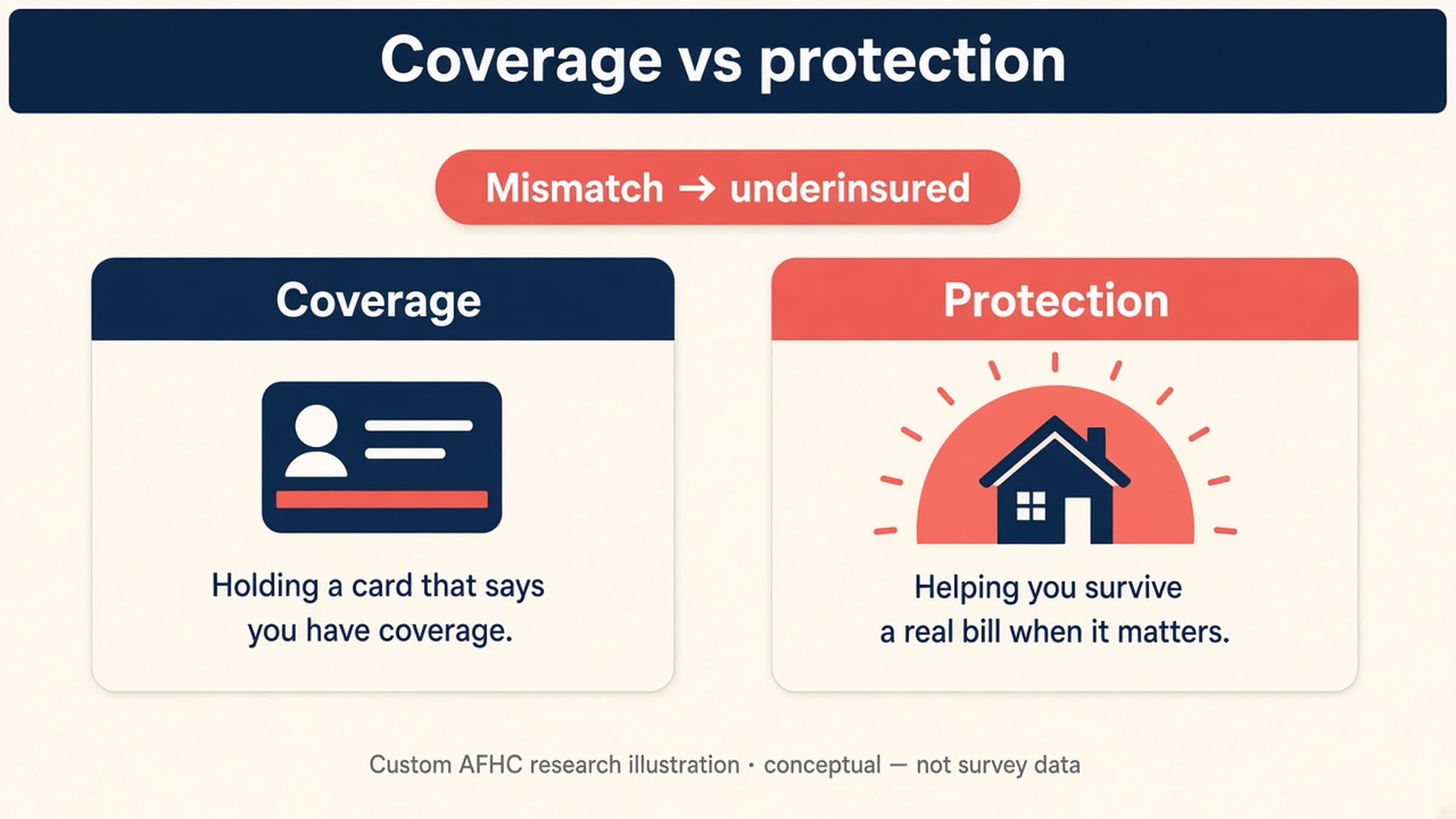
Underinsured means you have health insurance, but the plan's deductible and other out-of-pocket costs are so large, relative to your income and savings, that a serious medical bill would still damage your household finances. You have a card. The card does not protect you. That mismatch is the whole definition.
Below: the plain-English definition, the measured definition researchers use, underinsured vs uninsured vs the auto-insurance term, a five-question self-check, and what to do about it. Educational only, not medical, legal, or personalized insurance advice.

Underinsured definition in plain English
To be underinsured, two things must both be true:
- You have coverage in force. A health plan is active and you are paying the premium, or someone pays it for you.
- The plan makes you pay an amount first that you cannot pay. The deductible, copays, and coinsurance you owe before and after the plan pays are large compared with your income or your cash savings.
If only the first is true, you are insured and protected. If neither is true, you are uninsured. Underinsured is the middle state: enrolled, but exposed.
The word is an adjective. A person or a household is underinsured. The plan is not; the people who rely on it are.
The number that usually causes the problem is the deductible. That is the amount you pay for covered care before the plan starts to pay. If the deductible is larger than the cash you could raise in a bad month, a single hospital stay turns into debt, delayed care, or both. The mechanism is explained below.
The measured definition: how the Commonwealth Fund counts underinsured adults
Researchers need a yes-or-no rule, so the Commonwealth Fund's Biennial Health Insurance Survey defines "underinsured" with three thresholds. An adult who was insured all year counts as underinsured if at least one of these is true (Commonwealth Fund, 2024 Biennial Health Insurance Survey exhibits):
- Out-of-pocket costs over the prior 12 months, excluding premiums, equaled 10 percent or more of household income.
- Out-of-pocket costs, excluding premiums, equaled 5 percent or more of household income for a household with income under 200 percent of the federal poverty level.
- The deductible equaled 5 percent or more of household income.
Two details matter. Premiums do not count; the test is about what you pay when you use care. And the deductible test looks at the plan's design, not at what you spent, so a household can be underinsured in a year when nobody got sick.
An illustration of the arithmetic, not a survey figure: a household with $60,000 of income crosses the deductible threshold at a $3,000 deductible, and crosses the out-of-pocket threshold after $6,000 of medical spending in a year.
How many Americans are underinsured
The latest published edition is the 2024 survey, fielded between March and June 2024 with a nationally representative sample of adults ages 18 to 64 (Commonwealth Fund news release, November 21, 2024). Among adults ages 19 to 64 it found:
- 23 percent were insured all year but underinsured.
- 12 percent were insured at the time of the survey but had a coverage gap during the year.
- 9 percent were uninsured at the time of the survey.
- 56 percent were insured all year and not underinsured (exhibits).
Of the underinsured adults, two-thirds (66 percent) had coverage through an employer, 14 percent had individual or Marketplace plans, and 11 percent were enrolled in Medicaid. More than half (57 percent) reported going without care because of cost, and 44 percent said they carry medical debt (news release).
Why deductibles drive the number
Deductibles are now the norm in job-based plans. In KFF's 2025 Employer Health Benefits Survey, 88 percent of covered workers with single coverage had a general annual deductible, the average deductible for those workers was $1,886, and 34 percent of covered workers were in a plan with a single-coverage deductible of $2,000 or more (KFF, 2025 Employer Health Benefits Survey).
Marketplace plans set a legal ceiling on what you can pay for covered in-network care in a year. HealthCare.gov lists the out-of-pocket maximum as $10,600 for an individual and $21,200 for a family for the 2026 plan year, rising to $12,000 and $24,000 for 2027. Premiums, out-of-network care, and services the plan does not cover sit outside that limit (HealthCare.gov, out-of-pocket maximum). A plan can be fully legal and still leave a family on the hook for a five-figure sum.
Underinsured vs uninsured vs "underinsured" in auto insurance
The same word appears in three places, and search results mix them up.
| Term | What it means | Where you meet it |
|---|---|---|
| Uninsured | No health coverage in force. Every bill is yours. | Health insurance |
| Underinsured | Health coverage in force, but the deductible and out-of-pocket costs are too large for your income or savings. | Health insurance (this page) |
| Underinsured motorist coverage | Part of an auto policy. It pays your injury costs when the at-fault driver has liability limits too low to cover them. | Auto insurance |
Underinsured motorist coverage has nothing to do with your health plan. Its rules vary by state, so check your auto policy or your state department of insurance. If an answer to "what does underinsured mean" talks about an at-fault driver, it is answering the auto question.

Why a deductible you cannot pay is the mechanism
Health insurance works in layers. You pay the deductible first. Then you share costs through copays and coinsurance. Then you reach the out-of-pocket maximum and the plan pays 100 percent of covered in-network care for the rest of the year. The terms are worked through with numbers in deductible, copay, coinsurance, and out-of-pocket max examples.
The problem is the order. The deductible comes first, and it comes all at once. A household that could pay $200 a month toward a bill cannot always pay $4,000 in week one. When the first layer is unaffordable, three things follow:
- Care gets delayed. The scan, the follow-up, or the prescription waits, because the first dollars are yours.
- Debt replaces coverage. The hospital bills you for the deductible, and the balance goes on a card or a payment plan.
- The plan's real protection never activates. The out-of-pocket maximum only helps if you can get through the deductible to reach it.
This is why the measured definition tests the deductible against income even when no claim happened. The gap exists on day one.
Household framing vs survey measurement
AFHC talks with families in household terms: the deductible relative to your cash buffer, network and referral friction, and what happens after a serious claim. The Commonwealth Fund and KFF measure "underinsured" with survey rules built for population research. The two are not the same, and we do not present their prevalence rates as AFHC claims. If you cite a national rate, cite the source, the year, and the method.
The five-question self-check

Ask these five questions before you call coverage "enough."
- Cash buffer: If you hit the deductible and the out-of-pocket maximum this year, does your household still function?
- Access friction: Can you see the doctors and facilities you actually use without surprise denials or referral dead ends?
- After a claim: Do you understand what the plan pays, what you pay, and in what order?
- Card vs match: Did you choose this plan because it fits your household, or because it was the cheapest card available?
- Costs outside the plan: What sits outside the plan entirely: out-of-network care, excluded services, dental, vision, or a second deductible on a separate policy?
If any answer is "I don't know," treat that as a review signal, not a failure.
If answers are unclear, walk the healthcare review checklist.
What to do if you are underinsured
Being underinsured is a design problem, not a character flaw. The fix is to change the design.
- Write down three numbers. Your plan's deductible, its out-of-pocket maximum, and your household income. Compare the first two with the thresholds above and with the cash you could raise in a bad month.
- Name which layer is missing. If a six-figure hospital bill would break you, the problem is the core. If the core is fine but the deductible would break you, the problem is the gap below it. What is catastrophic health coverage, and who should buy it? explains the core layer. Catastrophic core + gap explains how a fixed-benefit gap layer can be sized to the deductible.
- Learn the cost words before you shop. Worked examples show how deductible, copay, coinsurance, and out-of-pocket maximum move the bad-year total.
- Check the calendar. Most plan changes happen in a window. See the OE and Medicare AEP calendar and the 2027 out-of-pocket limits and Open Enrollment dates.
- Screen every pitch. A cheap card can be a mislabeled product. Check it against medical insurance scams before you pay.
- Get a structured review. A free healthcare review walks your current cards, deductible, and household numbers in plain English. It is a conversation, not a hard sell.
Related research
- Browse the research library.
- See how matching works in catastrophic core + gap.
- Use the healthcare review checklist when answers are unclear.
- Check windows on the OE and Medicare AEP calendar.
- See the 2027 out-of-pocket limits and Open Enrollment dates.
- Screen a pitch with medical insurance scams.
- Paying cash for a test or visit? Read what self-pay patients should know.
FAQ
What does underinsured mean?
Underinsured means you have health insurance, but the plan's deductible and out-of-pocket costs are too large for your income or savings to absorb. You are enrolled, but a serious bill would still hurt your household.
What is the difference between uninsured and underinsured?
Uninsured means you have no health coverage in force. Underinsured means you have coverage, but the costs the plan makes you pay first can still leave your household exposed when something goes wrong.
Can I be underinsured if I have an insurance card?
Yes. A card shows you enrolled in something. It does not prove the plan matches your household cash buffer, network needs, or claim exposure. The Commonwealth Fund's 2024 survey found that 23 percent of insured working-age adults were underinsured, and two-thirds of them had employer coverage.
How is "underinsured" measured?
The Commonwealth Fund counts an insured adult as underinsured if out-of-pocket costs excluding premiums reached 10 percent or more of household income (5 percent for households under 200 percent of the federal poverty level), or if the deductible alone was 5 percent or more of household income. The latest published rate is 23 percent of adults ages 19 to 64 in 2024.
Is "underinsured" the same as underinsured motorist coverage?
No. Underinsured motorist coverage is part of an auto policy. It pays your injury costs when the driver who hit you has liability limits that are too low. It has nothing to do with your health plan's deductible.
Does AFHC use the same underinsured definition as KFF or Commonwealth Fund?
No. Those organizations use survey measurement rules for population research. AFHC uses a household framing for family conversations. We cite their rates with the year and method, and we do not present them as AFHC claims.
Key takeaways
- Underinsured means insured but exposed: the deductible and out-of-pocket costs are too large for your income or savings.
- The Commonwealth Fund's measured definition uses three thresholds: out-of-pocket costs of 10 percent or more of income, 5 percent for lower-income households, or a deductible of 5 percent or more of income.
- In the 2024 survey, 23 percent of adults ages 19 to 64 were insured all year but underinsured, and 66 percent of them had employer coverage.
- Underinsured is not uninsured, and it is not underinsured motorist coverage on a car policy.
- The deductible is the mechanism. It comes first and all at once, and a plan's real protection never activates if you cannot get through it.
- Use the five-question self-check, then fix the missing layer: the core for the ruinous bill, or the gap for the deductible.
Next step
If you want a structured walkthrough of your current setup, use our free healthcare review. It is a conversation, not a hard sell.
More plain-English guides live in the research library.
For shorter articles and news, browse Resources.
See how AFHC works with families on Our services.
Medicare timing and product basics: Medicare.