



Resources · Coverage Basics
Hospital indemnity insurance vs major medical: what does it really pay?
The short answer
Hospital indemnity insurance is a type of fixed indemnity coverage: it pays you a set dollar amount, such as a flat sum when you are admitted and a daily amount for each day you stay, regardless of what the hospital actually bills. The federal agencies that oversee it describe it as a form of income replacement that is "not a substitute for comprehensive coverage" (CMS, March 28, 2024 fact sheet). It is not major medical, it does not pay the hospital, and the check can be a small fraction of the bill. It can make sense as a second layer on top of major medical, to help with a deductible or lost income. As your only coverage, it leaves you exposed to almost all of a large hospital bill.
This post compares the two side by side. For the full guide to hospital indemnity insurance, including how the benefit schedule works, who it fits, HSA and tax rules and what drives the cost, read that page first.
What is a fixed indemnity plan?
"Indemnity" here means a scheduled cash benefit. The policy lists events (an admission, a day in the hospital, sometimes a specific service) and a dollar amount for each. When the event happens and you file a claim, the insurer pays that amount, usually to you.
CMS explains the rules plainly. In the group market, payments must be a fixed dollar amount per day or other period of hospitalization or illness, for example $100 per day. In the individual market, payments can also be per service, for example $50 per medical exam. Either way, "benefits must be paid regardless of the amount of expenses a consumer incurs," and you can use the money for anything, including rent (CMS fact sheet).
Is this insurance or a supplement?
It is an insurance policy, but federal law treats one that meets those payment rules as an "excepted benefit," "not subject to the federal requirements or consumer protections that apply to comprehensive coverage" (same source). In practice it is a supplement: something you add, not something that pays a hospital.
How a hospital indemnity plan pays
A made-up example, so the arithmetic is visible. None of these numbers comes from a real policy or a real bill.
| Made-up policy schedule | Amount |
|---|---|
| Admission benefit, once per inpatient stay | $1,500 |
| Daily benefit, per day of inpatient confinement | $200 |
| Maximum days paid per stay | 30 |
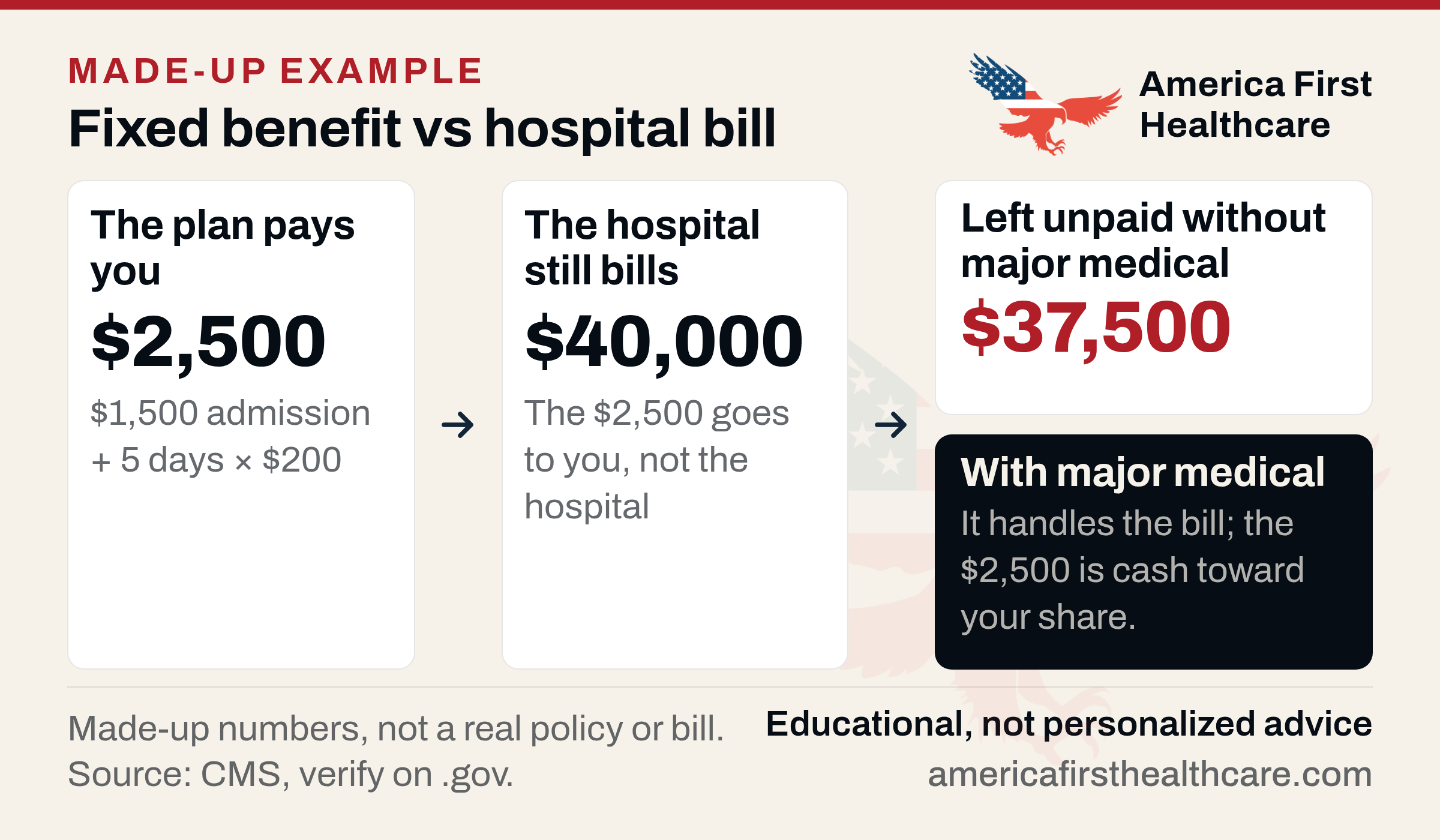
Say you are admitted for five days and the hospital's bill comes to $40,000.
- The plan pays $1,500 for the admission plus 5 × $200 = $1,000 in daily benefit, so $2,500 in total.
- The hospital still bills $40,000. The $2,500 goes to you, not to the hospital, and does not reduce the bill.
- Without major medical, you owe the hospital $40,000 and have $2,500 to put toward it: $37,500 left unpaid.
- With a major medical plan, that plan handles the bill under its own deductible, coinsurance and out-of-pocket maximum. The $2,500 is cash you can use toward your share.
How the deductible, coinsurance and out-of-pocket maximum work on major medical is shown step by step in deductible, copay, coinsurance and out-of-pocket max, with examples.
So they pay a lump sum when I'm in the hospital, then so much a day after that?
That is the usual shape: an admission benefit, then a daily amount, up to a maximum number of days. It pays you; it does not look at the bill.
If I'm in the hospital for ten days, is it basically paid for?
Run the made-up schedule: $1,500 + 10 × $200 = $3,500. A ten-day bill can be many times that. Whether it is "paid for" depends on whether you also have major medical.
Who covers critical care if I'm in the hospital more than 30 days?
Once you pass the policy's maximum days, the daily benefit stops. Some policies pay a separate ICU benefit or offer one as a rider. The bill itself, for every day, is covered only by major medical, if you have it.
Fixed indemnity vs major medical
| Fixed / hospital indemnity | Major medical (ACA Marketplace plan) | |
|---|---|---|
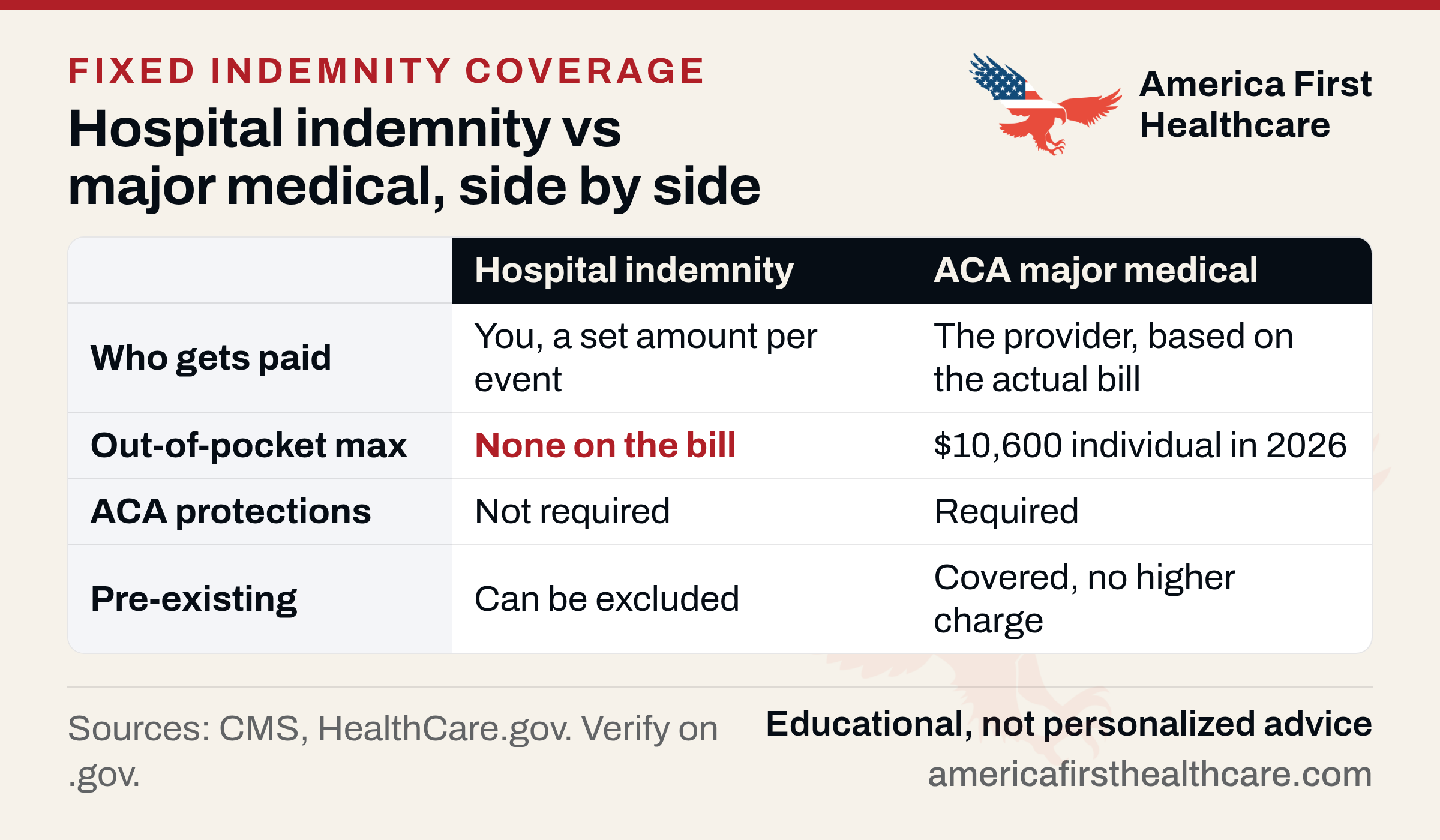
| Who gets paid | You, a set amount per event | The provider, based on the actual bill |
| Out-of-pocket maximum | None on the bill; the plan's own benefit caps apply | For 2026, no more than $10,600 individual / $21,200 family for covered in-network care (HealthCare.gov) |
| ACA consumer protections | Not required; it is an excepted benefit (CMS) | Required, including no yearly or lifetime dollar limits on essential health benefits (HealthCare.gov) |
| Pre-existing conditions | Can be excluded | Covered, no higher charge (HealthCare.gov) |
| Pregnancy and childbirth | Can be excluded or limited | Covered from the day the plan starts (same source) |
| Networks | Generally no network rules; check the policy | Network rules decide what you pay |
What it does not do
Because these policies sit outside the ACA's market rules, insurers can "exclude coverage for preexisting conditions, impose annual or lifetime limits, opt not to cover entire categories of benefits, or rescind coverage altogether," as Georgetown's Health Care Litigation Tracker summarises (Georgetown Law). In practice, a fixed indemnity plan:
- Does not pay the hospital, the surgeon or the anesthesiologist.
- Does not cap what you owe on the bill.
- Is not required to cover the ten essential health benefits that every Marketplace plan must, such as prescription drugs, maternity care and mental health services (HealthCare.gov).
- May pay nothing, or a smaller amount, if you were kept under observation instead of admitted (see the checklist below).
If someone calls one of these plans "full coverage," check the written policy. Warning signs are in medical insurance scams: what to watch for.
Routine checkups and screenings are a separate question; see preventive care on and off the Marketplace.
When it makes sense and when it does not
As a supplement to major medical, a hospital indemnity policy can do a real job. A high-deductible plan protects you from the ruin-level bill but leaves the deductible to you, and a hospital stay is when that deductible arrives, sometimes with lost wages. A fixed cash benefit can help. This is the gap layer in our framework, the America First structure: catastrophic core + gap layer: a fixed-benefit policy stacked on top of major medical, never used instead of it. How to choose that core is covered on catastrophic health coverage.
As your only coverage, it does not make sense for most households. The made-up example left $37,500 unpaid after one five-day stay. A household with a pre-existing condition, a planned pregnancy or ongoing prescriptions is especially exposed, because those are what these policies can exclude.
If a pregnancy is part of the picture, see which health plans cover pregnancy and birth.
Is it an add-on to regular insurance, or does it replace it?
An add-on. CMS says fixed indemnity coverage "is not a substitute for comprehensive coverage" and that the consumer notice rules were meant to keep people from buying it "as an alternative to, or replacement for, comprehensive coverage" (CMS).
The federal notice and what changed in 2025
On March 28, 2024, the Departments of Health and Human Services, Labor and the Treasury finalised rules that revised the consumer notice for individual-market fixed indemnity coverage and added one for the group market. The notice was designed "to highlight the differences between fixed indemnity excepted benefits coverage and comprehensive coverage" and was to appear in marketing, application and enrollment materials for plan years beginning on or after January 1, 2025 (CMS fact sheet).
Insurers challenged the notice in court. On December 4, 2024, a federal district court in the Eastern District of Texas vacated the rule's fixed indemnity notice provisions, so those notice requirements no longer apply for now (NFP summary, January 14, 2025; case docket, Georgetown Law).
Separately, on August 7, 2025, the Departments said that until new rulemaking they do not intend to prioritize enforcement of the 2024 rules' definition of short-term, limited-duration insurance, including its notice provision (U.S. Department of Labor). That statement is about short-term plans; it does not mention fixed indemnity coverage.
What this means for you: the federal notice may or may not appear on what you are shown. Insurance is still regulated state by state (NAIC), so your state's rules still apply, and your state department of insurance can tell you what they are. With or without a notice, the substance is the same: this is not comprehensive health coverage.
Questions to ask before you buy
Ask for the written policy or outline of coverage, and get answers to these:
- Benefit per day. How much per day of inpatient stay, and does it change after a certain day?
- First-day or admission benefit. Is there one, and is it paid once per stay or once per year?
- Maximum days. How many days per stay and per year does it pay?
- Waiting periods. How long after the policy starts before a hospital stay or an illness is eligible?
- Pre-existing condition exclusions. Which conditions are excluded, and for how long?
- Admission vs observation. How does the policy define a covered hospital stay? Medicare, for comparison, treats a patient under observation as an outpatient "even if you spend the night in the hospital" (Medicare.gov). If the policy requires a formal inpatient admission, an observation stay may pay nothing.
- Other coverage. Does it pay in full on top of your major medical plan, or does it reduce its benefit if another plan pays?
- Claims. How do you file, what proof does the insurer need (itemised bill, discharge papers), and how long does payment take?
- Renewability. Can the insurer cancel the policy or raise its rate for your class, and at what age does it end?
Our healthcare review checklist puts these alongside the questions for your core plan.
How AFHC handles this
America First Healthcare is an independent licensed agency. In a free 15-minute review, a licensed advisor looks at the coverage you have and anything you are considering, and we say in writing which category each plan is in: ACA major medical, underwritten major medical, short-term, or fixed indemnity. If a hospital indemnity policy fits on top of your core plan, we show you its schedule and exclusions. If it does not fit, we say so. Start with a free healthcare review. For how this compares with other paths, see private health insurance vs Obamacare. To see what clients say about working with us, including the critical reviews, read America First Healthcare reviews.
Frequently asked questions
What is a fixed indemnity plan?
A fixed indemnity plan is an insurance policy that pays a set dollar amount when a listed event happens, such as $100 for each day in the hospital, regardless of what the care actually costs. Hospital indemnity insurance is one kind. Federal agencies describe it as income replacement that is not a substitute for comprehensive coverage.
Does the hospital give a cash discount and then the insurance reimburses me?
No. A fixed indemnity plan does not reimburse the bill or negotiate with the hospital. It pays you its scheduled amount after you file a claim with proof of the stay, whatever the hospital charged. Any cash price or discount is a separate conversation between you and the hospital.
Is hospital indemnity insurance the same as major medical?
No. Major medical pays providers based on the actual bill and, on the ACA Marketplace, caps your yearly share of covered in-network costs at $10,600 for an individual in 2026. Hospital indemnity pays you a fixed amount and has no cap on what you owe the hospital.
What's covered before I reach the deductible?
On a major medical plan, you generally pay for covered care until you meet the deductible, though some preventive services are free (HealthCare.gov). A fixed indemnity plan does not track your deductible: it pays its scheduled amount when a covered event happens, subject to its own waiting periods, exclusions and limits. That is why some people pair the two.
Does hospital indemnity insurance cover pre-existing conditions?
It may not. Fixed indemnity policies are not bound by the ACA's pre-existing condition protections, so they can exclude a condition you already have, sometimes for a set period after the policy starts. Read the exclusions section before you buy, and ask for the exclusion period in writing.
Will a hospital indemnity plan actually pay when I use it?
It pays when the event matches the policy's definition and falls within its limits. A claim can pay less than expected because of an observation stay that did not count as an admission, a waiting period, a pre-existing condition exclusion, or reaching the maximum days. Check those four items before you buy.