



Resources · Coverage Basics
The most common health insurance questions, answered
After helping thousands of American families compare coverage, the same questions come up again and again. Here they are, most common first, each with a short answer and a guide that goes deeper. Facts come from HealthCare.gov, CMS and other primary sources, linked in each guide. How we ranked the questions is at the end.
Frequently asked questions
How much does health insurance cost per month?
It depends on your age, where you live, who is on the plan and the plan you pick, so any single number quoted for everyone is a guess. On the Marketplace, savings are based on your estimated income for the year you want coverage, and HealthCare.gov says you get exact prices and savings only when you fill out an application. See when is Open Enrollment for 2027? for how tax credits work now, and why health insurance costs keep rising.
What happens if I end up in the hospital?
On ACA major medical, you pay your deductible and coinsurance up to the plan's out-of-pocket maximum, which for a 2027 Marketplace plan is no more than $12,000 for one person or $24,000 for a family ($10,600 and $21,200 in 2026, per HealthCare.gov); after that the plan pays covered in-network care in full. A fixed indemnity plan is different: it pays you a set amount per day or event and does not cap what you owe the hospital. See hospital indemnity insurance vs major medical.
Does health insurance cover dental and vision?
Most adult health plans do not include dental or vision, so adults usually buy them separately. Children's dental and vision work differently, and so does Medicare. See does health insurance cover dental and vision?
Will my prescriptions be covered?
Only if they are on the plan's drug list, and the tier decides what you pay. Check each medicine by name, strength and dose on the plan's own formulary before you enroll. See check your doctor, hospital and prescriptions before you buy.
What is a deductible, and what is covered before I meet it?
The deductible is what you pay for covered services each year before the plan starts to pay. On Marketplace plans and many other plans, listed preventive care, such as screening mammograms and colorectal cancer screening, is covered without a copay even before you meet it. See deductible, copay, coinsurance and out-of-pocket max, with examples and does health insurance cover preventive care?
Can I keep my doctor?
Only if your doctor, and the hospital you would use, are in the plan's network. Look them up in the carrier's provider directory for the exact plan, then call the office to confirm. See check your doctor, hospital and prescriptions before you buy.
When can I sign up for health insurance?
Marketplace Open Enrollment for 2027 coverage runs November 1, 2026 to January 15, 2027; enroll by December 15 for coverage that starts January 1. Outside that window you need a Special Enrollment Period, for example after losing other coverage, and Medicaid and CHIP take applications all year. See when is Open Enrollment for 2027?
Does health insurance cover pregnancy?
Marketplace plans cover pregnancy and childbirth, including when you were already pregnant before the plan started. Short-term plans, fixed indemnity and health sharing programs can exclude or limit it. See health insurance and pregnancy: which plans cover maternity.
Are pre-existing conditions covered?
Marketplace plans cannot refuse you or charge you more because of a pre-existing condition. Short-term plans are not bound by that rule and can exclude conditions you already have. See private health insurance vs Obamacare.
What are my options if I lose my job or retire before 65?
You can usually choose between COBRA, a Marketplace plan through a Special Enrollment Period, a spouse's plan or a private plan, and the clock starts when your coverage ends. See losing employer coverage and health insurance for early retirees.
What are my options if I am self-employed?
A Marketplace plan (the only place the premium tax credit applies), a private plan bought outside the Marketplace, a health sharing program, or a spouse's employer plan. See health insurance for the self-employed and the self-employed health insurance deduction.
How do I know if a health insurance agency is legitimate?
Look the agent up by name on the NIPR license lookup or with your state department of insurance, and get the plan documents in writing before you pay. See how to know a health insurance agency is legit and common health insurance scams.
More guides by topic
- Costs: deductibles and out-of-pocket max, preventive care, 2027 Open Enrollment, paying cash and disputing a bill
- Coverage: dental and vision, pregnancy, doctors and prescriptions
- Types of plan: private health insurance in the USA, every type explained, hospital indemnity, private vs Obamacare, health share vs insurance, catastrophic coverage, how to choose a private plan
- Your situation: losing employer coverage, early retirees, self-employed, small business owners, Medicare advisors
How AFHC can help
America First Healthcare is an independent licensed agency. If your question is not here, ask it in a free healthcare review with a licensed advisor. To see what clients say about us, including the critical reviews, read America First Healthcare reviews.
How we know which questions come up most
We counted the topics in our free healthcare review calls from September 2026. The monthly price came up most, in 64% of calls, then a hospital or ER bill (47%), dental (45%), prescriptions (43%) and the deductible (41%).
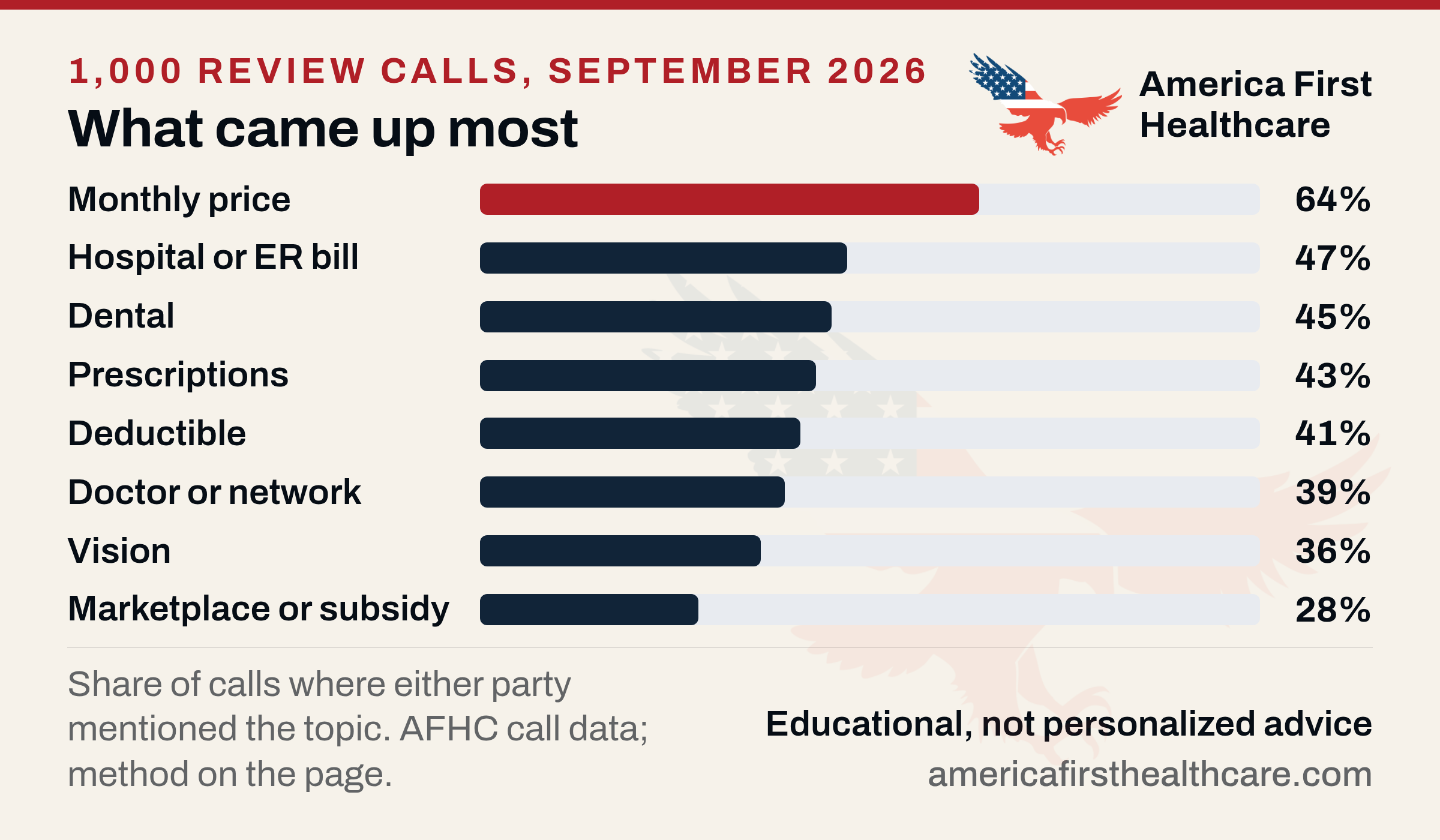
Every topic, by share of review calls
| Topic | Calls (of 1,000) | Share |
|---|---|---|
| Monthly price | 638 | 64% |
| Hospital or ER bill | 473 | 47% |
| Dental | 449 | 45% |
| Prescriptions | 426 | 43% |
| Deductible | 408 | 41% |
| Doctor or network | 385 | 39% |
| Vision | 358 | 36% |
| Marketplace or subsidy | 283 | 28% |
| Employer plan | 236 | 24% |
| Cancelling or switching a plan | 201 | 20% |
| Cancer | 179 | 18% |
| Heart | 178 | 18% |
| Surgery | 165 | 17% |
| Medicare | 156 | 16% |
| Catastrophic coverage | 153 | 15% |
| Pregnancy | 138 | 14% |
| Retiring before 65 | 125 | 13% |
| Pre-existing conditions | 111 | 11% |
| Medicaid | 109 | 11% |
| PPO | 107 | 11% |
| A claim denied or not paid | 95 | 10% |
| Diabetes | 89 | 9% |
| Self-employed | 88 | 9% |
| Health sharing | 79 | 8% |
| COBRA | 54 | 5% |
| GLP-1 medications | 36 | 4% |
| Scams, or whether a company is legitimate | 32 | 3% |
One call can mention many topics, so the shares add up to far more than 100%.
Method
- Calls. Recorded free healthcare review calls handled through our CRM (GoHighLevel), from September 2026. For each contact we took the longest call, and only calls of at least 5 minutes (300 seconds). That gave 1,000 calls. The extract was run on September 23, 2026.
- Privacy. Transcripts were redacted before analysis, and only aggregate counts left the analysis machine. No transcript text, name or detail that could identify a caller is published here or stored in our website's code.
- Counting. Each call was checked for mentions of each topic in the table. A call counts once per topic, however many times it came up. Shares are calls with the topic divided by 1,000, rounded to the nearest whole percent.
- What was left out. Dollar amounts (they mix what callers reported with what advisors quoted, so they are not reliable enough to publish). A "cards and paperwork" topic (inflated by payment-card talk). Any quote that could identify a person.
Limits
- Either party counts. The split between caller and advisor speech is automated and leaks, so the counts mean "came up in at least this many calls," not "callers asked."
- Topic matching is automated. It can miss a topic phrased unusually or count a passing mention. Treat the numbers as close, not exact.
- One month, one company. September 2026, callers who booked with America First Healthcare. Seasonality and our own advertising shape who calls.
- Longer calls only. Calls under 5 minutes are excluded, which leans toward fuller conversations.
If you cite these numbers, cite them as "America First Healthcare review calls, September 2026 (n=1,000); share of calls in which the topic came up."