



Resources · Coverage Basics
Health insurance and pregnancy: which plans cover maternity and birth
The short answer
Every Marketplace plan and every Medicaid plan covers pregnancy and childbirth, even if the pregnancy began before the coverage started (HealthCare.gov, coverage if you're pregnant). Pregnancy, maternity and newborn care are one of the ten essential health benefits every Marketplace plan must include (HealthCare.gov, what Marketplace plans cover). Short-term plans, fixed indemnity policies and health-share programs are not held to those rules, and some of them exclude or limit pregnancy, including some fixed-benefit and health-share options we present. Being pregnant does not open a Special Enrollment Period on the Marketplace, but the birth of a baby does (same HealthCare.gov source). If you are expecting or planning a pregnancy, get maternity coverage confirmed in writing before you buy.
This guide is educational. It is not medical advice, and it is not a promise about any specific policy.
Does this plan cover pregnancy? It depends on what kind of plan it is
What matters is the plan's category, not its name.
| Plan type | Covers pregnancy and childbirth? | Pregnancy that began before coverage |
|---|---|---|
| Marketplace (ACA) plan | Yes. Maternity and newborn care are essential health benefits (HealthCare.gov) | Covered (HealthCare.gov) |
| ACA-compliant plan bought outside the Marketplace | Yes. All qualified health plans inside and outside the Marketplace must cover maternity and newborn care (HealthCare.gov) | Varies: confirm in writing |
| Employer plan, 15 or more employees | Yes. An employer that offers health insurance must cover pregnancy and childbirth on the same terms as other conditions (EEOC) | A group plan cannot apply a pre-existing condition exclusion to pregnancy (U.S. Department of Labor) |
| Medicaid and CHIP | Yes, for people who qualify (HealthCare.gov) | Covered; you can apply any time of year |
| Private plan that is not ACA-compliant | Varies: confirm in writing. These plans "may not include the same benefits" (NAIC) | Varies: confirm in writing |
| Short-term plan | Not required. Short-term plans are generally not subject to federal requirements for comprehensive coverage (CMS) | Federal law does not stop them excluding pre-existing conditions (same CMS source) |
| Fixed or hospital indemnity | Pays a set cash amount per day or per service if the policy counts the event. It is "not a substitute for comprehensive coverage" (same CMS source) | Varies: confirm in writing |
| Health-share program | Not insurance. Program rules decide what is shared, and payment is not promised (NAIC) | Varies: confirm in writing |
Grandfathered plans are not required to cover essential health benefits (HealthCare.gov), and the employer rule applies to employers with 15 or more employees (EEOC), so confirm a smaller employer's plan.
Fixed indemnity pays a fixed dollar amount, such as a set amount per day in the hospital, regardless of what the bill actually is (CMS). Our guide to hospital indemnity insurance vs major medical explains the difference, and health share vs traditional insurance covers how sharing programs work.
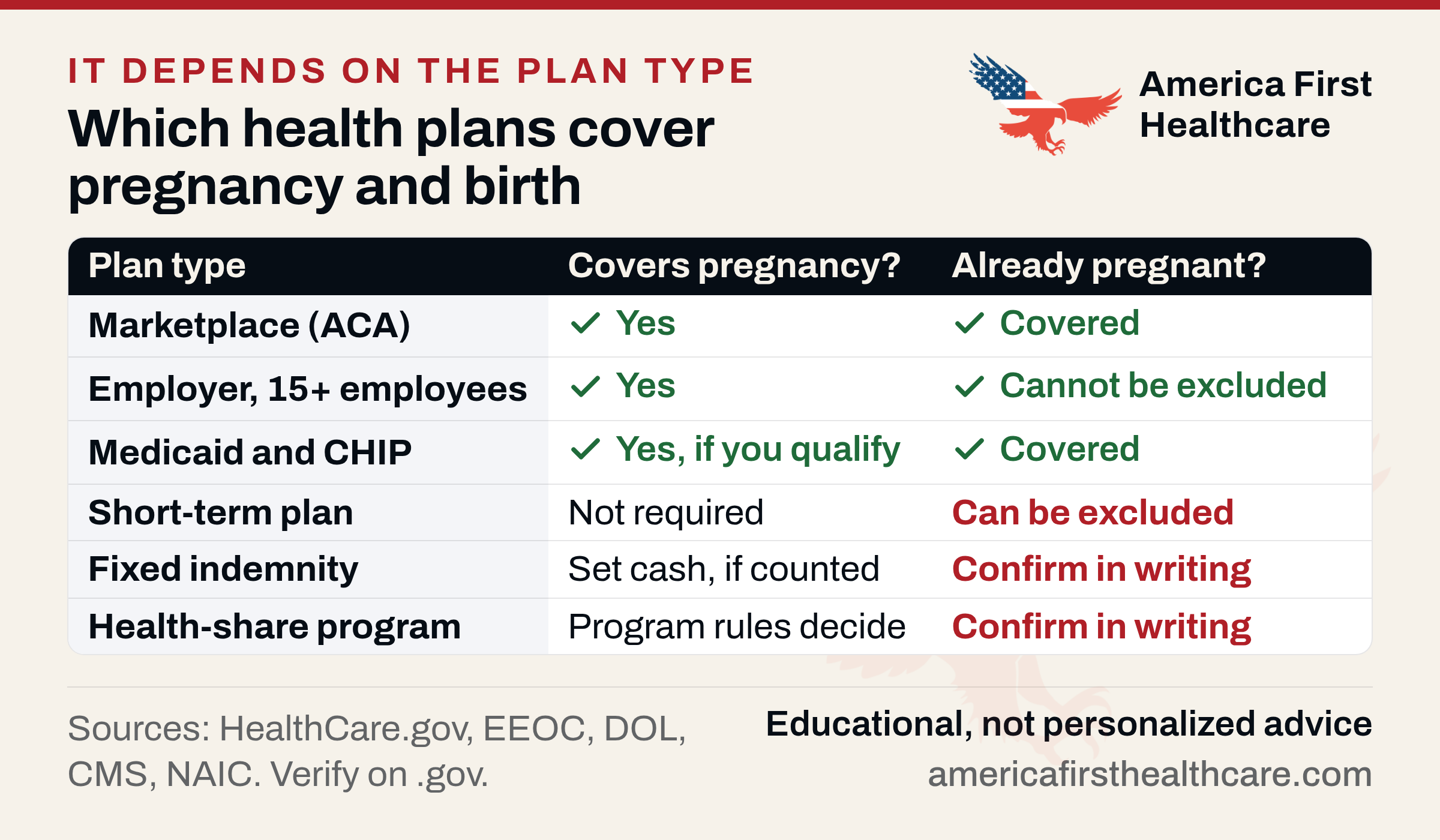
If I enroll after I'm already pregnant, is it covered?
On a Marketplace plan or Medicaid, yes, even if the pregnancy began before coverage started (HealthCare.gov). For employer group plans, the Department of Labor says a plan cannot refuse to pay benefits by treating a pregnancy as a pre-existing condition (DOL).
Outside those categories, read the policy's pre-existing condition and maternity sections, not the brochure.
When can you get health insurance while pregnant?
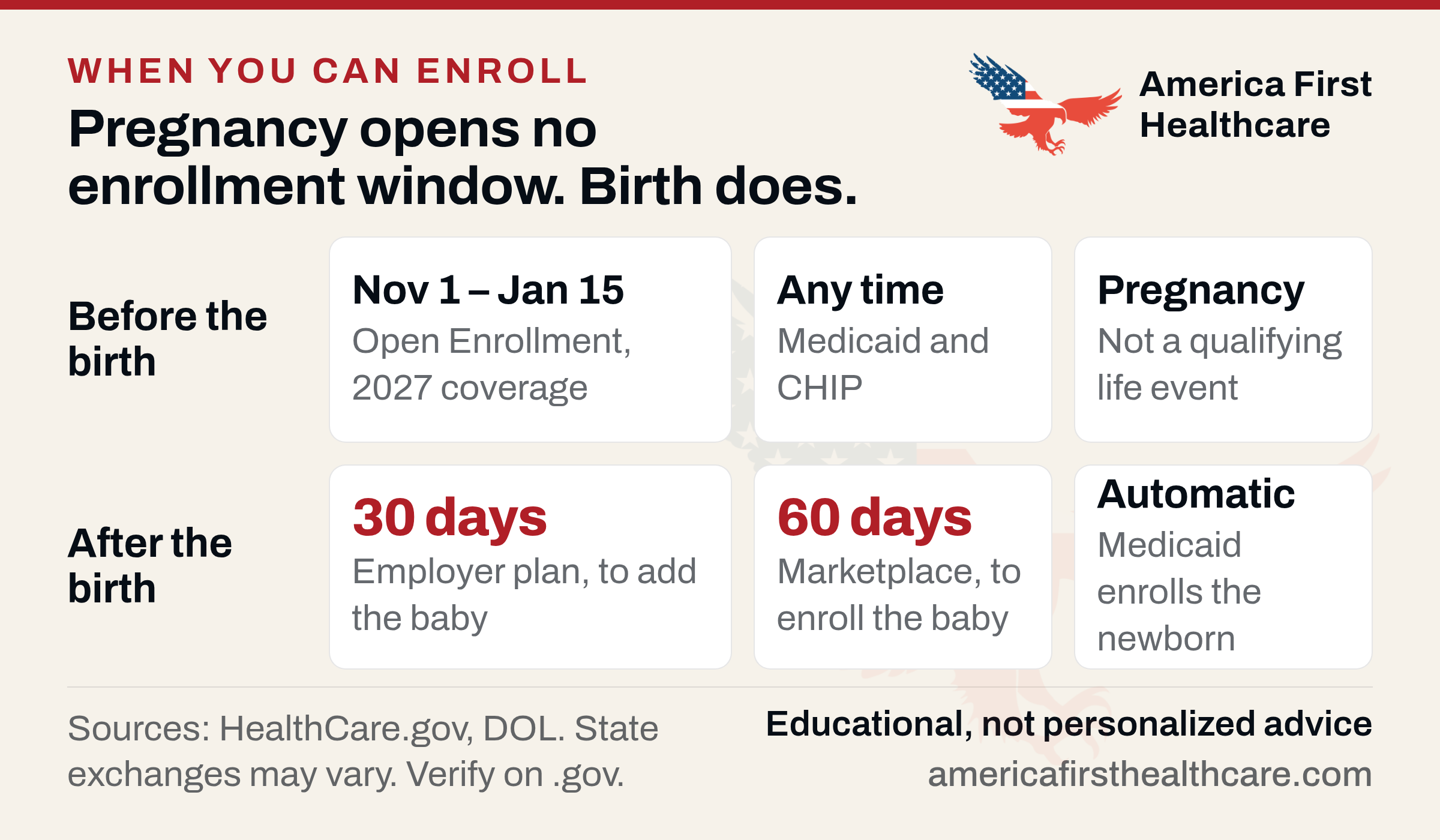
- Marketplace Open Enrollment. For 2027 coverage it runs November 1, 2026 to January 15, 2027. Enroll by December 15 for coverage that starts January 1 (HealthCare.gov, dates and deadlines). If your state runs its own exchange, dates may vary (NAIC).
- Is pregnancy a qualifying life event? Not on HealthCare.gov. "Being pregnant doesn't qualify you for a Special Enrollment Period, but the birth of a child does" (HealthCare.gov). Other events, such as losing coverage, moving or marriage, can still open a window (HealthCare.gov, Special Enrollment Periods).
- Medicaid and CHIP. You can apply any time of year, and if you are eligible, coverage can begin at any time (HealthCare.gov). Rules vary by state, and HealthCare.gov suggests applying even if your income seems too high, because states consider pregnancy (HealthCare.gov, Medicaid and CHIP).
- Employer plans. These follow the employer's enrollment period, plus special enrollment for events such as a birth (see below).
If you already have a Marketplace plan, HealthCare.gov notes that reporting a pregnancy may make you eligible for Medicaid or CHIP, and that if you are found eligible you won't be given the option to keep your Marketplace plan (HealthCare.gov). Full dates for the coming season are on our open enrollment calendar.
Can we insure just the one who is pregnant?
On the Marketplace, your application lists everyone in your tax household, including people who do not need coverage, and you state which members need coverage (HealthCare.gov, who's included in your household). A baby is not included until born; you then have up to 60 days to enroll the baby (same source). Employer plans set their own eligibility rules for spouses and dependents, so check the plan documents.
How do you add a newborn to your insurance?
- Marketplace. Having a baby qualifies you for a Special Enrollment Period. Coverage can start on the day of the birth even if you enroll up to 60 days afterward (HealthCare.gov). If you already have a Marketplace plan, you can add the baby to it, or enroll the baby in a separate plan for the rest of the year (HealthCare.gov).
- Employer plan. Request special enrollment within 30 days of the birth. Coverage is effective as of the date of birth (DOL).
- Medicaid. If you have Medicaid when you give birth, your newborn is automatically enrolled and stays eligible for at least a year. Coverage for the parent lasts at least 60 days after birth, and some states extend it to 12 months (HealthCare.gov).
Group health plans, insurers and HMOs that provide maternity benefits may not limit the hospital stay after childbirth to less than 48 hours after a vaginal delivery or 96 hours after a cesarean (DOL).
Does it have to be that OB? Networks, birthing centers and midwives
- Your OB and the hospital. Check both; your doctor may deliver at a hospital your plan does not include. Out-of-network care does not count toward a plan's out-of-pocket limit (HealthCare.gov glossary). Our step-by-step guide is check your doctor, hospital and prescriptions before you buy.
- Birthing centers and midwives. Ask whether the plan covers them and whether your specific center or midwife is in network. Under Medicaid, nurse-midwife services and freestanding birth center services (when licensed or recognized by the state) are mandatory benefits (Medicaid.gov). For private plans it varies: confirm in writing.
I'm high risk and will need a lot of ultrasounds. What would that cost?
No honest dollar figure exists without the plan in front of you. What decides it is the plan's deductible, copayments and coinsurance, which apply to most covered services on Marketplace plans (HealthCare.gov), and its out-of-pocket maximum. For 2027 Marketplace plans the maximum is no more than $12,000 for an individual or $24,000 for a family for covered in-network care (HealthCare.gov glossary).
Some prenatal screenings are preventive services that Marketplace plans must cover without a copayment or coinsurance when you use an in-network provider, including gestational diabetes screening, hepatitis B screening at the first prenatal visit and Rh incompatibility screening. HealthCare.gov notes that coverage may vary (HealthCare.gov, preventive care for women). For extra imaging or specialist visits, ask whether prior authorization, meaning approval from the plan before the service, is required (HealthCare.gov glossary).
Checklist before you choose a plan
- Get maternity, childbirth and newborn coverage confirmed in writing, including a pregnancy that began before the start date.
- Check your OB, the delivering hospital, and any birthing center or midwife against the network.
- Ask what prenatal visits, screenings and ultrasounds cost after the deductible, whether prior authorization applies, and what the out-of-pocket maximum is.
- Note how and by when to add the baby: 60 days on the Marketplace, 30 days on an employer plan.
- If your income may qualify, apply for Medicaid or CHIP.
My plan didn't cover my pregnancy. What now?
Find out what kind of plan it is and ask for the reason in writing; with a short-term, indemnity or health-share plan, the exclusion may be in the terms you signed. Then look forward: Medicaid and CHIP take applications year-round, the baby's birth opens a Marketplace Special Enrollment Period, and Open Enrollment starts November 1 (HealthCare.gov).
How AFHC handles this
In a free 15-minute review, a licensed advisor asks whether anyone in the household is pregnant or planning to be. If so, we say plainly which options cover maternity and which exclude or limit it, including some fixed-benefit and health-share options we present, and we show the Marketplace alongside them, as in our guide to private PPO vs Obamacare plans. Our advisors are compensated by the carriers we are appointed with. You can decline any recommendation. To see what clients say about working with us, including the critical reviews, read America First Healthcare reviews.
Frequently asked questions
Does health insurance cover pregnancy?
Marketplace plans, ACA-compliant plans bought outside the Marketplace, and Medicaid cover pregnancy and childbirth. Employers with 15 or more employees that offer health insurance must cover pregnancy on the same terms as other conditions. Short-term plans, fixed indemnity policies and health-share programs are not required to, so confirm maternity coverage in writing.
Can you get health insurance while pregnant?
Yes. A Marketplace plan bought during Open Enrollment (November 1 to January 15), or with a Special Enrollment Period from another life event, covers the pregnancy. Medicaid and CHIP accept applications any time of year. Employer plans follow their own enrollment periods.
Is pregnancy a qualifying life event?
Not on HealthCare.gov. Being pregnant does not open a Special Enrollment Period, but the birth of a child does, and you have 60 days after the birth to enroll. If you use a state-run exchange, check its rules.
How long do I have to add my newborn to my plan?
On the Marketplace, up to 60 days after the birth, with coverage that can start on the birth date. On an employer plan, request special enrollment within 30 days; coverage is effective from the birth date. A baby born to a parent on Medicaid is automatically enrolled and stays eligible for at least a year.
Does a fixed indemnity or hospital indemnity plan cover childbirth?
It may pay a set cash amount, such as a fixed amount per hospital day, if the policy counts childbirth as a covered event. That amount does not depend on the actual bill, so it does not pay the hospital's charges, and it is not a substitute for comprehensive coverage.
Does health insurance cover a birthing center or a midwife?
It depends on the plan and the network. Medicaid must cover nurse-midwife services and freestanding birth center services where the state licenses or recognizes them. For other plans, ask whether the service is covered and your specific provider is in network, in writing.