



Resources · Coverage Basics
How to check your doctor, hospital and prescriptions before you buy
The short answer
Get the exact plan name and the exact network name before you check anything, because a carrier can run several networks and a doctor can be in one and not another. Search the carrier's own directory for each doctor and hospital, then call each office and ask whether they take that plan on that network. Look up every drug you take on the plan's formulary (its drug list), note the tier, and check for prior authorization, step therapy and quantity limits. Get the answers in writing before you pay the first premium. This guide is educational; the plan's own documents are what count.
In network vs out of network: what it changes
A network is "the facilities, providers and suppliers your health insurer or plan has contracted with to provide health care services" (HealthCare.gov, network). It decides what you pay, and on some plans whether the plan pays at all (HealthCare.gov, plan and network types):
| Plan type | Out-of-network care | Referral to see a specialist |
|---|---|---|
| HMO | Generally not covered except in an emergency | Often required |
| EPO | Not covered, except in an emergency | Check the plan documents |
| POS | Covered, but you pay less in network | Required from your primary care doctor |
| PPO | Covered at an additional cost | Not required, in or out of network |
A referral is a written order from your primary care doctor to see a specialist; in many HMOs, without one "the plan may not pay for the services" (HealthCare.gov, referral). If you see a specialist or chiropractor regularly, check this rule too.
Can I pick any doctor, or only doctors in my area?
It depends on the plan type. An HMO "may require you to live or work in its service area to be eligible for coverage" (HealthCare.gov); a PPO lets you go outside the network for a higher cost. Out of network, a provider can also balance bill you for the difference between their charge and the plan's allowed amount; an in-network provider may not, for covered services (HealthCare.gov, balance billing).
How to check that your doctor is in network
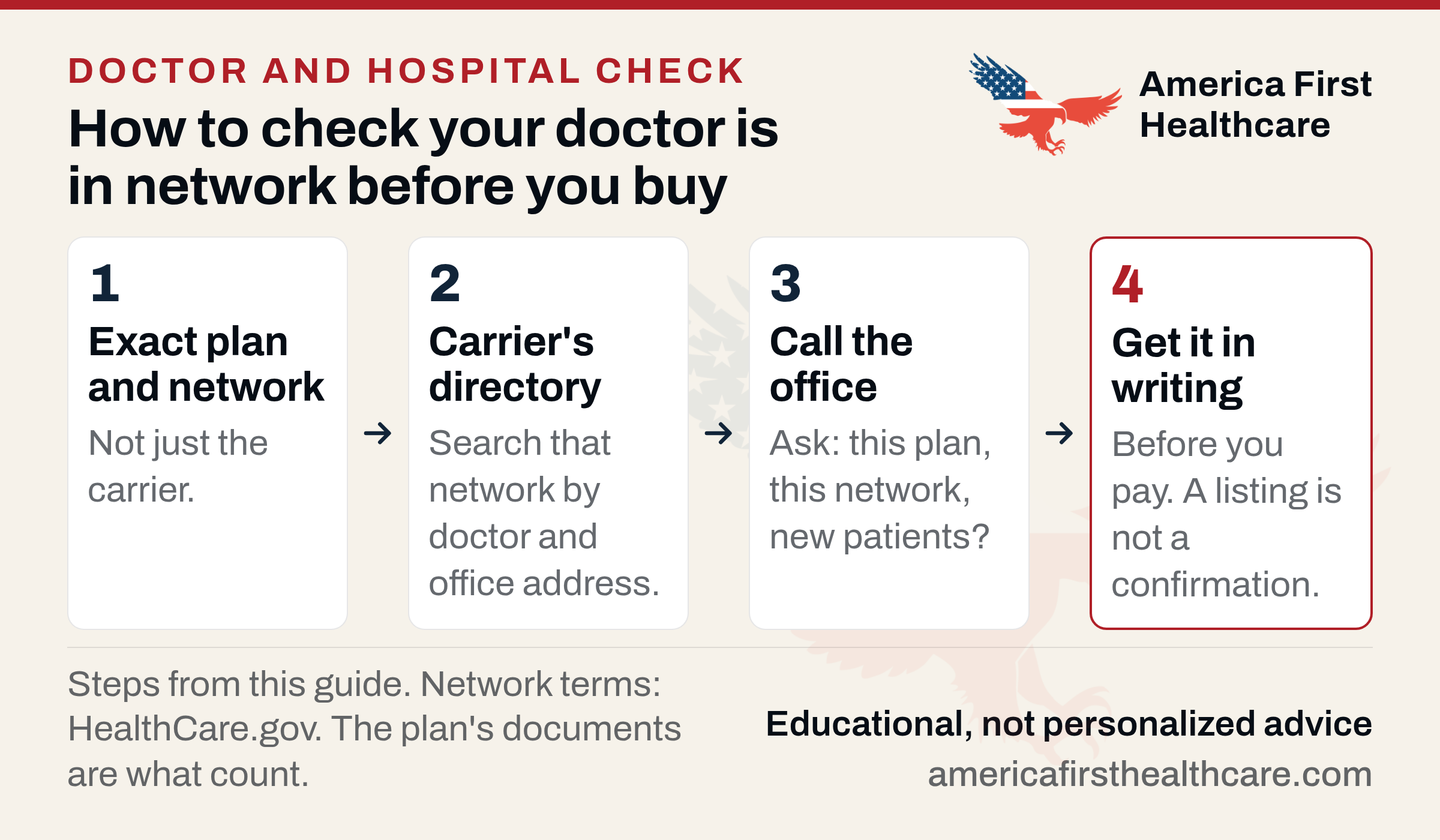
- Get the exact plan and network name, not just the carrier. The network name is what the office looks for.
- Search the carrier's directory for that network, by the doctor's name and by the office address you use. A doctor with several offices may be listed at one and not another.
- Call the office. Ask: "Do you accept [plan name] on the [network name] network, and are you taking new patients on it?" Note the date and who you spoke to.
- Get it confirmed in writing before you pay. A directory listing is a starting point, not a confirmation.
Will the carrier's website show all my in-network doctors?
It shows the carrier's directory for the network you select, so search the wrong network and you get the wrong answer. If the directory and the office disagree, get the carrier to settle it in writing before you enroll.
What if keeping my primary care doctor or OB matters most?
If keeping a specific doctor is the priority, check that doctor before you compare anything else. If a doctor leaves the network during treatment, the No Surprises Act may give "continuing care patients," including people who are pregnant and undergoing treatment, up to 90 days of in-network coverage with that provider (CMS, know your rights with insurance).
How to check a hospital
Run the same steps for the hospital, by name and address, then check the doctors who work there separately. CMS gives the example: "your local hospital may be in-network, but an attending physician might be out-of-network" (CMS). For a planned surgery or delivery, ask which surgeon and other providers will be involved, and check each.
What a formulary is and how drug tiers work
A formulary is "a list of prescription drugs covered by a prescription drug plan or another insurance plan offering prescription drug benefits. Also called a drug list" (HealthCare.gov, formulary). Drugs on the formulary "usually will be less expensive for you" (HealthCare.gov, getting prescription medications).
Many plans sort the list into tiers, and a drug in a lower tier generally costs you less than one in a higher tier. Medicare gives this example, noting that each plan can divide its tiers differently (Medicare.gov, how drug plans work):
- Tier 1: lowest copayment, most generic drugs
- Tier 2: medium copayment, preferred brand-name drugs
- Tier 3: higher copayment, non-preferred brand-name drugs
- Specialty tier: highest copayment, very high-cost drugs
A generic has the same active-ingredient formula as the brand, is rated by the FDA as safe and effective as the brand, and usually costs less (HealthCare.gov, generic drugs). Medicare notes that plans can change their drug lists during the year and must tell you when a change affects your drugs (Medicare.gov).
How to check a prescription before you buy
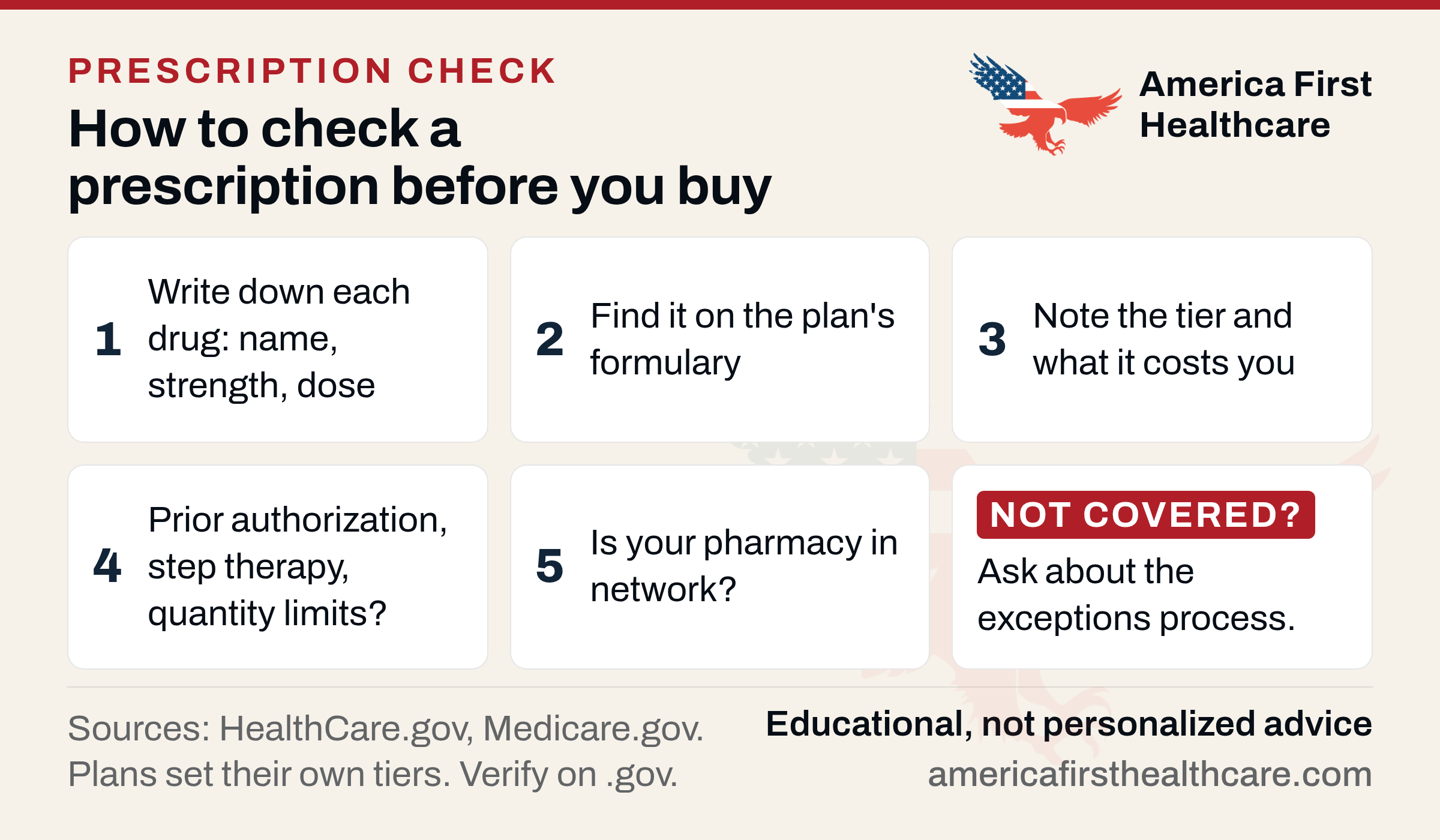
- Write down each drug exactly: name, strength, dose and how often you take it. Note whether you take the brand or a generic.
- Find it on the plan's formulary. HealthCare.gov suggests the insurer's website, the plan's Summary of Benefits and Coverage, or a call to the insurer (HealthCare.gov).
- Note the tier and what that tier costs you, before and after the deductible.
- Check for prior authorization: approval from the plan that may be required before you fill a prescription for it to be covered (HealthCare.gov, prior authorization). Plans may use it when they cover a drug for some medical conditions and not others (Medicare.gov, drug plan rules).
- Check for step therapy, which requires you to try a less expensive drug first before the plan covers a more expensive one (Medicare.gov).
- Check for quantity limits, such as covering only 30 tablets a month (Medicare.gov).
- Check the pharmacy. Different plans use different in-network pharmacies; ask whether yours is one and whether mail delivery is available (HealthCare.gov). For a specialty drug, ask where it must be filled.
Is my GLP-1 covered?
Only the plan's formulary can answer that, and the answer can depend on why it is prescribed. Look the drug up by name, check whether it carries prior authorization and for which conditions, and check whether the plan's documents exclude weight-loss drugs. People with Medicare drug coverage have separate rules: Medicare says a temporary GLP-1 Bridge program covers certain GLP-1 drugs for weight management from July 1, 2026 for eligible people, with a $50 monthly copayment (Medicare.gov, weight loss drugs). Our Medicare page covers Medicare choices.
When a drug isn't covered: the exceptions process
If a drug you need is not on the formulary, you have the right to follow the insurer's drug exceptions process; each plan's process differs, so ask the insurer (HealthCare.gov). Generally, your doctor must confirm that covered alternatives won't work as well or are likely to cause harmful side effects, or that an allowed dose hasn't worked. If granted, the plan generally charges the copayment for the most expensive drugs it already covers, and what you pay generally counts toward your deductible and out-of-pocket maximum.
If the exception is denied, file an internal appeal within 180 days (HealthCare.gov, internal appeals), then, if needed, an external review within 4 months of the final denial. The insurer must accept the external reviewer's decision (HealthCare.gov, external review).
Emergencies and surprise bills: what the No Surprises Act does and does not cover
The No Surprises Act, in effect since January 1, 2022, protects you from unexpected out-of-network bills for emergency room visits, non-emergency care related to a visit to an in-network hospital, hospital outpatient department or ambulatory surgical center, and air ambulance services (CMS). If your plan covers emergency care, you can't be charged more than the in-network cost-sharing for emergency services.
What it does not cover, per CMS:
- Ground ambulance services, unless state law says otherwise.
- Short-term limited duration plans and health care sharing ministry plans.
- Fixed indemnity plans, such as hospital indemnity insurance.
- Care at an out-of-network facility, or at a doctor's office that isn't a hospital outpatient department.
- Care after you sign a notice and consent form, which gives up the protections for that care.
Before signing a consent form, you can call the No Surprises Help Desk at 1-800-985-3059 (CMS).
Plans outside the Marketplace: why you must check in writing
Every Marketplace plan must cover ten essential health benefits, including prescription drugs (HealthCare.gov, what Marketplace plans cover). That rule describes Marketplace plans. A product sold outside the Marketplace may or may not be ACA-compliant; if it is not, don't assume drug coverage, the network you expect, or surprise-billing protection, which CMS says does not extend to short-term plans, sharing ministries or fixed indemnity plans. To compare the paths, see private PPO vs Obamacare plans and how to choose a private health insurance plan.
Questions to ask before you buy
- What is the exact plan name and network name?
- Is each doctor in that network, at my office, and taking new patients?
- Is my hospital in network, and are the doctors who practice there?
- Do I need a referral for a specialist or chiropractor?
- What is covered out of network, if anything?
- Which tier is each of my drugs on, and what will I pay?
- Do any of them need prior authorization or step therapy, or have a quantity limit?
- Is my pharmacy in network, and is mail order available?
- Is this plan ACA-compliant, and is it covered by the No Surprises Act?
- Can I have these answers in writing?
The full version is our healthcare review checklist.
How AFHC handles this
No doctor accepts America First Healthcare, because we are an agency, not an insurer; a doctor accepts the carrier's plan and network (who accepts America First Healthcare). Bring your doctors' names, your hospital and your drug list (name, strength, dose) to a free 15-minute review with a licensed advisor. We check them against the plans you are considering and tell you what we could not confirm. To see what clients say about working with us, including the critical reviews, read America First Healthcare reviews.
Frequently asked questions
What is the difference between in network and out of network?
In network means the provider has a contract with your plan, so you pay the plan's cost-sharing. Out of network, an HMO or EPO generally won't pay except in an emergency, and a PPO pays but you pay more. Out-of-network providers can also balance bill you.
How do I find out if my doctor takes my insurance?
Get the exact plan and network name, search the carrier's directory for that network, then call the office and ask if they accept that plan on that network and are taking new patients. Get the answer in writing before you enroll.
What is a formulary?
A formulary is a plan's list of covered prescription drugs, also called a drug list. Drugs on it usually cost you less than drugs that are not.
What are prescription drug tiers?
Tiers are cost levels on a formulary. A common example is Tier 1 for most generics, Tier 2 for preferred brands, Tier 3 for non-preferred brands, and a specialty tier for very high-cost drugs, but each plan divides its tiers its own way.
What can I do if my plan doesn't cover my medication?
Ask the insurer about its drug exceptions process, and whether it offers a one-time refill in the meantime. Your doctor generally must confirm that covered alternatives won't work as well or would cause harmful side effects. If the exception is denied, you can appeal and then request an external review.
Does the No Surprises Act protect me in an emergency?
For most private health insurance, yes: if your plan covers emergency care, you can't be charged more than in-network cost-sharing for emergency services. It does not cover ground ambulance (unless state law does), short-term plans, sharing ministries or fixed indemnity plans.