




Resources · Health Freedom
Private health insurance vs Obamacare: how do you compare health plans?
The right way to compare health plans is to ask six questions in order: what the plan protects you from, what it costs in a bad year (premium plus deductible plus exclusions), whether your doctors, hospital and pharmacy are in the network, how your prescriptions are covered, whether you qualify for a premium tax credit, and when you can enroll. Private health plans usually win on network breadth, direct specialist access and enrollment timing. ACA Marketplace plans, commonly called Obamacare, win on guaranteed acceptance for pre-existing conditions and on subsidies. Health sharing is a third option and is not insurance.
America First Healthcare reviews all three paths in one free call. This guide is the comparison we walk through, written down so you can run it yourself first.
What are the plan types you are comparing?
The full map of private plan types in the USA, including employer, short-term, indemnity and health sharing, is in private health insurance in the USA.
Private health insurance plans
Private health plans are bought from an insurance carrier or through an independent licensed agency rather than through the government Marketplace. The most common design is the preferred provider organization (PPO): you can see any doctor, with lower costs in network, and you do not need a referral to see a specialist. Depending on the product and state, private plans use medical underwriting, meaning health questions at application, and some are not ACA-compliant and need not cover all ten essential health benefits. Our private health insurance plans page covers the path in depth.
Obamacare (ACA Marketplace) plans
The Affordable Care Act, widely known as Obamacare, was enacted in 2010. Obamacare and the ACA are the same law, not two programs: "Obamacare" is the nickname, "ACA" is the statute, and the Marketplace is the part of the law where its plans are sold. Marketplace plans are sold through HealthCare.gov or a state exchange. Every one must cover the ten essential health benefits, none may reject or surcharge you for a pre-existing condition, and they are the only plans on which the premium tax credit can be used. They are sold in metal tiers, and many use narrower local HMO or EPO networks that require referrals or exclude out-of-network care.
Health sharing
Health sharing programs are member-based communities where participants share eligible medical costs. They are not insurance and are not regulated as insurance. Member sharing is activated only for defined incidents and conditions, which is why the monthly cost can be lower and why they are not appropriate for everyone. Our health share vs traditional insurance guide covers them in detail.
Who is each plan type for?
- A private health plan fits a household that does not qualify for a meaningful premium tax credit, wants a nationwide PPO network, can pass underwriting, and may need to enroll outside the Marketplace window.
- A Marketplace plan fits a household that qualifies for the premium tax credit or cost-sharing reductions, has a pre-existing condition an underwriter would exclude, or is planning a pregnancy.
- Health sharing fits a household that understands it is not insurance, is comfortable with defined sharing rules, and wants the lowest monthly cost with a catastrophic mindset.
How to compare health plans: the six questions
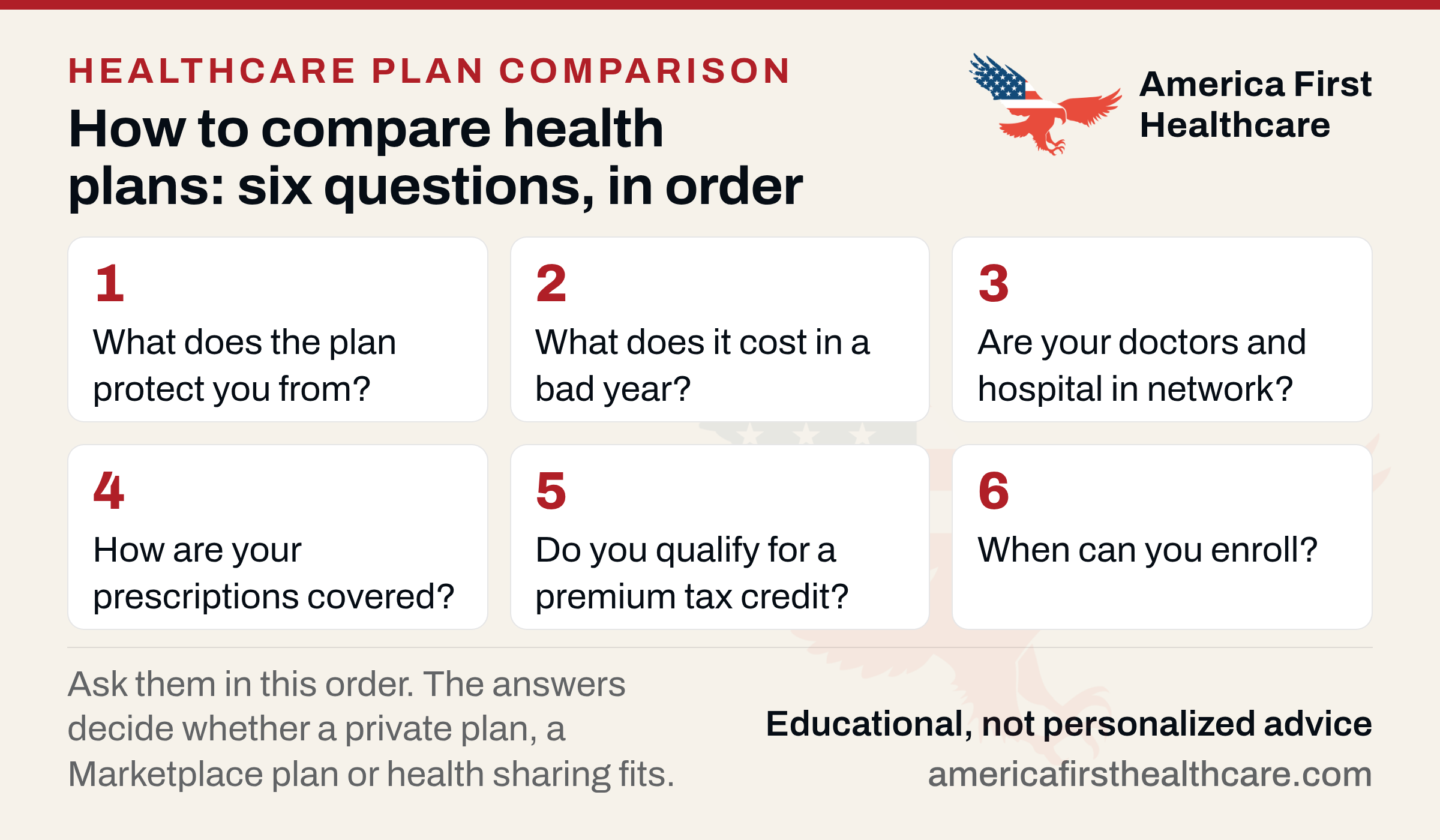
1. What does the plan protect you from?
Ruin-level bills, routine care, or both? A high-deductible private or Bronze plan protects against the six-figure event and leaves routine care to you. A low-deductible plan pre-pays routine care in the premium. Name the bill that would break your household first; that decides how much deductible you can carry. The catastrophic health coverage guide explains that decision.
Checkups and screenings are part of that answer; see does health insurance cover preventive care?
2. What does it cost in a bad year?
Premium times twelve, plus the deductible, plus copays and coinsurance up to the out-of-pocket maximum, plus anything the plan excludes. The out-of-pocket maximum is the most you pay in a year for covered in-network services; after it, the plan pays covered costs in full. A low premium with a high deductible and an uncapped exclusion can cost more in a bad year than a higher premium with a low out-of-pocket maximum. Compare the yearly total, not the monthly number.
For worked examples of how a deductible, coinsurance and the out-of-pocket maximum add up in one year, see deductible, copay, coinsurance and out-of-pocket max, with examples.
3. Are your people in network?
Primary care, specialists, the hospital you would actually go to, and your pharmacy. Private PPO plans may include broader, often nationwide, networks and cover out-of-network care at a higher cost. Marketplace plans often operate within narrower, local networks, and HMO designs cover nothing out of network except emergencies. This is the question that decides whether you keep your current doctors.
4. How are your prescriptions covered?
Check how each medication you take is tiered, what your share of the cost is, and whether it is on the formulary at all. Non-ACA private products may not include prescription coverage as an essential benefit. Step by step, for both doctors and drugs: check your doctor, hospital and prescriptions before you buy.
5. Do you qualify for a subsidy?
The premium tax credit and cost-sharing reductions apply only to Marketplace plans. If you qualify, the Marketplace sticker price is not your price, and a subsidised Bronze or Silver plan can cost less than any private plan. If you do not qualify, the comparison is on unsubsidised premiums, and private plans become competitive.
6. When can you enroll?
Marketplace coverage is available during the annual open enrollment period, or in a 60-day special enrollment period after a qualifying life event such as losing employer coverage or marriage. Private plans may allow enrollment at other times of the year. Dates for the 2026 to 2027 cycle are on the open enrollment and Medicare AEP calendar.
Cost factors: what moves the premium
- Age. Premiums rise with age in every market. Marketplace rules cap the ratio at three to one between older and younger adults; private underwritten plans price age their own way.
- Location, tobacco use, household size and metal tier. The only other factors Marketplace plans may use. Health and gender are prohibited on the Marketplace.
- Health history. The main driver for underwritten private plans: standard rate, higher rate, exclusion rider, or decline.
- Deductible and network. A higher deductible and a narrower network both lower the premium. A nationwide PPO costs more than a local HMO because you are paying for the choice.
- Subsidy. The premium tax credit, if you qualify, applies only to Marketplace plans and can reverse the sticker-price comparison.
- Marketplace premiums. For 2026, insurers raised what they charge on the ACA Marketplaces by an estimated 26% on average for 2026, and the benchmark Silver premium rose about 30% in HealthCare.gov states and 17% in state-run marketplaces (KFF, what we know so far about 2026 ACA Marketplace enrollment, premiums and deductibles). This site publishes no general private-vs-Marketplace savings figure; get both quotes for the same age and zip code.
What changed for 2027
- The out-of-pocket cap rose. A 2027 Marketplace plan can make you pay up to $12,000 for one person or $24,000 for a family for covered in-network care, up from $10,600 and $21,200 in 2026 (HealthCare.gov, out-of-pocket maximum).
- The tax credit expects a larger share of income. For 2027 the credit assumes you pay 2.15% to 10.22% of household income toward the benchmark Silver plan, up from 2.10% to 9.96% in 2026, and eligibility still ends at 400% of the federal poverty level (IRS Revenue Procedure 2026-26). For 2027 coverage, 400% is $63,840 for one person and $132,000 for a family of four, based on the 2026 poverty guidelines (HealthCare.gov, federal poverty level).
- The enhanced premium tax credits expired at the end of 2025. The NAIC's October 2025 consumer guidance said the enhanced subsidies were "scheduled to end after 2025" and that out-of-pocket premiums "could be much higher in 2026" (NAIC, what are my health plan options for 2026); KFF dates the expiration to December 31, 2025. The premium tax credit still exists for households between 100% and 400% of the federal poverty level, but at the pre-2021 levels, so question five above rules more households out of a subsidy than it did in 2025.
- Marketplace premiums rose an estimated 26% on average for 2026, with the benchmark Silver premium up about 30% in HealthCare.gov states (KFF, cited above).
- Catastrophic plans opened to adults who lose subsidy eligibility because of income. CMS guidance of September 4, 2025 grants a hardship exemption to consumers ineligible for the premium tax credit or cost-sharing reductions because of projected income, so they can buy a Marketplace catastrophic plan on or off the exchange (CMS fact sheet). For 2027, CMS made this hardship exemption available in all states and let catastrophic plans run terms of up to 10 consecutive plan years (CMS, 2027 payment notice final rule). See catastrophic health coverage.
- HSA limits rose again. An HSA-eligible high-deductible plan in 2027 needs a deductible of at least $1,750 self-only or $3,500 family, with out-of-pocket limits of $8,700 and $17,400; contribution limits are $4,500 and $9,000 (IRS Revenue Procedure 2026-24). The 2026 figures were $1,700 and $3,400, $8,500 and $17,000, and $4,400 and $8,750 (IRS Revenue Procedure 2025-19).
- Open enrollment for 2027 Marketplace coverage runs November 1, 2026 to January 15, 2027 on HealthCare.gov, with a December 15 deadline for a January 1 start; state exchanges may differ (calendar; what changed for 2027).
Coverage limits to check on any plan
Question two, the bad-year total, only works if you read the limits in the policy rather than the brochure.
| Limit | Marketplace (ACA) plan | Private plan |
|---|---|---|
| Out-of-pocket maximum | Capped at $12,000 individual / $24,000 family for 2027 ($10,600 / $21,200 for 2026) (HealthCare.gov) | Set by the policy; ACA-compliant plans follow the same cap, non-ACA products may set their own or none |
| Lifetime or per-cause benefit maximum | Prohibited | Allowed on non-ACA products; ask for the number |
| Pre-existing conditions | Covered, no surcharge | Underwritten: standard, rated, excluded by rider, or declined |
| Ten essential health benefits | Required | Only on ACA-compliant products |
| Out-of-network care | Often not covered except emergencies (HMO/EPO) | Often covered at higher cost (PPO); check whether it counts toward the maximum |
| Renewal | Guaranteed | ACA-compliant: guaranteed; other products: check the policy |
If a pregnancy is possible, check how each option handles maternity before you choose; see health insurance and pregnancy: which plans cover maternity. For dental and vision, see does health insurance cover dental and vision?
Pros and cons of each path
Private health plans
Advantages: nationwide PPO networks in many designs; direct access to specialists without referrals; enrollment often available outside the Marketplace window; premiums not tied to subsidies that can expire; you choose the deductible.
Drawbacks: medical underwriting can decline, surcharge or exclude a pre-existing condition; the premium tax credit cannot be used; some products are not ACA-compliant and may not cover maternity, mental health or prescriptions; some carry benefit maximums.
Obamacare (ACA Marketplace) plans
Advantages: guaranteed acceptance regardless of health; all ten essential health benefits; income-based premium tax credits and cost-sharing reductions; a capped out-of-pocket maximum on every plan.
Drawbacks: often narrow, local HMO or EPO networks with referral rules; high premiums without a subsidy; plans, networks and premiums can change every year; enrollment limited to open or special enrollment periods.
Health sharing
Advantages: lower monthly cost for many households; members are not paying for benefits they do not want; broad provider choice in many programs.
Drawbacks: not insurance and not regulated as insurance; no obligation to cover the ten essential health benefits; sharing applies only to defined incidents; pre-existing conditions are commonly limited or excluded.
Side by side: private health plans vs Obamacare vs health sharing
| Private health plans | Obamacare (ACA Marketplace) | Health sharing | |
|---|---|---|---|
| Is it insurance | Yes | Yes | No |
| Pre-existing conditions | Underwritten: can be declined, rated or excluded | Covered, no surcharge | Commonly limited or excluded |
| Ten essential health benefits | Only if ACA-compliant | Always | Not required |
| Network | Often nationwide PPO, out-of-network covered at higher cost | Often local HMO or EPO, referrals common | Varies; often any provider |
| Specialist access | Usually no referral needed | Referral often required | Varies |
| Premium tax credit | Not usable | Usable if you qualify | Not usable |
| Enrollment timing | Often year-round | Open enrollment or special enrollment period | Varies by program |
| Monthly cost | Set by age, health and deductible | High without subsidy, low with one | Typically the lowest share |
| Out-of-pocket maximum | Depends on the policy | Capped on every plan | Sharing limits set by program rules |
Private health plan vs Medicare
A question that comes up in this comparison is whether a private health plan can replace Medicare. It cannot. Once you are Medicare-eligible, the private-plan decision changes shape: Medicare Advantage (a private plan that replaces Original Medicare, with a network and a yearly out-of-pocket limit) or a Medicare Supplement (Medigap) policy alongside Original Medicare (any doctor who accepts Medicare, a higher premium, very little per visit). HealthCare.gov is explicit that it is against the law for someone who knows you have Medicare to sell you a Marketplace plan (HealthCare.gov). Before 65, a private plan can be the bridge from employer coverage to Medicare; the handoff is covered on health insurance for early retirees, and the Supplement vs Advantage decision on how to choose a Medicare advisor.
Where to get help comparing health plans, and who pays them
"Is there a reputable service for comparing plans?" has a short answer: yes, several, and they are paid differently.
- Marketplace-certified assisters and Navigators. Listed on HealthCare.gov's Find Local Help. "Required to provide fair, impartial, and accurate information." They cannot sell you anything and only help with Marketplace, Medicaid and CHIP coverage.
- Licensed agents and brokers. Also listed there. HealthCare.gov describes them as "generally paid by insurance companies whose plans they represent," "required in many states to act in your best interest," and notes "some may not sell plans from insurance companies they don't represent." They can enroll you with any subsidy you qualify for, as long as the enrollment runs through the Marketplace. Independent agencies can also show you private and health sharing options assisters cannot.
- Your state department of insurance. Verifies licenses, takes complaints, and per the NAIC "can help you find licensed agents or certified assisters who can review your options" (NAIC).
- SHIP, for Medicare questions: free one-on-one counseling that sells nothing, at shiphelp.org or 877-839-2675.
- America First Healthcare. An independent licensed agency; our advisors are compensated by the carriers we are appointed with, and we say so at the start of the call. The review is free, quotes the Marketplace at your income next to the private options, and ends with a recommendation you can decline. What to ask us or anyone else is in how to choose a private health insurance plan.
FAQ
Is Obamacare the same as the ACA?
Yes. "Obamacare" is the popular name for the Affordable Care Act, the federal law signed in 2010. There is no difference between an Obamacare plan and an ACA plan: both mean a plan sold through the Health Insurance Marketplace (HealthCare.gov or a state exchange) that meets the law's rules, covers the ten essential health benefits, accepts pre-existing conditions, and can carry the premium tax credit. When people ask about "Obamacare vs the ACA", they are comparing a nickname with the law it refers to.
What is the difference between a private PPO and an ACA Marketplace plan?
A private PPO is a health insurance plan bought outside the Marketplace that lets you see doctors and specialists without a referral and covers in-network and out-of-network care, at lower cost in network. An ACA Marketplace plan is bought through HealthCare.gov or a state exchange, must cover the ten essential health benefits, cannot reject or surcharge you for a pre-existing condition, and is the only kind of plan the premium tax credit can be applied to. Private PPOs generally offer more flexibility in how you access care; Marketplace plans offer guaranteed acceptance and income-based subsidies.
Is private health insurance cheaper than Obamacare?
It depends on two things: whether you qualify for the premium tax credit, which can only be used on Marketplace plans, and whether you would pass a private plan's medical underwriting. A subsidised Marketplace plan is usually cheaper for a household that qualifies. An unsubsidised, healthy household often finds a private plan competitive on premium, especially with a higher deductible. This site does not publish a general savings figure.
Do private health plans cover pre-existing conditions?
Not the way Marketplace plans do. Medically underwritten private plans can decline you, charge more, or exclude a condition with a rider. Every Marketplace plan must cover pre-existing conditions with no surcharge.
Can private plans be bought outside open enrollment?
Often, yes. Private health plans may be available for enrollment at different times of the year, unlike Marketplace plans, which are limited to the annual open enrollment period or a special enrollment period after a qualifying life event such as losing employer coverage.
Is health sharing the same as health insurance?
No. Health sharing programs are member communities that share eligible medical costs. They are not insurance, are not regulated as insurance, and are not required to cover the ten essential health benefits. They can lower the monthly cost for some households but are not appropriate for everyone.
When should I compare private and Marketplace options side by side?
Whenever your income, household or coverage changes: losing employer coverage, adding a family member, a new diagnosis, or a change in subsidy eligibility. Comparing both against the same six questions before you enroll is the only way to know which fits.
Where can I get free help comparing health plans?
HealthCare.gov's Find Local Help lists Marketplace-certified assisters and Navigators, who must give impartial help and cannot sell you anything, and licensed agents and brokers, who are generally paid by the insurance companies whose plans they represent (HealthCare.gov). For Medicare, your State Health Insurance Assistance Program (SHIP) offers free one-on-one counseling and sells nothing. Your state department of insurance can verify any agent's license. America First Healthcare's review is free to you because carriers compensate our licensed advisors; we say so up front and quote the Marketplace alongside private plans.
Can I use a private health plan instead of Medicare?
Not as a substitute. Once you are eligible for Medicare, the private-plan choice is Medicare Advantage or a Medicare Supplement (Medigap) policy alongside Original Medicare, and it is against the law for someone who knows you have Medicare to sell you a Marketplace plan (HealthCare.gov). Before 65, a private plan can bridge the years between employer coverage and Medicare.
Key takeaways
- Compare health plans on six questions in order: what it protects you from, the total cost in a bad year, whether your doctors are in network, how prescriptions are covered, whether you qualify for a subsidy, and when you can enroll.
- Private health plans usually win on nationwide PPO networks, direct specialist access and year-round enrollment, and lose on underwriting: a pre-existing condition can be declined or excluded.
- Obamacare (ACA Marketplace) plans win on guaranteed acceptance, the ten essential health benefits and the premium tax credit, and lose on narrow local networks and unsubsidised premiums.
- Health sharing is not insurance; it can be the lowest monthly cost but is not required to cover essential benefits and is not for everyone.
- Whether private insurance is cheaper than Obamacare depends on your subsidy eligibility and your health, not on the sticker price.
- For 2027 the enhanced subsidies are still gone, the out-of-pocket cap rises to $12,000 for one person, the tax credit expects a larger share of income, catastrophic plans stay open to adults priced out of the tax credit, and HSA limits rise again.
- Free comparison help exists: Marketplace assisters cannot sell you anything, agents and brokers are paid by carriers and should say so, and your state department of insurance verifies both.
- A licensed advisor at America First Healthcare runs this comparison for free and will tell you if the plan you have is already the right one.
Next step
Run the six questions against your current plan with the healthcare review checklist, then book a free health insurance review to compare private, Marketplace and health sharing options side by side.