



Resources · Coverage Basics
Deductible, copay, coinsurance and out-of-pocket max, with examples
The short answer
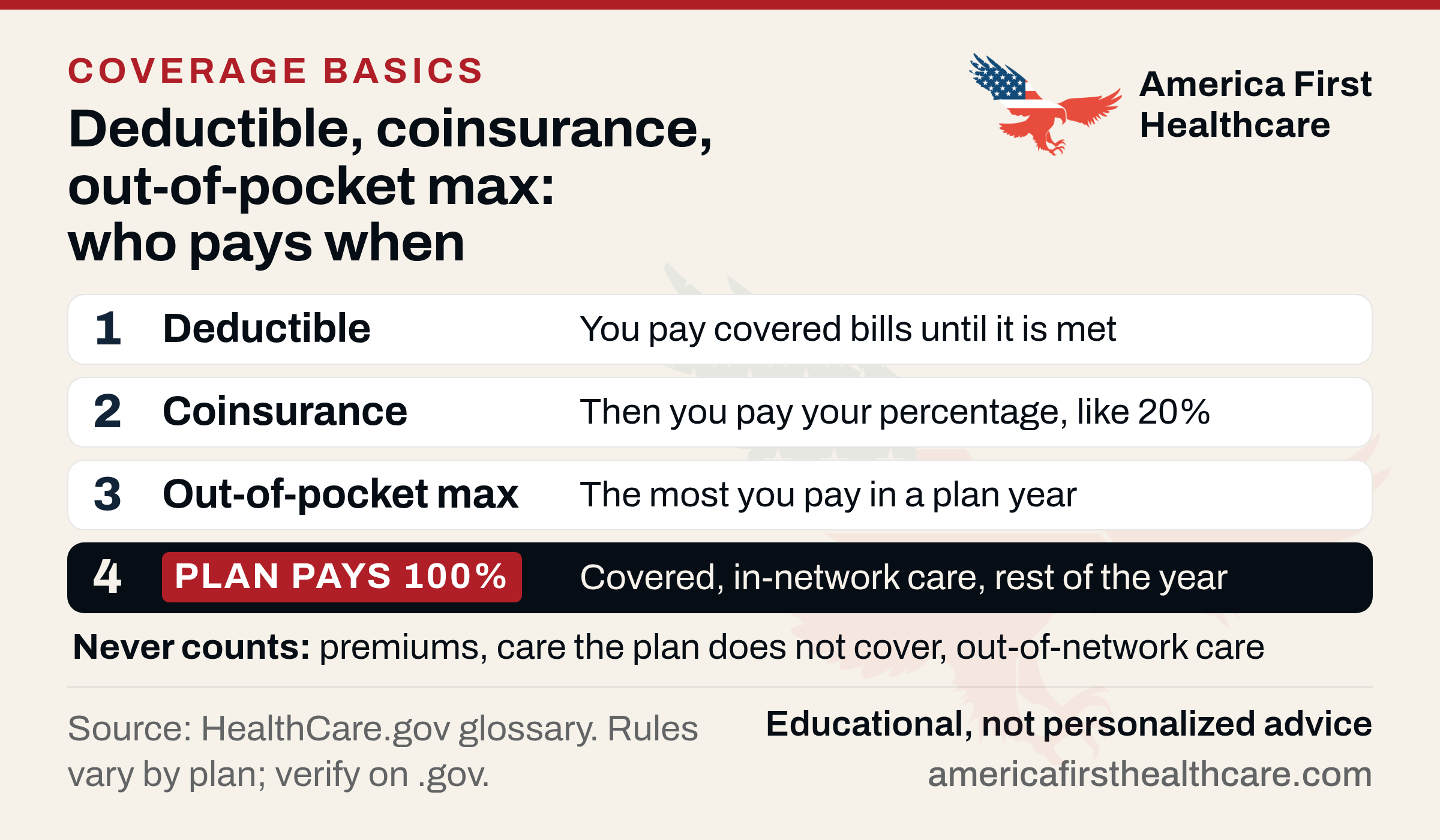
The deductible is what you pay for covered services before your plan starts to pay. With a $2,000 deductible, you pay the first $2,000 of covered services yourself (HealthCare.gov, deductible). A copay is a fixed amount per service; coinsurance is a percentage of the cost. The out-of-pocket maximum is the most you pay for covered, in-network services in a plan year; once your deductible, copays and coinsurance reach it, the plan pays 100% of covered benefits (HealthCare.gov, out-of-pocket maximum). Premiums, services the plan does not cover, and out-of-network care never count toward that maximum.
A high deductible does not make a plan fake. It changes which year the plan is built for.
The terms, side by side
| Term | What it is | When you pay it | Counts toward the out-of-pocket max? |
|---|---|---|---|
| Premium | The monthly amount you pay for coverage whether you get care or not | Every month | No |
| Deductible | What you pay for covered services before the plan starts to pay | From the first covered bill until it is met | Yes |
| Copay | A fixed amount for a covered service, like $20 (HealthCare.gov, copayment) | At the visit, before or after the deductible depending on the service | Yes |
| Coinsurance | Your percentage of a covered service's cost, like 20% (HealthCare.gov, coinsurance) | After the deductible is met | Yes |
| Allowed amount | The most the plan will pay for a covered service, also called the negotiated rate | It is the price your share is figured on | Charges above it do not count |
| Out-of-pocket max | The most you pay for covered, in-network care in a plan year | It is the cap | It is the total |
For 2026, a Marketplace plan's out-of-pocket limit can be no more than $10,600 for an individual or $21,200 for a family. For 2027 the limits are $12,000 and $24,000 (HealthCare.gov).
Five worked examples
All five use one plan. A made-up example, so the arithmetic is visible. These are not real prices or a real plan.
- Deductible: $3,000 per person, $6,000 per family
- Coinsurance after the deductible: 20%
- Primary care visit: $30 copay, before the deductible
- Out-of-pocket maximum: $8,000 per person, $16,000 per family
- All care in network and covered. In this made-up plan, copays count toward the out-of-pocket max but not toward the deductible.
1. "Shouldn't that go toward the deductible?" A primary care visit
A sick visit to your primary care doctor. Allowed amount: $150.
| Amount | |
|---|---|
| You pay (the copay) | $30 |
| Plan pays | $120 |
| Added to your deductible | $0 |
| Added to your out-of-pocket max | $30 |
Many plans pay for certain services before the deductible is met (HealthCare.gov). Whether a copay also counts toward the deductible is a plan detail, so check the plan. Without a pre-deductible copay, you would pay the full allowed amount, $150 (HealthCare.gov).
2. "Is the urgent care copay before or after the deductible?"
It depends on the plan. Allowed amount for the visit: $200. Two versions:
| Version A: $75 copay before the deductible | Version B: urgent care is subject to the deductible | |
|---|---|---|
| Deductible not yet met | You pay $75, plan pays $125 | You pay $200, plan pays $0 |
| Deductible already met | You pay $75, plan pays $125 | You pay 20% of $200 = $40, plan pays $160 |
In Marketplace plans marked "easy pricing", you pay only a copay for primary care, specialist and urgent care, among other services (HealthCare.gov, your total costs). Otherwise, read the urgent care line of the plan's summary.
3. An emergency room visit plus a hospital stay
Nothing yet paid toward the deductible. The ER visit and a three-night admission total $20,500 in allowed amounts, with no separate ER copay.
- Deductible: you pay the first $3,000.
- Coinsurance: 20% of the remaining $17,500 = $3,500.
- You pay $6,500. The plan pays $14,000. ($6,500 + $14,000 = $20,500.)
You are now $1,500 below the $8,000 maximum; after that $1,500, covered in-network care is $0 for the rest of the plan year. Out-of-network emergency rules are in how to check your doctor, hospital and prescriptions before you buy.
4. "If we had a surgery, is that the most we'd pay?" A year that hits the max
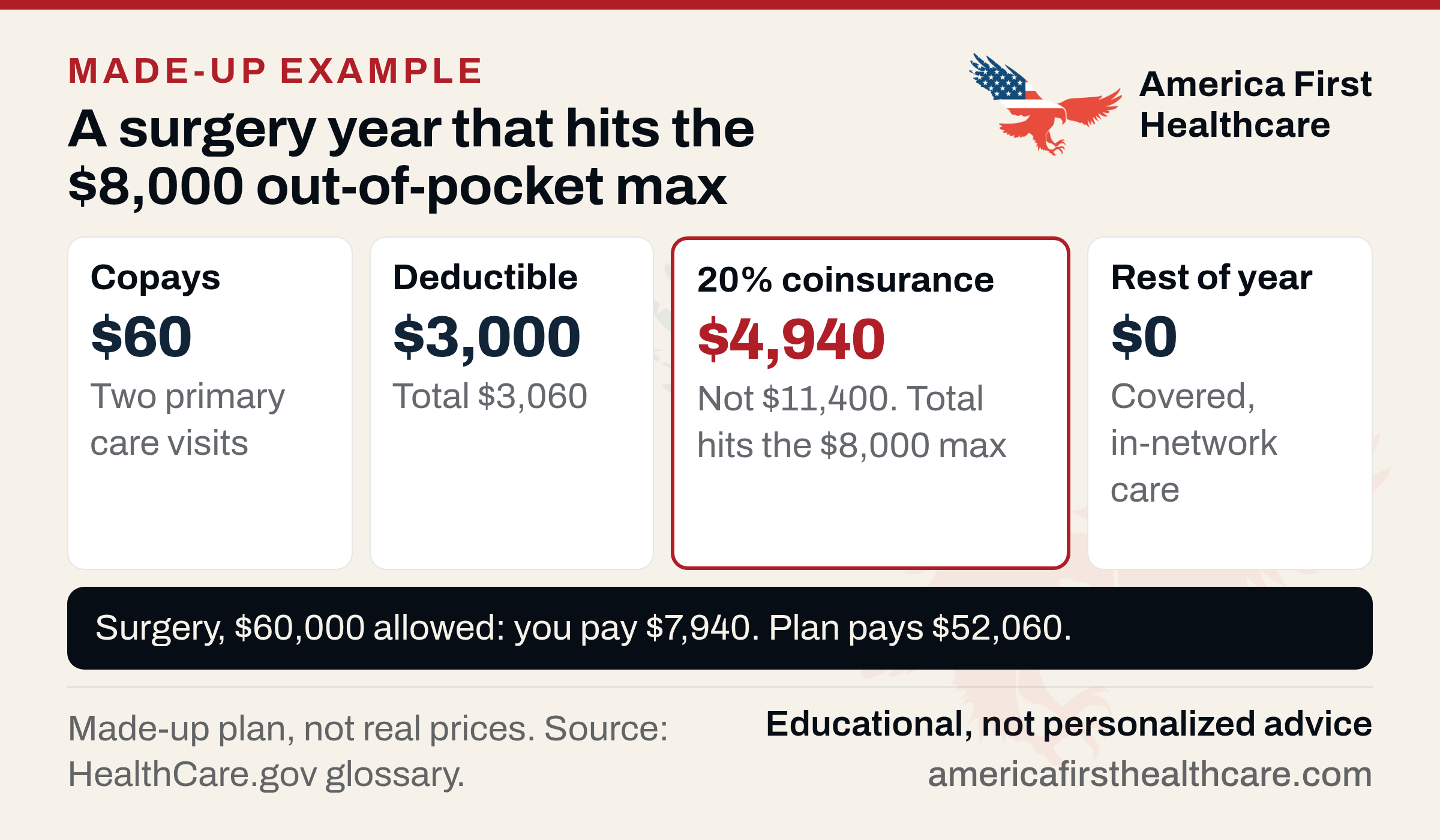
Two primary care visits ($60 in copays), then surgery with a $60,000 allowed amount.
- Already paid toward the max: $60.
- Deductible: $3,000. Running total $3,060.
- Coinsurance: 20% of the remaining $57,000 would be $11,400, but only $4,940 more is needed to reach $8,000.
- You pay $7,940 for the surgery ($3,000 + $4,940). The plan pays $52,060. Your total for the year is $8,000.
- Follow-up visits and covered in-network care for the rest of the plan year: $0.
So yes, the maximum is the most you would pay, if the care is covered and in network, and not counting premiums, which come on top (HealthCare.gov).
5. A family where one person meets the deductible
Family plans often have both an individual deductible for each person and a family deductible for everyone (HealthCare.gov). On "some family plans" with both, once one member meets the individual deductible, that person does not have to meet the higher family amount (IRS Publication 969). This is called an embedded deductible (healthinsurance.org).
A child breaks an arm. Allowed amount: $5,000.
| Individual deductible inside the family deductible | Family deductible only | |
|---|---|---|
| Deductible paid | $3,000 (the child's individual deductible) | $5,000 (all of it goes toward the $6,000 family deductible) |
| Coinsurance | 20% of $2,000 = $400 | $0, the deductible is not met yet |
| You pay | $3,400 | $5,000 |
| Plan pays | $1,600 | $0 |
Either way, the family's combined deductible payments count toward the $6,000 family deductible. Separately, non-grandfathered plans must cap one person's out-of-pocket costs at no more than that year's individual limit, even on a family plan (healthinsurance.org). Ask which kind of family deductible a plan has.
What counts toward the out-of-pocket max, and what never does
Counts: deductibles, copays and coinsurance for covered, in-network care.
Never counts (HealthCare.gov):
- Your monthly premiums
- Anything you spend on services the plan does not cover
- Out-of-network care and services
- Charges above the allowed amount that a provider may bill
Drug costs may run on their own track. Some plans have separate deductibles for prescription drugs (HealthCare.gov), and some a separate drug coinsurance and maximum too (HealthCare.gov). Then a drug copay may not reduce your medical deductible.
The count restarts each plan year. Once you reach the maximum, the plan pays covered costs through the end of the coverage period, usually December 31 (HealthCare.gov). Then the deductible and the maximum start again from zero.
A big bill does not "use up" the plan. Insurers cannot set a lifetime dollar limit on essential health benefits, and that applies to all individual and job-based plans. Yearly dollar limits are banned on most plans, though not on grandfathered individual plans, and limits are still allowed on services that are not essential health benefits (HealthCare.gov, lifetime and yearly limits).
Preventive care at $0 on ACA plans
Most health plans, including Marketplace plans, must cover a set of preventive services, like screening tests, at no cost to you. Generally that applies when an in-network provider delivers the service, with no copay or coinsurance even before the deductible. HealthCare.gov adds that coverage may vary and a $0 cost is not assured in every case (HealthCare.gov, preventive services).
Two catches. First, your plan may charge for an office visit while not charging for the preventive service that was part of it (HealthCare.gov), so a new problem raised at your physical may be billed. Second, not every plan must follow the rule. Grandfathered plans do not have to offer free preventive care (HealthCare.gov, grandfathered plans), and short-term plans are generally not subject to federal individual market consumer protections (CMS). Outside the Marketplace, check the preventive line in writing.
Fixed-benefit plans work differently
Hospital indemnity and other fixed indemnity products pay a set amount, such as $100 per hospital day or $50 per medical exam, regardless of what the care costs. CMS calls them income replacement that "is not a substitute for comprehensive coverage," and they are not subject to the federal requirements that apply to comprehensive coverage (CMS).
There is no deductible-then-coinsurance arithmetic and no out-of-pocket maximum ending your share of the bill. A made-up example: a policy paying $500 per hospital day pays $1,500 for three nights. If the stay's bill is $18,000 and this is your only coverage, the other $16,500 is yours. Next to a major medical plan, the same $1,500 can help cover a deductible. See hospital indemnity insurance vs major medical and the catastrophic core plus gap structure.
"We've never met our deductible in a year"
Then the plan has been doing its low-use-year job: in-network preventive care generally at $0, some copays before the deductible, and the maximum waiting for the year something goes wrong. Whether that trade suits you is the question in catastrophic health coverage. If the deductible makes you skip care you need, read what "underinsured" means.
The numbers to get in writing
For any individual or job-based plan, you have the right to a short, plain-language Summary of Benefits and Coverage (SBC) and a Uniform Glossary. The SBC includes coverage examples for diabetes care and childbirth (HealthCare.gov, Summary of Benefits and Coverage). From it, write down:
- The individual and family deductible, and whether one person can meet their own
- The individual and family out-of-pocket maximum
- Which services have a copay before the deductible: primary care, specialist, urgent care, generic drugs
- The coinsurance percentage after the deductible
- Whether prescriptions have a separate deductible or maximum
- Whether out-of-network care is covered at all
- For any product without an SBC, what kind of product it is, in writing
Our healthcare review checklist puts these side by side, and comparing private and Marketplace plans adds premiums for a bad-year total.
How AFHC handles this
In a free 15-minute healthcare review, a licensed advisor reads your plan's SBC with you, runs one bad year through it as this page does, and names the numbers to confirm before you enroll. Our advisors are compensated by the carriers we are appointed with, and we say so on the call. To see what clients say about working with us, including the critical reviews, read America First Healthcare reviews.
Which checkups and screenings skip the deductible entirely is covered in does health insurance cover preventive care? Colonoscopy, mammograms and physicals.
Frequently asked questions
What is the difference between a deductible and an out-of-pocket maximum?
The deductible is what you pay for covered services before your plan starts to pay. The out-of-pocket maximum is the most you pay in a plan year for covered, in-network care, counting deductible, copays and coinsurance together; after it, the plan pays 100% of covered benefits (HealthCare.gov).
What is the difference between a copay and coinsurance?
A copay is a fixed dollar amount per covered service, like $20 for a visit. Coinsurance is a percentage of the allowed amount, like 20%, usually paid after the deductible. Both count toward the out-of-pocket maximum (HealthCare.gov).
What's covered before I reach the deductible?
On Marketplace plans, certain preventive services are covered in full even before the deductible. Many plans also cover some other services, like primary care with a copay, before the deductible. The plan's Summary of Benefits and Coverage lists them (HealthCare.gov).
Does my annual physical count toward the out-of-pocket max?
If the preventive visit costs you $0, there is nothing to count. If part of the visit is billed, for example because you raised a new problem, what you pay for that covered, in-network part counts toward the deductible or maximum under your plan's rules (HealthCare.gov).
Is the prescription drug deductible separate?
On some plans, yes. Some plans have a separate deductible for prescription drugs (HealthCare.gov). Check the prescription section of the plan's summary.
If my bills go over a million dollars, does coverage start over?
Not on an individual or job-based health plan: insurers cannot put a lifetime dollar limit on essential health benefits (HealthCare.gov). Short-term plans are not held to that rule (CMS). What does start over is your cost sharing: the deductible and out-of-pocket maximum reset each plan year (HealthCare.gov).