



Research note · Checklists
How to compare health insurance and find an advisor you trust
To compare and select health insurance, take three steps in order: write down what your household needs covered, including doctors, prescriptions and the most you could pay in a bad year; get a free independent review that puts your options side by side; and choose a licensed advisor whose license you can check and who tells you how they are paid. The first step makes the other two faster, because every plan is judged against the same list.
This guide is educational and written by an independent licensed agency that sells the plans it describes. It quotes no premiums and every rule links to its source.
For every kind of private plan side by side, start with private health insurance in the USA. For the private-plan checklist in detail, read how to choose a private health insurance plan.
How to compare health insurance plans by your needs and total cost
Start with your household, not with the plans. Write down five things before you look at a single quote:
- Who needs coverage. Each person's age, and whether anyone has job-based coverage, Medicaid or Medicare.
- Your doctors, hospital and pharmacy. Write each name. You will check each one by name in every network you compare.
- Every prescription. The name and dose of each medicine. You will check each one on every plan's drug list (formulary) and note its tier.
- Care you expect next year. A planned surgery, a pregnancy, ongoing therapy or a condition you manage. These decide whether a low deductible is worth a higher premium.
- Your household income for 2027. It decides whether you can get help with Marketplace premiums (HealthCare.gov, federal poverty level).
Then compare plans on what they cost in a bad year, not only per month. For a Marketplace plan, the yearly most you pay for covered in-network care in 2027 is capped at $12,000 for one person and $24,000 for a family, up from $10,600 and $21,200 in 2026 (HealthCare.gov, out-of-pocket maximum). Premium plus out-of-pocket maximum is the number to put side by side. For the monthly side, the 2027 benchmark by state and what our clients paid are in what health insurance costs per month in 2027.
Income matters more for 2027 than it did before. The enhanced premium tax credits expired at the end of 2025 (NAIC; KFF). For 2027 the credit expects you to pay 2.15% to 10.22% of your income toward the benchmark plan and ends at 400% of the federal poverty level, which is $63,840 for one person and $132,000 for a family of four (IRS Revenue Procedure 2026-26; HealthCare.gov, federal poverty level). Above that line, a private plan and a Marketplace plan compete on price alone, so both belong in the comparison.
The 2027 numbers to compare plans against
| What | 2027 | Source |
|---|---|---|
| Most you pay for covered in-network care on a Marketplace plan | $12,000 for one person, $24,000 for a family | HealthCare.gov |
| Premium tax credit ends at | 400% of the poverty level: $63,840 for one person, $132,000 for a family of four | IRS Rev. Proc. 2026-26 |
| Share of income you pay toward the benchmark plan | 2.15% to 10.22% | IRS Rev. Proc. 2026-26 |
| Open Enrollment | November 1, 2026 to January 15, 2027 | HealthCare.gov |
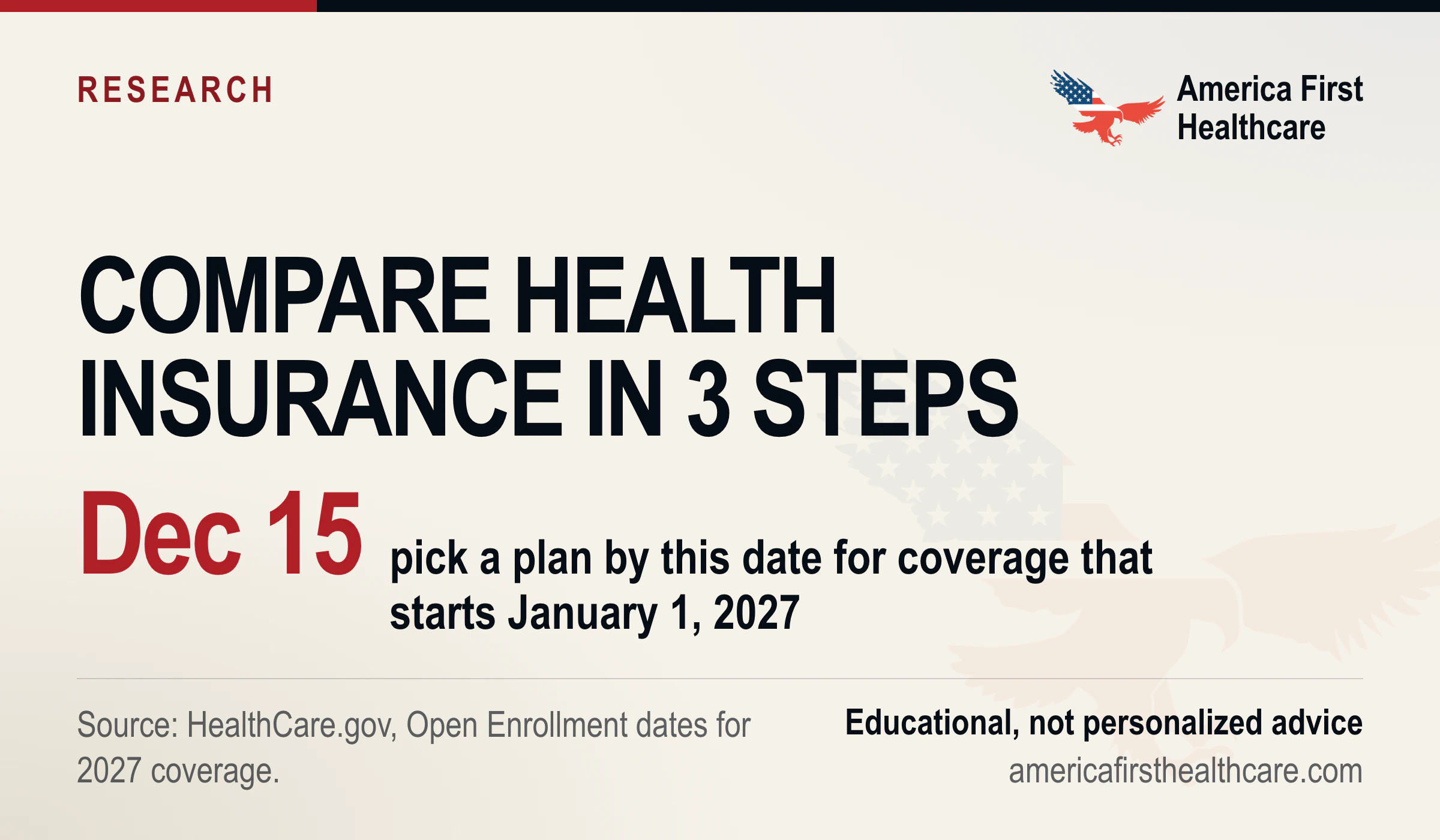
| Last day to enroll for a January 1 start | December 15, 2026 | HealthCare.gov |
Write these down for every plan you compare
| For each plan | Why it matters |
|---|---|
| Monthly premium times 12 | What you pay in a good year |
| Deductible | What you pay before the plan shares the cost |
| Out-of-pocket maximum | The most you pay for covered care in a bad year |
| Premium times 12 plus out-of-pocket maximum | Your bad-year total, the number to put side by side |
| Each doctor and hospital, checked by name | A plan is only as good as its network for you |
| Each prescription, checked on the drug list | A drug off the list is paid in full by you |
What a free health insurance review compares

A review puts your list next to the plans you can buy and shows the trade-offs in one place. It saves you from comparing networks, drug lists and deductibles one plan at a time.
A good review does four things:
- Reads your current plan line by line. The deductible, the out-of-pocket maximum, the network and any caps or exclusions in the policy.
- Checks your doctors and prescriptions by name in each plan it shows you.
- Puts Marketplace and private options side by side at your 2027 income, so you see the subsidy you can get and the plans that fit without one.
- Names the gaps that could turn into surprise bills, and says so when the plan you have already fits.
Free help exists in more than one form. Marketplace Navigators and certified assisters must give "fair, impartial, and accurate information" and cannot sell you a plan; you find them through HealthCare.gov Find Local Help (HealthCare.gov, get help applying). Licensed agents and brokers can also enroll you; HealthCare.gov says they are generally paid by the insurance companies whose plans they represent. The FTC warns that legitimate Marketplace help never asks you to pay to get or keep coverage (FTC).
Our free healthcare review is one scheduled 15-minute call with one licensed advisor from our team. We compare private plans, Marketplace plans and gap coverage with you. There is no cost and no obligation.
How to know your comparison worked
You are ready to choose when you can say yes to each of these:
- You know each plan's bad-year total: premium times 12 plus the out-of-pocket maximum.
- Every doctor, hospital and prescription on your list was checked by name in each plan.
- You know whether you get help with Marketplace premiums at your 2027 income, and how much.
- You have each plan's Summary of Benefits and Coverage, not only a quote.
- You confirmed your advisor's license with your state department of insurance.
Select a trustworthy insurance advisor
HealthCare.gov's description of agents and brokers is the place to start. They are "generally paid by insurance companies whose plans they represent," and in many states they are required to act in your best interest (HealthCare.gov, get help applying). An advisor you can trust tells you that up front.
Check three things before you share your details:
- The license. Your state department of insurance can confirm an agent's license; the NAIC says it "can help you find licensed agents or certified assisters" (NAIC).
- How they are paid and which carriers they represent. A clear answer is a good sign. A plan list limited to one carrier is a reason to ask what else is available.
- Who you will talk to. One named, licensed person who will still answer after you enroll is different from a call center that hands you off.
Six questions to ask any advisor:
- Are you licensed in my state, and what is your license number?
- Which insurance companies do you represent?
- How are you paid on the plan you recommend?
- Have you checked my doctors and prescriptions in this plan's network and drug list?
- What is the most I could pay next year on this plan, premium included?
- Who do I call after I enroll, and will it be you?
FAQ
How do I compare health insurance plans?
List your doctors, prescriptions, expected care and 2027 income first. Then compare each plan on premium plus out-of-pocket maximum, check your doctors and medicines by name, and read what the policy caps or excludes. For 2027 the Marketplace out-of-pocket maximum is $12,000 for one person and $24,000 for a family (HealthCare.gov).
What is a free health insurance review?
It is a comparison of your current plan and your options with a licensed advisor or a Marketplace assister, at no cost to you. A good review checks your doctors and prescriptions by name and shows Marketplace and private plans side by side at your income.
How do I know if a health insurance advisor is trustworthy?
Confirm the license with your state department of insurance, ask which carriers they represent and how they are paid, and ask who you will talk to after you enroll. HealthCare.gov notes that agents and brokers are generally paid by the insurance companies whose plans they represent.
Do I have to pay for help choosing a plan?
No. Marketplace Navigators and assisters are not allowed to charge you, and licensed agents and brokers are generally paid by the insurance companies whose plans they represent (HealthCare.gov). The FTC warns that legitimate Marketplace help never asks you to pay to get or keep coverage.
When can I enroll in a plan for 2027?
Open Enrollment for 2027 Marketplace coverage runs November 1, 2026 to January 15, 2027 on HealthCare.gov. Enroll by December 15, 2026 for coverage that starts January 1, 2027 (HealthCare.gov, dates and deadlines). State-run exchanges can set different dates.
What if my state runs its own exchange?
Some states run their own Marketplace with their own enrollment dates. Pick your state on HealthCare.gov, Marketplace in your state to find its site, then use that site's deadline, not the federal one. Your plan comparison works the same way.
Key takeaways
- Write down your household's doctors, prescriptions, expected care and 2027 income before you compare a single plan.
- Compare premium plus out-of-pocket maximum. For 2027 the Marketplace cap is $12,000 for one person and $24,000 for a family (HealthCare.gov).
- The enhanced premium tax credits ended after 2025. For 2027 the credit ends at 400% of the poverty level, $63,840 for one person (IRS Rev. Proc. 2026-26).
- A free review should check your doctors and medicines by name and show Marketplace and private options side by side.
- Choose an advisor whose license you can confirm and who tells you how they are paid.
Method / disclaimer
Rules on this page are summarised from HealthCare.gov, CMS, the IRS, the NAIC, the FTC and KFF as reviewed on 2026-11-03. Government pages can change, so verify current information before acting. Educational only, not medical, tax, legal or personalized insurance advice. America First Healthcare is an independent licensed insurance agency compensated by the carriers it is appointed with. We publish no premiums and no savings percentages.
Next step

Open Enrollment is open now through January 15, 2027, and December 15, 2026 is the last day to pick a plan that starts January 1 (HealthCare.gov, dates and deadlines). Bring your current plan's summary of benefits and your prescription list to a free healthcare review. One licensed advisor will compare your options with you in 15 minutes and tell you which fits, including if it is the one you have.
Dates for every enrollment window are on the enrollment calendar. The full library is at research.