



Resources · Health Freedom
Health Insurance for the Self-Employed, State by State: What Changes When You Cross a State Line
If you work for yourself, the hardest part of health insurance is not the forms. It is that half the advice you read was written for a different state.
The tax deduction, the ban on turning you down for a pre-existing condition, the way premiums are priced: those are federal, and they are the same whether you are a contractor in Texas or a consultant in Oregon. But which website you enroll on, the day enrollment closes, whether a slow year puts you into Medicaid or into a gap, and whether you can even buy a short-term plan between contracts all depend on where you live.
This guide separates the two. First the rules that do not move. Then the five that do, with a sourced table for the states where America First Healthcare has a state page. It is educational, not tax or legal advice, and every regulatory statement links to the government page that says it. For the fundamentals of choosing a plan as a self-employed person, start with our guide to health insurance for self-employed people.
Key Takeaways
- If you have self-employment income and no employees, every state treats you as an individual buyer, not a small business. You shop the individual market, on HealthCare.gov or your state's own exchange.
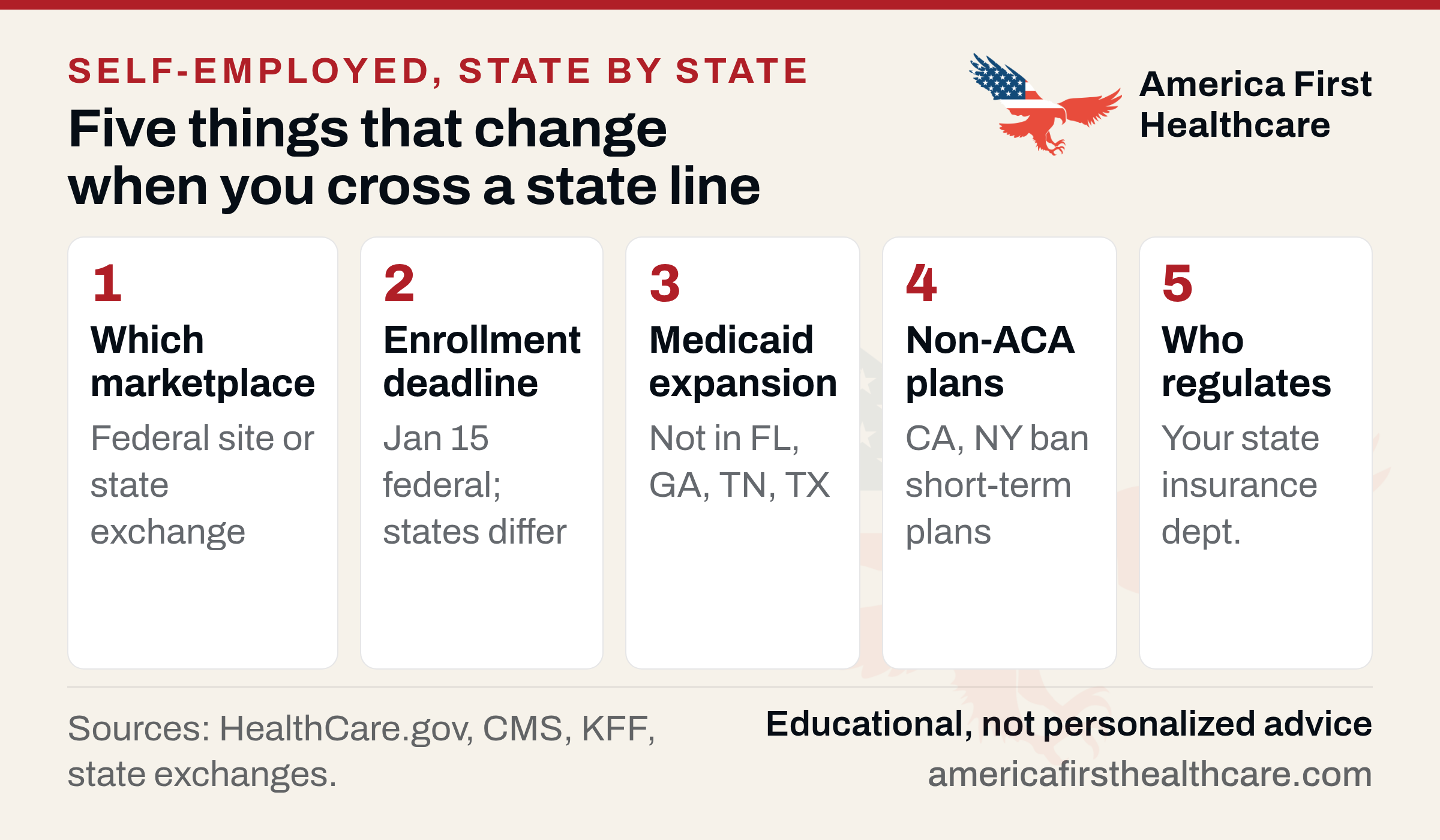
- Five things change by state: the marketplace you use, the open enrollment window, Medicaid expansion, the rules on short-term and other non-ACA plans, and the department that regulates your insurer.
- The self-employed health insurance deduction is federal and works the same everywhere. How your state income tax treats it is a question for your CPA.
- Georgia, Florida, Tennessee and Texas have not expanded Medicaid. A low-income year in those states can leave a self-employed adult without either Medicaid or Marketplace savings.
- California and New York prohibit short-term health plans outright. Most other states allow them with limits, and the federal rules on their duration tightened in 2024.
What is the same in every state
Start here, because it is most of the picture.
You are an individual, not a business, when you shop. HealthCare.gov says that if you run a business with income but no employees, you are considered self-employed and use the individual Marketplace, not the small-business SHOP program. Contractors you pay do not count as employees for this purpose (HealthCare.gov, health coverage if you're self-employed).
Marketplace plans cannot turn you down. Every Marketplace plan in every state must cover pre-existing conditions and cannot charge you more for one (HealthCare.gov, coverage for pre-existing conditions). Every one must cover the ten essential health benefits (HealthCare.gov, what Marketplace plans cover).
Premiums are priced on five factors, nowhere else. Age, location, tobacco use, whether the plan covers a spouse or dependents, and the plan category. Not your health, not your history, not your gender (HealthCare.gov, how plans set your premiums). Location is one of the five, which is why the same plan design costs different amounts in different states and even different counties.
The premium tax credit is federal. Whether you qualify, and how much, depends on your estimated household income for the coverage year, and you can only use it on a Marketplace plan (HealthCare.gov, lower costs). For self-employed people, HealthCare.gov's advice is to estimate net income for the year from past experience and realistic expectations, and to update the estimate when things change (HealthCare.gov, self-employed income).
The deduction is federal. Self-employed people may deduct premiums paid for themselves, a spouse, dependents and children under 27 as an adjustment to income, figured on Form 7206. You cannot take it for any month you were eligible for an employer-subsidized plan through your own or your spouse's job, and it cannot exceed the net profit of the business the policy is tied to (IRS Publication 502; IRS Form 7206). The full walkthrough is in Can you write off health insurance if you're self-employed?
Losing a job to go independent is a qualifying event. Losing employer coverage opens a Special Enrollment Period of 60 days before or after the loss, in every state (HealthCare.gov, Special Enrollment Period).
There is no federal penalty for going without coverage. HealthCare.gov states that the fee for not having health insurance no longer applies (HealthCare.gov, fee for not being covered). Some states have their own coverage rules; ask your state insurance department.
The five things that change by state
1. Which marketplace you use
The Affordable Care Act let each state decide whether to run its own exchange or use the federal one. CMS keeps the list by plan year (CMS, marketplaces by type). In a HealthCare.gov state you enroll at HealthCare.gov. In a state-based marketplace state you enroll on the state's site, Covered California or Pennie or MNsure, and the premium tax credit flows through that site instead.
Why it matters to you: the enrollment site sets the deadlines, runs its own income verification, and publishes its own plan finder. If a colleague in another state tells you "just go to HealthCare.gov", they may be sending you to the wrong door.
2. When open enrollment closes
On HealthCare.gov, open enrollment for 2027 coverage runs November 1, 2026 to January 15, 2027. Enroll by December 15 for coverage that starts January 1; enroll December 16 to January 15 for a February 1 start (HealthCare.gov, dates and deadlines).
State-based marketplaces set their own windows. Covered California, for example, runs open enrollment November 1 to January 31, with a December 31 deadline for a January 1 start (Covered California, get started). Washington Healthplanfinder and the Oregon Health Insurance Marketplace both state November 1 to January 15 (Washington Healthplanfinder, enrollment periods; Oregon Health Insurance Marketplace, enrollment periods). Some state exchanges had not published their 2027 dates when we checked in September 2026. If yours is one of them, confirm on the exchange before you plan around a date.
Why it matters to you: self-employed people often finish the year's books in January. In a January 15 state that is already too late for a January 1 start.
3. Whether your state expanded Medicaid
Under the ACA, states could expand Medicaid to adults with income up to a set level. Most did. As of the KFF tracker we checked, Florida, Georgia, Tennessee and Texas among the states on this page have not (KFF, status of state action on the Medicaid expansion decision).
Why it matters to you more than to a salaried worker: self-employed income swings. In an expansion state, a bad year can qualify you for Medicaid on income alone, and you can move back to a Marketplace plan when income recovers. In a non-expansion state, HealthCare.gov explains that adults below the income threshold for Marketplace savings may not qualify for Medicaid either, depending on state rules (HealthCare.gov, Medicaid and CHIP). A self-employed household in Texas or Florida should plan for a low-income year differently from one in Michigan or Colorado.
4. What you can buy outside the ACA
Short-term limited duration plans, and other products that are not ACA-compliant, are where states differ most. Federal rules issued in 2024 limit how long a short-term plan can last (CMS, statement regarding short-term limited duration insurance). On top of that, states can restrict them further or ban them.
California prohibits short-term limited duration insurance from being issued, sold, renewed or offered at all, under Senate Bill 910 (California Department of Insurance notice). New York does the same (New York Department of Financial Services, Circular Letter 2018-7). Washington allows them but caps them at three months, non-renewable, and bars their sale during open enrollment (Washington Office of the Insurance Commissioner). Most other states allow them with their own limits, and their insurance departments warn that these plans do not have to cover pre-existing conditions or the essential health benefits.
Why it matters to you: contractors between engagements sometimes reach for a short-term plan as a bridge. Whether that option exists, and for how long, is a state question. So is whether a medically underwritten private plan sold off-exchange is available in your state and on what terms. Anyone offering you one should tell you in writing which category the product is in.
5. Who regulates your plan
Every state has an insurance department that licenses carriers and agents, handles complaints, and publishes consumer guidance. That is the place to verify a company before you pay it, and to complain if a claim goes wrong. Any licensed agent, including ours, can be looked up through the National Insurance Producer Registry (NIPR license lookup).
Why it matters to you: the health insurance scams we see most often target people buying on their own, which is exactly the self-employed. The state department is your check.
State by state: the states we cover
Every fact in this table was read from the primary source linked on each state's page and checked on September 14, 2026. Each state name links to that page, which carries the sources and the state's own insurance department. Where a fact could not be verified from a primary source, the cell says so rather than guessing.
| State | Marketplace | Open enrollment for 2027 | Medicaid expanded | Short-term plans |
|---|---|---|---|---|
| Arizona | HealthCare.gov | Nov 1, 2026 to Jan 15, 2027 | Yes | Sold, with state limits |
| California | State-based: Covered California | Nov 1 to Jan 31 | Yes | Prohibited |
| Colorado | State-based: Connect for Health Colorado | Opens Nov 1, 2026; confirm close date on the exchange | Yes | Sold, with state limits |
| Florida | HealthCare.gov | Nov 1, 2026 to Jan 15, 2027 | No | Sold, with state limits |
| Georgia | State-based: Georgia Access | Not confirmed on Sep 14; check the exchange | No | Sold, with state limits |
| Michigan | HealthCare.gov | Nov 1, 2026 to Jan 15, 2027 | Yes | Sold, with state limits |
| Minnesota | State-based: MNsure | Not confirmed on Sep 14; check the exchange | Yes | Sold, with state limits |
| Missouri | HealthCare.gov | Nov 1, 2026 to Jan 15, 2027 | Yes | Sold, with state limits |
| New York | State-based: NY State of Health | Not confirmed on Sep 14; check the exchange | Yes | Prohibited |
| North Carolina | HealthCare.gov | Nov 1, 2026 to Jan 15, 2027 | Yes | Sold, with state limits |
| North Dakota | HealthCare.gov | Nov 1, 2026 to Jan 15, 2027 | Yes | Sold, with state limits |
| Oregon | State-based: Oregon Health Insurance Marketplace | Nov 1 to Jan 15 | Yes | Sold, with state limits |
| Pennsylvania | State-based: Pennie | Not confirmed on Sep 14; check the exchange | Yes | Sold, with state limits |
| South Dakota | HealthCare.gov | Nov 1, 2026 to Jan 15, 2027 | Yes | Sold, with state limits |
| Tennessee | HealthCare.gov | Nov 1, 2026 to Jan 15, 2027 | No | Sold, with state limits |
| Texas | HealthCare.gov | Nov 1, 2026 to Jan 15, 2027 | No | Sold, with state limits |
| Washington | State-based: Washington Healthplanfinder | Nov 1 to Jan 15 | Yes | Sold, with state limits |
Not in the table: your state's premium levels, carrier lineup, or plan count. Those change every year and by county, and the honest place to read them is the marketplace itself once open enrollment begins.
How to use this if you are self-employed
- Find your door. Check whether your state uses HealthCare.gov or its own exchange, and write down that exchange's deadline for a January 1 start. In most HealthCare.gov states that is December 15.
- Estimate this year's net income honestly, then check it against your state. In an expansion state, a low estimate may point to Medicaid. In a non-expansion state, it may point to nothing, and the plan has to be built without a credit.
- Decide whether underwriting is even an option. List every diagnosis and prescription in the household. If any of them would be excluded or declined by a medically underwritten plan, the Marketplace's guaranteed issue rule is worth more than any premium difference, in every state.
- Only then look outside the ACA. If you are considering a short-term or other non-ACA product as a bridge, confirm your state allows it and for how long, and read what it excludes before you read the price.
- Run the deduction last. Compare premiums after the self-employed health insurance deduction and after any credit, and ask your CPA how your state's income tax treats the same premium.
America First Healthcare's approach for a self-employed household, protecting first against the bill that would change your life and then filling the routine gaps, is described in health insurance for self-employed people and in The America First structure: catastrophic core + gap layer. Which pieces of it are available to you is, as this whole article says, a state question.
FAQ
Does the self-employed health insurance deduction change by state?
The federal deduction does not. It is figured on IRS Form 7206 and taken as an adjustment to income on your federal return, with the same eligibility rules in every state (IRS Form 7206). Whether and how your state income tax follows the federal treatment is a state question, and a CPA question.
I move between states for work. Which state's rules apply?
Marketplace coverage is tied to where you live, and a permanent move to a new state is itself a qualifying event that opens a Special Enrollment Period (HealthCare.gov, Special Enrollment Period). Plans and networks are local, so a move usually means a new plan through the new state's marketplace.
My income dropped and I live in a state that did not expand Medicaid. What are my options?
Report the change to your marketplace first, because a lower estimate can raise your premium tax credit if you are still above the threshold for savings. If you fall below it, HealthCare.gov's Medicaid and CHIP page explains what your state's rules allow (HealthCare.gov, Medicaid and CHIP). Children in the household may qualify for CHIP even where the adults do not. This is one of the situations a free healthcare review is built for.
Next step
If you want help reading your own state, your income estimate and your deduction in one conversation, start a free healthcare review. It is a conversation, not a hard sell, and it is not tax advice.
More plain-English guides live in the research library, and the state pages carry each state's sources and insurance department.